King Asa and King Jehoshaphat turn to the Lord when Judah is attacked
2 Chronicles Chapter 14 Asa reigns in Judah, rebuilds the cities, and defeats and plunders the Ethiopians, who attack Judah.
2 Chronicles Chapter 15 Azariah prophesies that Judah will prosper if the people keep the commandments—Asa does away with false worship in Judah—Many from Ephraim, Manasseh, and Simeon migrate to Judah—The people covenant to serve the Lord and are blessed.
2 Chronicles Chapter 16 Asa employs Syria to defeat Israel—Hanani the seer reproves Asa for lack of faith—Asa suffers from disease and dies.
2 Chronicles Chapter 20 The Ammonites and others attack Judah—Jehoshaphat and all the people fast and pray—Jahaziel prophesies the deliverance of Judah—Judah’s attackers war among and destroy themselves.
To introduce the idea of trusting the Lord, you might show your children something you trust to keep you dry when it rains, like an umbrella or jacket. Let them talk about why we can trust these things. Then help them compare that to our trust in the Lord. Why do we trust Him to keep us safe spiritually?
You could help your children discover how King Asa and King Jehoshaphat responded to challenges by trusting in the Lord (see 2 Chronicles 14:11; 20:3–5, 12). Share with each other ways you can show the Lord that you trust Him.
Friend July 2018 “Allie’s New Class” Allie has to change kindergarten classes and she is worried, but she says a prayer, and she knows she can be brave because Heavenly Father will help her.
This week’s activity page can help your children understand the story of Jehoshaphat’s prayer and the Lord’s answer. You and your children could share times when God heard and answered your prayers. Consider including times when the answers came in ways or at times that you didn’t expect.
A song about prayer, such as “I Pray in Faith” (Children’s Songbook, 14), could help build your children’s faith.
King Uzziah
2 Chronicles Chapter 26 Uzziah reigns and prospers as long as he keeps the commandments—He transgresses, attempts to burn incense upon the altar, and is cursed with leprosy.
To learn about the dangers of pride, your children could build a tower with blocks or small cups. As they place each block or cup on the tower, help them identify one of Uzziah’s accomplishments from 2 Chronicles 26:3–15. After they finish the tower, discuss with your children how Uzziah could keep it tall and strong. What could make it fall? Then, as you read verse 16, you could talk about what it means to have our hearts “lifted up to [our] destruction.” Share with your children what happened to Uzziah in verses 16–23. Let them knock down their tower. Talk about what we can do to stay humble.
The Red Crystal See this site for these printable images to put on cups. Have children stack them as you tell or read the story, then knock it down after his heart became proud.
Definition of Pride: A inflated, high opinion of one’s own importance, merit, or superiority.
What is humility? A modest opinion of one’s own importance, rank, etc. Guide to the Scriptures: The condition of being meek and teachable. Humility includes recognizing our dependence upon God and desiring to submit to His will.
2 Chronicles Chapter 30 Hezekiah invites all Israel to a solemn Passover in Jerusalem—Some accept the call; others laugh him to scorn—The faithful Israelites worship the Lord in Jerusalem.
The picture above shows when Hezekiah invited Judah’s neighbors from the Kingdom of Israel to celebrate Passover with them. You could look at this image with your children and read 2 Chronicles 30:18–19, which explains that some of the guests had not washed themselves according to the law of Moses. What did Hezekiah do? How would this have made the guests feel? Help your children think of how they can be like Hezekiah in the way they treat others. You could also help you children discover ways President Dallin H. Oaks said we can be peacemakers in “Alive in Christ” (Liahona, May 2026, 86–87).
1 Samuel CHAPTER 17 Israel and the Philistines engage in war—Goliath of Gath, a giant, defies Israel and challenges any Israelite to personal combat—David goes against him in the name of the Lord—David slays Goliath with a sling and a stone—Israel defeats the Philistines.
Review the story of David and Goliath with the children (see “David and Goliath” in Old Testament Stories). Then you could let them retell the story using the pictures or line drawings in this outline. Ask them what they think the Lord wants them to learn from this story. (Or assign the children to draw pictures of different parts of the story in 1 Samuel 17:20–54. Display the pictures in order on the board, and invite the children to share the story by talking about each of the pictures they drew.)
Use this week’s activity page to show how tall Goliath might have been compared to a young boy like David. Explain that the army of Israel was afraid of Goliath. Ask the children to pretend to be scared. Then show a picture of Jesus Christ, and tell the children that because David had faith in the Lord, he could be brave. Ask them to stand up tall, like they are brave.
Invite the children to march like they are David going to fight Goliath while singing a song about being courageous, such as “I Will Be Valiant” (Children’s Songbook, 162).
You and your children could also make a list of some difficult challenges they (or others) might face during their life. Then help them find things David said that can help with these challenges (see 1 Samuel 17:26, 32, 34–37, 45–47). Share how Jesus Christ has helped you during challenges.
Activity: Make a square on the ground with chalk or tape. Write the name “Goliath” inside. Stand back and toss pebbles into the square. Every time your pebble lands in the square, name a way Heavenly Father helps you overcome big challenges.
Come Follow Me Kid Includes an activity where you knock over Goliath with marshmallows. Could use it to have the children name a way Heavenly Father helps them overcome big challenges.
Friend May 2019 “Bright Idea” Poster or handout that says “I can conquer giant problems” next to a giant like David slew.
Lesson 28: David and Goliath,” Primary 6: Old Testament (1996), 120–24 To encourage each child to seek Heavenly Father’s help in overcoming obstacles.
Show the children a string or rope that you have cut to the length of 9 feet 9 inches (3 meters). You may want to attach it to the wall or ceiling or have children hold the two ends and pull it out to its full length so they can see how tall Goliath was. To help them visualize how much Goliath’s armor weighed, invite the children to volunteer their weights and see what combined weight would be close to the 150 pounds (67.5 kilos) that his armor is estimated to have weighed. Let the children describe how they would feel if they had to fight such an opponent.
Ask the children to choose “Goliaths,” or challenges, in their lives they would like to overcome and write them on the giant. Then have them think of ways to overcome their challenges, write them on pieces of paper, and cut these papers to look like stones. Explain that all challenges can’t be overcome, but if we ask Heavenly Father for his help, he will give us strength to cope with them. Encourage each child to choose a challenge that he or she can work on and to include faith and prayer as part of the solution.
Give the children a piece of paper, and ask them to write a trial or challenge children face today, such as immodest clothing, inappropriate media, and so on. (Younger children can draw pictures.) As the children share the trial, have them wrap the paper around a small rock and place it in the backpack. Pass the backpack to some of the children. Discuss ways Heavenly Father helps them with their trials. With each suggestion, remove several rocks. Pass the backpack again. Sing a song or hymn about the Savior. Explain that Jesus will always help us and comfort us.
1 Samuel CHAPTER 18 Jonathan loves David—Saul sets David over his armies—David is honored by the people, and Saul becomes jealous—David marries Michal, a daughter of Saul.
Give each child two paper hearts. Your children could then write or draw on their paper hearts how they can show love to a friend.
Friend August 2018 Find the words below that tell how we can share the Savior’s love with others.
Tell the children about a good friend who helps you live the gospel or build your faith in Jesus Christ, and invite the children to share who helps them. Invite the children to act out doing something nice for a friend.
Friend April 2017 “Be a Light” Color in the sun as you figure out someone to do certain things for as a true friend such as loving, forgiving, encouraging, etc.
Activity: Jonathan was happy for David after he beat Goliath. You can learn to show love to others like Jonathan did! Cut out the cards on page 43 and play the matching game with your family. Be kind to the winner—say things like, “Good game” or “Great job!”
Lesson 29: David and Jonathan,” Primary 6: Old Testament (1996), 125–30 To help the children understand how to be a true friend.
DAVID SPARES SAUL’S LIFE
1 Samuel Chapter 24 David finds Saul in a cave and spares his life—Saul confesses that David is more righteous than he—David swears that he will not cut off the seed of Saul.
1Samuel Chapter 25 Samuel dies—Nabal rebuffs David and refuses to give him food—Abigail intercedes, saves Nabal, and gives David a present—David is pacified, Nabal dies, and David marries Abigail.
1 Samuel Chapter 26 David again spares Saul’s life—He again refuses to stretch forth his hand against the Lord’s anointed—Saul and David separate.
Forgiveness is the sure path to peace and healing.
In 1 Samuel 24–26, look for lessons about pride, forgiveness, and self-control. “Spiritual poise blesses us to stay calm and focused on what matters most, especially when we are under pressure.”(“Christlike Poise”) How did David, Abigail, and others demonstrate—or fail to demonstrate—Christlike poise in these chapters? What opportunities do you have to show Christlike poise?
2 Samuel CHAPTER 5 All Israel anoints David king—He takes Jerusalem and is blessed of the Lord—He conquers the Philistines.
2 Samuel CHAPTER 6 David takes the ark to the city of David—Uzzah is smitten for steadying the ark and dies—David dances before the Lord, causing a breach between him and Michal.
2 Samuel CHAPTER 7 David offers to build a house for the Lord—The Lord, through Nathan, says He has not asked David to do so—The Lord will establish David’s house and kingdom forever—David offers a prayer of thanksgiving.
In these chapters, David became the king of Israel. It might be fun for your children to pretend to be a king or queen. What laws would they make? Where would they go for help? Help your children discover that when David needed help, he “inquired,” or prayed, for answers. For example, as you read 2 Samuel 5:19, 23, invite the children to listen for the word “inquired” and to fold their arms when they hear it. Why would David need the Lord’s help in his new role?
Tell each other about times when you prayed for Heavenly Father’s help. What difference did it make to have Him help you? Testify that we can always pray to Heavenly Father when we need help.
Friend November 2017 “Prayers and Pumpkins” Rachel loses her family during a pumpkin walk in Nauvoo. She prays for help and is inspired to talk to a missionary couple. The couple she finds turns out to be Elder Perry and his wife, and they helped her find her family.
Tell the children about a time when you prayed for Heavenly Father’s help. How did He answer your prayer? What difference did it make to have Him help you? Invite the children to share their experiences.
Doctrine and Covenants “Section 1” Revelation given through Joseph Smith the Prophet, on November 1, 1831, during a special conference of elders of the Church, held at Hiram, Ohio. Many revelations had been received from the Lord prior to this time, and the compilation of these for publication in book form was one of the principal subjects passed upon at the conference. This section constitutes the Lord’s preface to the doctrines, covenants, and commandments given in this dispensation.
Friend March 2021 “Getting to Know the Doctrine and Covenants” Jesus gave Joseph Smith special messages, called revelations, to help set up His Church. These messages were written down so people could remember them. Then Church leaders put these messages together in a book. That’s how we got the Doctrine and Covenants! (Match each scripture to the special message taught in the Doctrine and Covenants.)
Family members will quickly look through the beginning of the Doctrine and Covenants to count the number of references they can find to Christ. Start in the introduction and end with section 9.
After the time is up, give additional time for each person to choose one of these verses that is especially meaningful to them. Take turns sharing.
Secretly assign each family member a number: (1) Bible, (2) Book of Mormon, or (3) Doctrine and Covenants.
Each person will find a meaningful verse in that book which has the “tender and firm voice” of the Lord teaching or explaining principles to us.
Without revealing scripture references, take turns sharing verses out loud. Others will hold up either 1, 2, or 3 fingers to guess which book of scriptures each verse came from.
Discussion: How do scriptures from ancient times work together with modern revelations found in the Doctrine and Covenants to help us learn more of Christ and hear His voice?
Title Page
“This title which the Lord gave when they got out this edition—let me refer to the title page: ‘The Doctrine and Covenants of the Church of Jesus Christ of Latter-day Saints’—is very significant and tells the story of what this book actually is. It contains the doctrine of the Church; it contains the covenants the Lord will make with the Church, if we are willing to receive them.” (Joseph Fielding Smith Doctrines of Salvation, volume 3, page 198)
For the Strength of Youth January 2021 “Hear, Hearken, and Heed” “The very first word in the Doctrine and Covenants is hearken (see Doctrine and Covenants 1:1). It means “to listen with the intent to obey.” To hearken means to “hear Him”—to hear what the Savior says and then to heed His counsel. Where can we go to hear Him? We can go to the scriptures. We also hear Him more clearly as we refine our ability to recognize the whisperings of the Holy Ghost. And, finally, we hear Him as we heed the words of prophets, seers, and revelators.”(President Russell M. Nelson)
Prior to the printing of the Book of Commandments, which later became part of the Doctrine and Covenants, the Prophet Joseph Smith petitioned the Lord for a preface to the book. In response, the Lord revealed what is now Doctrine and Covenants section 1 as an introduction of the revelations to the world. This lesson can help students understand why the Lord gives warnings to the world.
Through His prophets, the Lord warns me of spiritual danger.
To start a discussion about warnings from the Lord, you could talk about warnings we receive from other people about dangers we cannot see. Some examples might include a slippery floor, a coming storm, or an approaching car. Maybe you and your children could look at examples of warning signs and compare these warnings to the warnings the Lord gives us. Testify that He warns us because He loves us and wants us to be safe (see also this week’s activity page).
According to Doctrine and Covenants 1:4, 37–39, how does the Lord warn us? What has He warned us about recently? Perhaps you could watch or read parts of recent general conference messages and look for examples of God’s “voice of warning.” Talk about how you are following the prophet’s counsel.
Let the children hold pictures of warning signs—such as traffic hazards, bad weather, or poison—and talk about how they warn us of danger. Or tell a story about a time when you obeyed a warning. Compare these warnings to the warnings the Lord gives us through His prophets.
Imagine that a friend is making a decision that will lead to negative consequences. (Invite students to share realistic examples of what this decision could be. Some examples might be lying to parents, breaking the Word of Wisdom, cheating in school, or leaving the Church.)
Why would you want to warn your friend about this decision?
The Savior also gives a “voice of warning” (Doctrine and Covenants 1:4). Ponder the following questions:
Sing together a song about prophets, such as the last verse of “Follow the Prophet” (Children’s Songbook, 111). Share your testimony that the prophet speaks the word of God.
The Lord knew the challenges we would face. The Restoration helps me face the challenges of the latter days.
To encourage discussion about Doctrine and Covenants 1:17, you and your children could imagine you are preparing for a trip. What would you pack? If you knew ahead of time that it would rain or that your car or bus would get a flat tire, how would that affect the way you prepared for the trip?
Help the children think of some of the problems in the world today. Review Doctrine and Covenants 1:15–16 with them, and help them identify some of the problems that the Lord prophesied would occur.
Invite them to discover in verses 17 and 30 what the Lord has done to help us face the challenges of our time. If necessary, explain that a “calamity” is a disaster or terrible thing.) How do God’s commandments help us deal with the challenges of our time?
The Church of Jesus Christ of Latter-day Saints is the Lord’s “true and living church.”
What does it mean to say that the Church is “true and living”? To get your children thinking about this question, perhaps you could show them living and nonliving things—such as a live plant and a dead plant. How do we know something is living? Then you could read Doctrine and Covenants 1:30 and talk about what it might mean for the Church to be “true and living.”
Liahona January 2025 “The Restored Church of Jesus Christ: Come, Follow Me Family Fun” If possible, have your children help you pick a leaf or small branch from a tree or vegetation nearby. Discuss what will happen to it now that it’s not connected to the tree. Why will the leaf or branch die? Read John 15:4, where the Savior compares Himself to a vine and His followers to the branches. How else might the Church of Jesus Christ be considered a living church?
The Church is guided by Jesus Christ, who reveals His will in our day to living prophets and other inspired leaders. Continuing revelation from the Savior allows the Church to be aligned with heaven and also to grow and progress—to be both a true and a living church. All living things grow and change. (Topics and Questions “The Only True and Living Church”)
Display a picture, such as a painting of the Savior, and ask the children to describe it with the lights in the room turned off. Use this activity to help the children see that for many people, the Savior’s true Church is in “obscurity” and “darkness.” How can we help others learn about the Church?
For the Strength of Youth January 2021 “To the Point” The Lord Himself said to Joseph Smith that this Church is “the only true and living church upon the face of the whole earth.(Doctrine and Covenants 1:30). This statement certainly does not mean that we’re better than anyone else. But it does mean that this is Jesus Christ’s Church. He leads it, He restored it, and He gave it His authority. Because of this, there are certain things that only this Church can offer, such as prophets and apostles, temple ordinances and covenants, and the Book of Mormon. We’re grateful for these things, and we want to share them with others out of genuine love—not because we want to “be right” or “grow the Church.”
While we can boldly and confidently testify of the Church, we should never be arrogant toward others or disrespect their beliefs. The Prophet Joseph Smith once said, “We don’t ask any people to throw away any good they have got; we only ask them to come and get more” (Teachings of Presidents of the Church: Joseph Smith [2007], 155).
To learn about the role of Joseph Smith in restoring the Savior’s gospel, you and your children could look at a picture of the Savior and a picture of Joseph Smith (see the pictures in this outline) and talk about what the Savior gave us through Joseph Smith. Your children could look for examples in Doctrine and Covenants 1:17, 29. Tell your children how you know that God “called upon my servant Joseph Smith, Jun., and spake unto him from heaven” (verse 17).
The children you teach may have heard the President of the Church speak, but they may not realize that his words come from God.
Play a simple game by giving instructions to one child and asking him or her to repeat the instructions for the other children. Help them see that following the child’s instructions is the same as following your instructions and that following the prophet is the same as following the Lord. Read to them the last line of Doctrine and Covenants 1:38: “Whether by mine own voice or by the voice of my servants, it is the same.”
Help the children compare things that are temporary, like a bubble or a snowflake, with things that seem permanent, like a mountain or the sun. Ask them to find in verses 37–38 something that the Lord said is permanent. Why is it a blessing to know that God’s word “shall not pass away”?
Help the children understand that the “voice of my servants” includes the voices of our apostles and prophets. Help the children find “prophecies and promises” in a recent general conference address by one of the Lord’s servants. Bear your testimony that these words are inspired by the Lord and “shall all be fulfilled.”
Doctrine and Covenants Seminary Teacher Manual “The Great Apostasy” Jesus Christ established His Church during His mortal ministry. Following His death and Resurrection, the Savior commissioned His Apostles to guide the Church with His priesthood authority and keys. Due to intense persecution and the death of the Apostles, people were left without divine direction from living prophets. Jesus Christ’s teachings and doctrine were altered, resulting in a period called the Great Apostasy. This lesson can help students understand the need for a restoration of Jesus Christ’s true Church in the latter days.
Restoration Proclamation
Come, Follow Me—For Home and Church: Doctrine and Covenants 2025 “The Restoration of the Fulness of the Gospel of Jesus Christ” How do you commemorate the 200th anniversary of an event that changed the world? That’s the question the First Presidency and Quorum of the Twelve Apostles pondered as April 2020 approached, marking 200 years since Joseph Smith’s First Vision. “We wondered if a monument should be erected,” President Russell M. Nelson recalled. “But as we considered the unique historic and international impact of that First Vision, we felt impressed to create a monument not of granite or stone but of words … , not to be carved in ‘tables of stone’ but rather to be etched in the ‘fleshy tables’ of our hearts [2 Corinthians 3:3]” (“Hear Him,” Ensign or Liahona, May 2020, 90).
The monument of words they created is titled “The Restoration of the Fulness of the Gospel of Jesus Christ: A Bicentennial Proclamation to the World.” It’s a monument not just to the First Vision but also to everything Jesus Christ has done—and is still doing—since then. The Restoration of His gospel started when one person turned to God and heard Him. It continues that same way: one heart, one sacred experience at a time—including yours.
As you read parts of the Restoration proclamation with your children (or watch the video of President Nelson reading it), help them find sentences that begin with phrases like “we proclaim,” “we declare,” or “we testify.” What truths are our prophets and apostles declaring? Perhaps you and your children could share your own testimonies of some of these same truths.
It might be interesting to your children to explore some of the questions Joseph Smith had that led to the Restoration of the Savior’s gospel. Help them find some examples in Joseph Smith—History 1:10, 29, 68. How are we blessed today because God answered Joseph Smith’s questions?
You might also give your children a chance to talk about questions they have. What do we learn from Joseph Smith about how to find answers? (see Joseph Smith—History 1:8–17; see also verses 3 and 4 of “This Is My Beloved Son,” Children’s Songbook, 76).
Who were the “heavenly messengers [who] came to instruct Joseph”? Your children might enjoy looking for pictures of them in the Gospel Art Book (see nos. 91, 93, 94, 95). How did each of these messengers help “re-establish the Church of Jesus Christ”? The scriptures suggested in this week’s activity page can help your children answer this question.
How might you help your children understand what it means for the Savior’s Church to be restored? Maybe they could build a simple tower with blocks or cups and “restore,” or rebuild, it. Or, if your children have ever had to replace something because it was lost or damaged, you could compare that experience to the Savior restoring His Church. Help them find specific things mentioned in the Restoration proclamation that the Savior restored.
Friend December 2015 “The Restoration Puzzle” Story about how to teach restoration using a puzzle.
To restore something means to put it back together. Read “The Restoration of the Fulness of the Gospel of Jesus Christ: A Bicentennial Proclamation to the World” in Gospel Library to learn more about how the Church was restored. Then play a restoration game! Find or draw a picture and cut it into puzzle pieces. Trade puzzles with a family member and restore each other’s pictures. Why was it important that Joseph Smith restored Jesus Christ’s gospel?
To illustrate what the phrase “the heavens are open” means, maybe you could share a message with your children, first behind a closed door and then through an open door. Let them take turns sharing a message too. What messages does Jesus Christ have for us? What experiences have helped us know that the heavens are open to us?
Moroni Chapter 10 A testimony of the Book of Mormon comes by the power of the Holy Ghost—The gifts of the Spirit are dispensed to the faithful—Spiritual gifts always accompany faith—Moroni’s words speak from the dust—Come unto Christ, be perfected in Him, and sanctify your souls. About A.D. 421.
Gold Plates/ Book of Mormon
Moroni Burying Plates Video – Explain that we’re studying the last chapter of the Book of Mormon today! This chapter has Moroni’s last words that he wrote before he buried the golden plates. (Come Follow Me Kid– more lesson ideas at link)
Use this activity to talk more about Moroni 10:18 (“every good gift cometh of Christ”).
Ahead of time, wrap a Book of Mormon with many layers of wrapping paper or colored cellophane. Tell your family you’ll share clues about what’s inside this gift.
As you share each clue (for example, “This teaches us about Jesus Christ”), invite a family member to take off a layer of paper and guess what’s inside.
If someone guesses correctly, continue unwrapping and take turns sharing truths about the Book of Mormon.
Discussion: Once the book is unwrapped, end by reading Moroni 10:18 together. What can your family do to share the gift of the gospel with others?
I can know for myself that the Book of Mormon is true.
How can you help your children accept Moroni’s invitation to ask God if the Book of Mormon is true? Consider giving them slips of paper with the words Read, Remember, Ponder, and Ask written on them. Your children could find these words in Moroni 10:3–4. What should we read, remember, ponder, and ask to gain or strengthen our testimonies of the Book of Mormon? Your children could also look for similarities between these verses and the song “Search, Ponder, and Pray” (Children’s Songbook, 109)
Your children could use the picture at the end of this outline to talk about Moroni burying the gold plates (see also “Chapter 54: The Promise of the Book of Mormon,” Book of Mormon Stories, 156). Younger children may enjoy pretending to be Moroni writing on the plates and burying them. Share with each other your testimonies of the Book of Mormon.
Show a picture of Moroni burying the golden plates (see this week’s outline in Come, Follow Me—For Individuals and Families), and ask the children to describe what they see. Invite them to point to the plates, and explain that on these plates were written the words that we now read in the Book of Mormon. Sing together “The Golden Plates” (Children’s Songbook, 86).
Help the children remember some of the experiences you have had together learning from the Book of Mormon. Share your feelings about the Book of Mormon, including how you have gained or strengthened your testimony that it is true. Invite the children to share their feelings and testimonies.
The Book of Mormon is full of stories that teach us about Heavenly Father and Jesus Christ and the people who follow Them (see Moroni 10:3–4). Take turns acting out your favorite Book of Mormon stories! See if your family can guess what the story is.
Read Moroni 10:5 together and help your little ones say, “The Holy Ghost helps me know what is true.” Some children mistakenly think the Holy Ghost is a spooky ghost. Explain that the Holy Ghost is a real person, like Heavenly Father and Jesus. He helps us have comforting, warm, happy feelings. Families: You could cuddle up together in a blanket and watch the sing-along video for “The Holy Ghost” at children.ChurchofJesusChrist.org.
Show the Book of Mormon, and read Moroni 10:4. Emphasize that we can ask God if the Book of Mormon is true, and He will send the Holy Ghost to testify to us. Help the children understand what a witness from the Spirit feels like. Tell about a time when the Holy Ghost bore witness to you about something. Describe how you felt and how you knew it was the Holy Ghost.
A feeling that Jesus loves us and that the gospel is true
A comforting feeling
A happy feeling
A good feeling
A peaceful feeling
Friend December 2020 “How I Know” Before bed, Damon’s father reads to the boys about Moroni’s promise and then he tells the boys how he prayed and gained his testimony of the Book of Mormon. That night, Damon prays to know if the Book of Mormon is true and he feels warm and good inside.
Spiritual gifts can be defined as “blessings or abilities given by God to His children through the power of the Holy Ghost. Gifts of the Spirit are given to bless and benefit those who love the Lord and seek to keep His commandments. (See Doctrine and Covenants 46:9.)” (Gospel Topics, “Spiritual Gifts,” topics.ChurchofJesusChrist.org).
President George Q. Cannon (1827–1901) of the First Presidency shared one way we can seek after spiritual gifts:
If any of us are imperfect, it is our duty to pray for the gift that will make us perfect. … No man ought to say, “Oh, I cannot help this; it is my nature.” He is not justified in it, for the reason that God has promised … to give gifts that will eradicate [our weaknesses]. (George Q. Cannon, “Seeking Spiritual Gifts,” Ensign or Liahona, Apr. 2016, 80
To teach your children about spiritual gifts, you could write the numbers 9 through 16 on separate pieces of paper and wrap each paper like a gift. Your children could take turns unwrapping the gifts, reading verses from Moroni 10:9–16 that correspond with the numbers, and identifying each spiritual gift. You could talk about how Heavenly Father wants us to use these gifts to bless His children.
The Red Crystal has black and white copies that the children could fill out.
Book of Mormon Seminary Student Manual (2024) It may be helpful to know that teaching “the word of wisdom” (verse 9) could refer to the ability to help others use good judgment or apply their knowledge; teaching the “word of knowledge” (verse 10) could refer to the ability to help others come to a knowledge of God and His laws; and “all kinds of tongues” (verse 15) could refer to the ability to speak in foreign or unknown languages.
You could also help your children notice the gifts that Heavenly Father has given them. (Explain that these are gifts Heavenly Father gives His children so we can help each other and do His work.)
Tell the children about spiritual gifts you have noticed that Heavenly Father has given them, such as the gifts of faith, wisdom, testimony, kindness, and the ability to learn. Let the children talk briefly about favorite gifts they have received.
Elder Bruce R. McConkie (1915–85) of the Quorum of the Twelve Apostles taught that “spiritual gifts are endless in number and infinite in variety” (A New Witness for the Articles of Faith [1985], 371).
Share with them some additional spiritual gifts mentioned by Elder Marvin J. Ashton: “The gift of asking; the gift of listening; … the gift of avoiding contention; … the gift of seeking that which is righteous; the gift of not passing judgment; the gift of looking to God for guidance; … the gift of caring for others; … the gift of offering prayer; the gift of bearing a mighty testimony” (“There Are Many Gifts,” Ensign, Nov. 1987, 20). Invite the children to talk about the spiritual gifts they see in each other. (Come, Follow Me—For Primary: New Testament 2023 “1 Corinthians 8–13” )
In the title page of the Book of Mormon, Moroni declared that the Book of Mormon was written to convince us that “Jesus is the Christ.”
We were sent to earth to learn and grow so that we can gain eternal life. To help us, Heavenly Father sent His Son, Jesus Christ. He has also called prophets to teach and testify of Jesus Christ. In the final verses of the Book of Mormon, Moroni invited all to follow the Savior. This lesson can help you “come unto Christ, and be perfected in him” (Moroni 10:32).
Do your children know what it means to “come unto Christ”? Maybe you could read Moroni 10:32 and invite them to repeat the phrase with you. (“Come unto Christ, and be perfected in him”) They could then close their eyes while you place a picture of Jesus somewhere in the room. Then let them open their eyes, find the picture, gather around it, and talk about ways that we can come unto Christ.
Write on the board a question like What does it mean to come unto Christ? Help the children search Moroni 10:32–33 to find possible answers. Work together to list what Christ wants us to do and what He promises to do for us. (see also Articles of Faith 1:3–4)
32 Yea, come unto Christ, and be perfected in him, and deny yourselves of all ungodliness; and if ye shall deny yourselves of all ungodliness, and love God with all your might, mind and strength, then is his grace sufficient for you, that by his grace ye may be perfect in Christ; and if by the grace of God ye are perfect in Christ, ye can in nowise deny the power of God.
33 And again, if ye by the grace of God are perfect in Christ, and deny not his power, then are ye sanctified in Christ by the grace of God, through the shedding of the blood of Christ, which is in the covenant of the Father unto the remission of your sins, that ye become holy, without spot.
Maybe your children would enjoy making and decorating heart-shaped badges that say “I love God with all my might, mind, and strength” (see Moroni 10:32). As they do, talk with them about how we show God that we love Him.
Review with the children the Prophet Joseph Smith’s words from the introduction to the Book of Mormon: “A man would get nearer to God by abiding by [the Book of Mormon’s] precepts, than by any other book.” Bear your testimony about how this has happened in your life.
Read this chapter together, looking for every time Moroni used the word exhort. List or mark what Moroni is exhorting—or strongly encouraging—us to do. What can we do to follow his exhortations?
Moroni Chapter 7 An invitation is given to enter into the rest of the Lord—Pray with real intent—The Spirit of Christ enables men to know good from evil—Satan persuades men to deny Christ and do evil—The prophets manifest the coming of Christ—By faith, miracles are wrought and angels minister—Men should hope for eternal life and cleave unto charity. About A.D. 401–21.
Moroni Chapter 8 The baptism of little children is an evil abomination—Little children are alive in Christ because of the Atonement—Faith, repentance, meekness and lowliness of heart, receiving the Holy Ghost, and enduring to the end lead to salvation. About A.D. 401–21.
Moroni Chapter 9 Both the Nephites and the Lamanites are depraved and degenerate—They torture and murder each other—Mormon prays that grace and goodness may rest upon Moroni forever. About A.D. 401.
Before Moroni concluded the record we know today as the Book of Mormon with his own final words, he shared three messages from his father, Mormon: an address to “the peaceable followers of Christ” (Moroni 7:3) and two letters that Mormon had written to Moroni. Perhaps Moroni included these messages in the Book of Mormon because he foresaw similarities between the perils of his day and ours.
Moroni 7
The light of Christ helps me judge between good and evil.
Many people wonder, “How can I know if an impression comes from God or from my own thoughts?” or “With so much deception today, how can I know what is right or wrong?” Mormon’s words in Moroni 7 give us several principles we can use to answer these questions. Look for them especially in verses 12–20.
How can Mormon’s counsel help us make good choices about how we spend our time and who we spend it with? You could invite family members to search your home and “lay hold upon” (Moroni 7:19), or hold on to, things that invite them “to do good, and to love God, and to serve him” (Moroni 7:13). Praise them for the good things they find.
Use the following or similar examples of choices that apply to your class. Have the children use Moroni 7:16 to help them choose good from evil.
You are playing ball with your friends when a child who does not play well wants to join your team. Your friends tell you if this person plays on your team you will lose the game. You consider telling the child not to play with you. Ask yourself, “Does this choice invite me to do good and to believe in Jesus Christ?”
You are watching a movie that has an immoral scene that lasts only a few seconds. You feel embarrassed to leave the movie. Ask yourself, “Does watching this movie invite me to do good and to believe in Jesus Christ?”
You are in a store when the clerk makes a mistake and doesn’t charge you the right amount for the item you are buying. You know that the item costs more than what you were charged, but the clerk made the error. Ask yourself, “Does paying the wrong price invite me to do good and to believe in Jesus Christ?”
Your bishop has asked you to read the Book of Mormon every day. Sometimes scripture words are hard for you to understand. Ask yourself, “Does reading the scriptures every day help me to do good and persuade me to believe in Christ?”
Mormon wanted the people to know that miracles did not stop when the Savior’s earthly ministry ended. As long as we have faith in Jesus Christ, we can, with His help, do anything He needs us to do—including miraculous things.
Consider looking at a few pictures together that show someone from the scriptures accomplishing something important (see, for example, Gospel Art Book, nos. 19, 70, 78, 81). How did having faith in Christ make a difference in these examples? You and your children could then read Moroni 7:33, looking for what we can do when we have faith in Jesus Christ. You could also share experiences with each other when God blessed you with power to do His will.
Help the children list on the board some of the “good thing[s]” that we receive through the gospel of Jesus Christ, such as having eternal families, returning to Heavenly Father, and being forgiven of our sins. Then invite the children to read Moroni 7:21–22 and 25, looking for how we can receive all of these good things. How can we show our faith in Jesus Christ and His promises?
21 And now I come to that faith, of which I said I would speak; and I will tell you the way whereby ye may lay hold on every good thing. 22 and in Christ there should come every good thing. 25 and by every word which proceeded forth out of the mouth of God, men began to exercise faith in Christ; and thus by faith, they did lay hold upon every good thing;
Read Moroni 7:33, and invite the children to stand up when they hear the word “faith.” Explain that we show our faith in Jesus Christ when we keep His commandments. Help the children make a list on the board of some things Jesus wants them to do, like obeying their parents or telling the truth. Testify that our faith in Jesus Christ can help us keep the commandments.
As you read Moroni 7:41 to your children, perhaps they could raise their hands when they hear something Mormon said we should hope for. Tell them about the hope you feel because of Jesus Christ.
One truth we can learn from Mormon is if we exercise faith in Jesus Christ, we can have hope through His Atonement to be raised to eternal life.
You and your children could also think of someone who may be having a hard time with something. Maybe your children could draw a picture for the person that can remind him or her to have hope in Jesus Christ.
After describing the wickedness he had seen, Mormon told his son not to grieve. What does it mean to you for Christ to “lift [you] up”? Moroni 9:25–26
Help the children list a few problems that might make people feel discouraged or hopeless. Invite the children to read Moroni 7:40–41 and 9:25–26, looking for something that might help someone who feels discouraged. Tell them how Jesus Christ and His gospel have helped you during difficult times.
Invite the children to write a message to someone who feels discouraged to help him or her find hope in Christ, as Mormon did for his son in Moroni 9:25–26. Encourage the children to use words and phrases from these verses in their messages.
To teach your children about hope in Jesus Christ, you could fill a clear container with water and drop two objects into it—one that floats and one that sinks. As you read together Moroni 7:40–41 and 9:25–26, your children could look for what hope does for us. Then they could compare the floating object to a person who has hope in Christ. How does He “lift [us] up” when we face difficult trials? Help your children think of ways they can keep the Savior and His encouraging teachings “in [their] mind forever.”
Life was hard for Moroni, but he stayed faithful. He wrote down what Mormon taught about charity, the pure love of Christ. Mormon said people should pray to God with all the energy of their hearts to get this love. He said God gives charity to those who truly follow Jesus.
Moroni loved the Lamanites even though some of them had killed everyone he knew and wanted to kill him. He wrote many things on the metal plates to help Lamanites in the future. He hoped they would read the record someday and believe in Jesus again.
Invite the children to share what they think the word “charity” means. Then invite one of the children to read Moroni 7:45. (If some of the words in this verse are hard to understand, help the children look them up in a dictionary.)
Explain the qualities of charity found in Moroni 7:45 using terms the children can understand. You could have the children match Moroni’s descriptions with your explanations.
Suffereth long: Is patient
Kind: Not cruel or mean, loving
Envieth not: Is not jealous
Not puffed up: Humble, not proud
Seeketh not her own: Is unselfish
Not easily provoked: Slow to anger, quick to forgive
Mormon taught that we “must needs have charity” (Moroni 7:44). Use this activity to talk about what charity means.
Show the picture of Jesus from page 193 of the Come, Follow Me manual for individuals and families.
Read Moroni 7:45–47 together. As you read, write down on slips of paper phrases that describe charity (for example, “is kind”).
Put the slips of paper around the picture of Christ. Talk about times He acted in those ways.
Now show a picture of your family. Talk about what your family can do to follow Christ’s examples of charity. As each idea is shared, move the corresponding paper from Christ’s picture to your family’s picture.
Discussion: Read and talk about Moroni 7:48. What can your family do to get ready to see the Savior again?
Ask the children to talk about people they know who are good examples of charity. Why is charity called “the pure love of Christ”? (Moroni 7:47). What does verse 48 teach us about how we can be filled with charity? Encourage each of the children to pray for charity this week and to look for ways to show charity to others.
Ask the children to write names of people they know on pieces of paper and place them in a small bag or container. Invite them to take their container home, select a name from it every day, and do something that shows love for that person. In a future lesson, invite them to share their experiences serving these people.
Jesus wants us to love each other (see Moroni 7:45–48). Have each family member write their name on a piece of paper and put it in a bowl. Then pick a name and secretly serve that person the next day to show your love. At the end of the day, guess who served you!
How can you inspire your children to seek and develop the pure love of Christ in their lives? Perhaps you could help them think of ways that Jesus showed charity (see, for example, Luke 23:34; John 8:1–11; Ether 12:33–34). How can we follow His example?
A song about love, such as “Love One Another” (Children’s Songbook, 136), may start a discussion about what charity is. You could read or summarize Moroni 7:47 and invite your children to draw pictures of themselves showing love to someone. Suggest that they put their picture where it will remind them to love others as Jesus does.
Ask the children to repeat this phrase with you: “Charity is the pure love of Christ” (Moroni 7:47). Who can we show love to as Jesus did? For an example, example, show the video “My Brother Hyrum” (ChurchofJesusChrist.org).
For younger children: Ask your child to draw a picture for someone they love.
Moroni had the pure love of Christ. Help the children find some of the following examples of Moroni’s charity, or use some of the following examples as you tell the children the story of Moroni.
Suffereth long: Moroni lived alone for over thirty-six years patiently keeping the records. (Mormon 8:5.)
Kind: Moroni prayed for us, and he loved his brethren. (Ether 12:36, 38.)
Envieth not: Moroni saw our day and counseled us to not be envious or proud. (Mormon 8:35–37.)
Not puffed up: Moroni was humble because of his weakness in writing. (Ether 12:23–25.)
Seeketh not her own: Moroni unselfishly worked and prayed for us that we would have a knowledge of Jesus Christ. (Mormon 9:36; Ether 12:41.)
Not easily provoked: Moroni forgave his enemies and worked hard to write things that he hoped would be of worth to them. (Moroni 1:4.)
Thinketh no evil: Moroni exhorted us to hold to good and touch not evil. (Moroni 10:30.)
Rejoiceth in truth: Moroni was honest. (Moroni 10:27.)
Beareth all things: Because Moroni would not deny Jesus Christ, he had to wander alone for his safety. (Moroni 1:2–3.)
Believeth all things: Moroni encouraged us to believe in Jesus Christ. (Mormon 9:21.) So great was Moroni’s faith that he was able to see Christ face to face. (Ether 12:39.)
Hopeth all things: Moroni understood the importance of hope. (Ether 12:32.)
Endureth all things: Moroni was faithful to the end. (Moroni 10:34.)
Moroni received a letter from his father when Moroni was first called to the ministry. As part of the letter Mormon expressed his love, appreciation, and concern for his son (see Moroni 8:2–3). Before class have a parent, or an adult relative or friend, of each of the children in your class write a letter of love and appreciation. Give these letters to the children as you explain the love that Mormon had for his son, Moroni. Point out that Moroni valued this letter; he carried it with him as he fled from his enemies. Suggest that the children save their letters as a reminder to continue to do good things which will please their parents and the Lord.
Come, Follow Me—For Home and Church: Book of Mormon 2024 “Moroni 1-6” After finishing his father’s record of the Nephites and abridging the record of the Jaredites, Moroni thought that his record-keeping work was done (see Moroni 1:1). What more was there to say about two nations that were utterly destroyed? But Moroni had seen our times (see Mormon 8:35), and he was inspired to “write a few more things, that perhaps they may be of worth … in some future day” (Moroni 1:4).
He knew that widespread apostasy was coming, bringing with it confusion about priesthood ordinances and about religion in general. This may be why he gave clarifying details about the sacrament, baptism, conferring the gift of the Holy Ghost, and the blessings of gathering with fellow believers to “keep [each other] in the right way, … relying alone upon the merits of Christ, who was the author and the finisher of [our] faith” (Moroni 6:4). Precious insights like these give us reason to be thankful that the Lord preserved Moroni’s life so he could “write a few more things” (Moroni 1:4).
Moroni was the last Nephite prophet. He fought in a big war between the Nephites and Lamanites. His family and everyone he knew died in the war. The people in the land were wicked. They killed anyone who believed in Jesus Christ. Moroni believed in Jesus. He would not deny that Jesus is the Savior.
Moroni’s father, Mormon, had been writing the history of their people on metal plates. Before Mormon died, he gave the plates to Moroni. Moroni had to hide to protect his own life and the plates.
To help you get a better idea of what life might have been like for Moroni, you might also watch “Moroni Invites All to Come unto Christ” from time code 0:00 to 3:59, available at ChurchofJesusChrist.org.
The Holy Ghost or the Spirit is mentioned several times in Moroni 2–6. Maybe you could ask your children to find every verse that mentions Him, (maybe divide into groups and give each group a chapter) read these verses, and ask the children to list on the board the things they learn bout the Holy Ghost. You could also share with each other experiences when you felt the Spirit’s influence (either at church or elsewhere). ( Explain how you knew it was the Holy Ghost and how He helped you. Encourage them to seek His influence.)
Scriptures where the Holy Ghost or the Spirit are mentioned:
Moroni 2:2 The words of Christ, which he spake unto his disciples. Ye shall call on the Father in my name, in mighty prayer; and after ye have done this ye shall have power that to him upon whom ye shall lay your hands, ye shall give the Holy Ghost; and in my name shall ye give it.
Behold Your Little Ones: Nursery Manual Explain that after we are baptized, we are confirmed. Invite the children to say “confirmed.” Tell them this means that men who hold the priesthood put their hands on our head to give us the gift of the Holy Ghost.
Moroni 3:4 And after this manner did they ordain priests and teachers, according to the gifts and callings of God unto men; and they ordained them by the power of the Holy Ghost, which was in them.
Moroni 6:4 And after they had been received unto baptism, and were wrought upon and cleansed by the power of the Holy Ghost.
Moroni 4:3 That they are willing to take upon them the name of thy Son, and always remember him, and keep his commandments which he hath given them, that they may always have his Spirit to be with them.
Moroni 5:2 that they may witness unto thee, O God, the Eternal Father, that they do always remember him, that they may have his Spirit to be with them.
Moroni 6:9 And their meetings were conducted by the church after the manner of the workings of the Spirit, and by the power of the Holy Ghost; for as the power of the Holy Ghost led them whether to preach, or to exhort, or to pray, or to supplicate, or to sing, even so it was done.
I take the sacrament to show that I will always remember Jesus Christ.
Reading the sacrament prayers with your children could lead to a discussion about how to have more meaningful experiences with the sacrament. It might help for them to imagine that a friend is coming to sacrament meeting for the first time. How would we explain to our friend what the sacrament is and why it is sacred? Encourage your children to use something from Moroni 4 or 5 in their explanations. Younger children could use this week’s activity page or Gospel Art Book, no. 108.
Blessing on the Bread
Blessing on the Water
Write phrases from Moroni 4:3 and 5:2 on separate strips of paper, and ask the children to put the phrases in the correct order. According to these verses, why is the sacrament important?
Show a picture of people partaking of the sacrament (see this week’s outline in Come, Follow Me—For Individuals and Families or Gospel Art Book, no. 108). Ask the children to tell you what happens during the sacrament. What should we be doing during the sacrament?
Sing a song that helps the children think about Jesus, such as “Reverently, Quietly” (Children’s Songbook, 26). Ask the children to practice sitting reverently like they would during the sacrament.
Invite the children to share things their families do during the sacrament to be reverent and think about Jesus Christ. What other ideas do they have? Invite them to pick one of these ideas and set a goal to spend more time thinking of the Savior during the sacrament.
Story and Activity Idea about being reverent and thinking about Jesus:
Friend December 2024 “Remembering Jesus” One Sunday Victoria asked her mom why they go to church. Her mother explained, “We go to church to take the sacrament and learn about Jesus Christ.” During the sacrament, her mom gave her a special book with lots of pictures of Jesus to help her think about Him. As she took the sacrament and looked at the book, a warm feeling filled her heart. She loved Jesus Christ. She wanted to always remember Him.
Who can be baptized? Help your children find answers to this question in Moroni 6:1–3. What does it mean to have a “broken heart and a contrite spirit”?(One meaning of “a broken heart and a contrite spirit” is to feel sorry for our sins.) (Moroni 6:2).
The Savior has taught us that we should have a “broken heart,” which means to be humble, repentant, and meek (3 Nephi 9:20; Guide to the Scriptures, “Broken Heart,” Gospel Library).
How does this help us prepare for baptism? Consider telling your children how you prepared to be baptized. (Help the children think of ways they can prepare to be baptized someday.)
From the scriptures we learn that John the Baptist “did baptize in the wilderness, and preach the baptism of repentance for the remission of sins” (Mark 1:4). The Apostle Peter taught, “Repent, and be baptized every one of you in the name of Jesus Christ for the remission of sins” (Acts 2:38). Following Paul’s conversion, Ananias said to him, “Arise, and be baptized, and wash away thy sins” (Acts 22:16).
The Lord said, “If thou wilt turn unto me, and … repent of all thy transgressions [sins], and be baptized, even in water, in the name of mine Only Begotten Son, … ye shall receive the gift of the Holy Ghost” (Moses 6:52).
Prepare to Make and Keep Baptismal Covenants
We go to church to take the sacrament and support each other.
Write Why do we come to church? on the board, and ask the children to write possible answers. Invite them to find additional answers in Moroni 6:4–6, 9 and add them to their list on the board. (Tell the children why you love going to church and how it has blessed you.) Invite the children to share how they have been blessed for attending church.
Ask the children why they like going to church, and help them name some of the things we do at church. Read to them some of these things from Moroni 6:4–6, 9, and invite them to act out or draw pictures of themselves doing some of these things (such as praying, teaching, singing, and taking the sacrament).
Help the children sing a song about attending church, such as “When I Go to Church” (Children’s Songbook, 157). Tell the children why you love going to church and how it has blessed you.
Show pictures or examples of nourishing foods. Why is it important to nourish our bodies? Read together Moroni 6:4, and ask the children what they think the phrase “nourished by the good word of God” means. How does the word of God nourish us? How can we help spiritually nourish each other at church?
You could also watch the video “Children Sharing the Gospel” (Gospel Library).
Invite one of the children to read the following quotation from Elder Jeffrey R. Holland, and discuss what it teaches about how we can nourish each other: “Most people don’t come to church looking merely for a few new gospel facts or to see old friends, though all of that is important. They come seeking a spiritual experience. They want peace. They want their faith fortified and their hope renewed. They want, in short, to be nourished by the good word of God, to be strengthened by the powers of heaven” (“A Teacher Come from God,” Ensign, May 1998, 26). How can we help spiritually nourish each other at church?
Let them role-play explaining to a friend of another faith why they are thankful to belong to the Church.
Moving with Moroni: Moroni wrote about several ordinances (or sacred acts performed by someone with priesthood authority). Use this activity to review the scriptures below.
Write the following on four sheets of paper and scatter them around the room:
Ask someone to start and stop a Church song while people walk from paper to paper.
When the music stops, everyone goes to the nearest paper. Whoever touches a paper last should read the scripture and say one reason that ordinance is important. Then start and stop the music for the next round.
Keep playing until all four ordinances have been discussed.
Discussion: What can we do to treat these ordinances as sacred? How do these ordinances bless our family?
Ether Chapter 12 The prophet Ether exhorts the people to believe in God—Moroni recounts the wonders and marvels done by faith—Faith enabled the brother of Jared to see Christ—The Lord gives men weakness that they may be humble—The brother of Jared moved Mount Zerin by faith—Faith, hope, and charity are essential to salvation—Moroni saw Jesus face to face.
Ether Chapter 13 Ether speaks of a New Jerusalem to be built in America by the seed of Joseph—He prophesies, is cast out, writes the Jaredite history, and foretells the destruction of the Jaredites—War rages over all the land.
Ether Chapter 14 The iniquity of the people brings a curse upon the land—Coriantumr engages in warfare against Gilead, then Lib, and then Shiz—Blood and carnage cover the land.
Ether Chapter 15 Millions of the Jaredites are slain in battle—Shiz and Coriantumr assemble all the people to mortal combat—The Spirit of the Lord ceases to strive with them—The Jaredite nation is utterly destroyed—Only Coriantumr remains.
Explain that the prophet Ether tried to teach the Jaredites “great and marvelous things,” but they didn’t believe what he said. Invite the children to read Ether 12:5 to find out why they didn’t believe.
Read together Ether 12:6. What did Moroni teach the people who would not believe spiritual truths because they couldn’t see them?
Consider helping your children repeat with you “Faith is things which are hoped for and not seen” from Ether 12:6.
Moroni shared several examples of people who accomplished great things because of their faith.
They might enjoy looking at pictures that show the examples of faith in Ether 12:13–15, 19–21 (see Gospel Art Book, nos. 78, 85, and this week’s activity page). Let your children explain what they know about each story. Here are some questions to help you discuss these examples of faith:
What did these people hope for?
How was their faith tested?
What happened because of their faith?
You could also share your own experiences exercising faith.
Play a guessing game with the children. Give them clues about the faithful people described in Ether 12:13–15, 19–20 until the children can guess who they are. Then let the children play the game again by taking turns giving clues about the same people (or other faithful people) while the rest of the class guesses. Share what you admire about the faith of these people.
What are some things Heavenly Father wants us to believe even though we don’t see them? Read together Ether 12:6.
Ask the children to read this phrase in Ether 12:6: “Ye receive no witness until after the trial of your faith.” Help the children understand that when we obey a commandment, we can know it is true. Ask them to think of gospel principles that God wants us to have a testimony of, such as paying tithing, keeping the Sabbath day holy, or living the Word of Wisdom. Then write on the board In order to gain a testimony of , I must . Share how you have exercised faith in order to gain your testimony of these and other gospel truths.
To understand what Ether 12:4 teaches about hope, you and your children could look at a picture of a boat and an anchor (or draw one on the board). Why do boats need anchors? What would happen to a boat that does not have an anchor? As you read Ether 12:4 together, talk about how hope helps us the way an anchor helps a boat. Invite your children to draw pictures of a boat and anchor so they can teach others (their families and friends) about hope.
If your children need a definition of hope, help them find one in Guide to the Scriptures, “Hope” (Gospel Library). According to this definition and Ether 12:4, 32, what should we hope for? (see also Moroni 7:40–42).
Help your children think of other words for hope, along with words that mean the opposite of hope. You could also share with each other some gospel truths that give you hope.
Life often brings unexpected, difficult circumstances that can lead us to feel discouraged, overwhelmed, and defeated. During such times, Heavenly Father does not leave us vulnerable and alone. He offers many spiritual resources—including the gift of hope—that help us find strength, courage, and an anticipation of a joyful future (see Moroni 9:25).
Children sometimes face situations in which they feel weak, just as Moroni did. Help your children find out why Moroni felt this way in Ether 12:23–25, and ask them if they have ever had similar feelings. Then invite them to read verses 26–27 to find out how the Lord helped Moroni.
Friend June 2019 “Weak Things Stronger” Parker gets frustrated with himself when he doesn’t succeed at something he is trying to do like playing the piano or dirt biking. His moms showed him a scripture about Jesus helping with weaknesses. She also reminds him that it takes time to learn, grow, and get better. He learns to be kind and patient with himself and remember that he is getting a little better each time he does something.
Perhaps your children could draw a picture of something weak and something strong. (twigs/log, paper/book) Then they could add to their drawing some words and phrases from Ether 12:23–29 that teach them about how the Savior can turn our weakness into strength.
Encourage your children to think about a weakness they have and then seek the Savior’s help to become strong. You could also share an experience when the Savior helped you become strong enough to do something hard.
Friend December 2024 “Come, Follow Me Activities”
Friend November 2020 “Come Follow Me for Little Ones Read Ether 12:27 and help your little ones say, “Jesus Christ can help me be strong.” Invite your children to try doing something physically hard, like moving a chair or lifting a heavy book. Then help them successfully complete the challenge. Show them a picture of Jesus and explain that Jesus can help us do hard things and make weak things strong.
Describe for the children a task that would require a lot of physical strength to accomplish. Invite them to share examples of things they aren’t strong enough to do now. How could we become strong enough to accomplish these tasks?
Explain that we also have spiritual work to do, but we sometimes feel spiritually weak. Moroni felt this way about his writings on the plates (Ether 12:23–25). Read Ether 12:27 to the children. What did the Lord promise those who feel weak?
Friend February 2015 “Juliana Gives a Talk” Juliana is scared to give a talk, but Heavenly Father helps her.
Friend February 2015Friend February 2015Friend February 2015 Friend February 2015
Friend November 2019 “The Primary Talk” Dennis was afraid to give a talk in Primary. He prayed, prepared, and practiced but he was still nervous, so he asked his father to give him a blessing. After the blessing he was able to give the talk with only a few stutters, and he knew Heavenly Father helped him.
Share an experience in which the Savior helped you or someone you know do something that was hard. Testify to the children that if they seek His help, Jesus can help them be strong, even when they feel weak.
Friend March 2020 “Eddy and the Book of Mormon” Some kids laugh at Eddy when he reads at school because he has a hard time with some words. It makes him nervous and not want to read out loud. But as his family read the Book of Mormon each day (first they figured out a way to remember to read each day), Eddy learns about Nephi and how his brothers made fun of him for building a boat. That didn’t stop Nephi. He trusted God, and God helped him do hard things. Next time some kids laughed at him while Eddy read in class, he thought of Nephi, and that helped him not to worry about what the kids would say.
Is there a fun way you could teach your children to “seek … Jesus”? One way might be to hide a picture of Jesus and invite your family members to “seek” and find the picture. How do we seek Jesus, and how are we blessed when we find Him?
Being king of the Jaredites was, historically, a dangerous position. This was especially true for Coriantumr, as many “mighty men … sought to destroy him” (Ether 13:15–16). In Ether 13:15–22, notice what Coriantumr did to protect himself and what the prophet Ether counseled him to do instead. As you read the rest of the book of Ether, ponder the consequences of rejecting the prophets. What happens to people when “the Spirit of the Lord [ceases] striving with them”? (Ether 15:19).
It might be interesting for your family members to compare the experience of Ether with the experiences of Mormon and Moroni (see Mormon 6; 8:1–10). How are they similar? How was the Nephites’ path to destruction similar to the Jaredites’ path? (compare Ether 15:19 with Moroni 8:28). What truths do we learn that can help us avoid what happened to them?
Explain to the children that all their choices have consequences. Consequences are what happen as a result of the choices we make. The scriptures and our prophets teach us the consequences of our choices because Heavenly Father wants us to make good choices. This lesson is about the Jaredites and the prophet Ether. Ether told the Jaredites that if they chose not to repent, the consequences would be that all of the people would be destroyed.
The Red Crystal Sort the seeds into the packets of Corrupution or Everlasting Life
Make the following wordstrips: Righteousness, Blessings, Prosperity, Pride, Wickedness, Suffering or destruction, Humility, Repentance. Explain that throughout history when people have been righteous, Heavenly Father has blessed them with prosperity. Unfortunately this prosperity can lead to pride and wickedness and sometimes complete destruction.Explain that this is what happened to the Jaredites. At first they were a righteous people and were blessed and prospered. (Draw a large circle on the chalkboard, and have the children put up the wordstrips “Righteousness,” “Blessings,” and “Prosperity” in the proper places on the circle [see the following illustration].) Then the Jaredites became proud and rejected the prophets. The people became so wicked that they were entirely destroyed. (Have the children put up the wordstrips “Pride,” “Wickedness,” and “Suffering or destruction” in the proper places on the circle.) Explain that if the Jaredites had humbled themselves and repented before they were destroyed, they could have returned to enjoying the blessings of righteous living. (Have the children put up the wordstrips “Humility” and “Repentance” in the proper places on the circle.) Help the children understand that this cycle often happens in our personal lives as well as in the history of nations.
Have the children make their own copies of the cycle of history to take home and share with their families. The children could make their cycles more personal by including such things as “listening to the prophets,” “obeying my parents,” “praying daily,” “expressing gratitude,” “serving others,” and so on.
Friend January 2020 “Find It” For family night, Maria hid stuffed animals around the room to represent the animals that Ammon helped find and protect (see Alma 17:27–33). Can you find all 12 stuffed animals? Then find the other hidden objects.
Friend April 2019 How many matching pairs of pachyderms can you find.
Kindness to Animals
Friend September 2018 “I Can Be Kind to Animals” Match each animal with what it needs.
Friend September 2018 “For Parents of Little Ones” Caring for animals can help young children learn about God’s creations, learn to be responsible, and practice being kind. (Also, teaching young children how to be gentle with pets and respectful of wildlife.)
Friend September 2018 “Cole Helps the Baby Birds” When a wind storm knocks a blows a bird nest out of the tree, Cole helps put it back in.
Friend August 2022 “Miguel and the Worm” As Miguel helped his mother with the garden he found a worm. He didn’t want to hurt it but he didn’t want it to hurt the plants. His mother explained that worms were helpful to gardens because they beak up the dirt. Miguel liked the worms. He wanted to treat all of Heavenly Father’s creatures with respect.
Friend October 2020 “Funstuff” These kids are volunteering at an animal shelter. Use the clues to figure out each cat’s name!
Respect Animals & Nature
The Hunters – A sister teaches her brother and his friend to respect life of animals in nature? Friend May 1984
Animal Art
Friend March 2021″Church History Animals” Early Church pioneers didn’t have cars or trains to travel in. Lots of them used horses and oxen to get around and help carry heavy things. Learn how to draw your own!
Friend September 2020 “Find It” These kids love watching birds with their aunt! Find 15 birds and 10 eggs. Then find the other objects. Bonus: How many times are birds (or “fowls”) mentioned during the Creation, in Genesis 1? ______. (6)
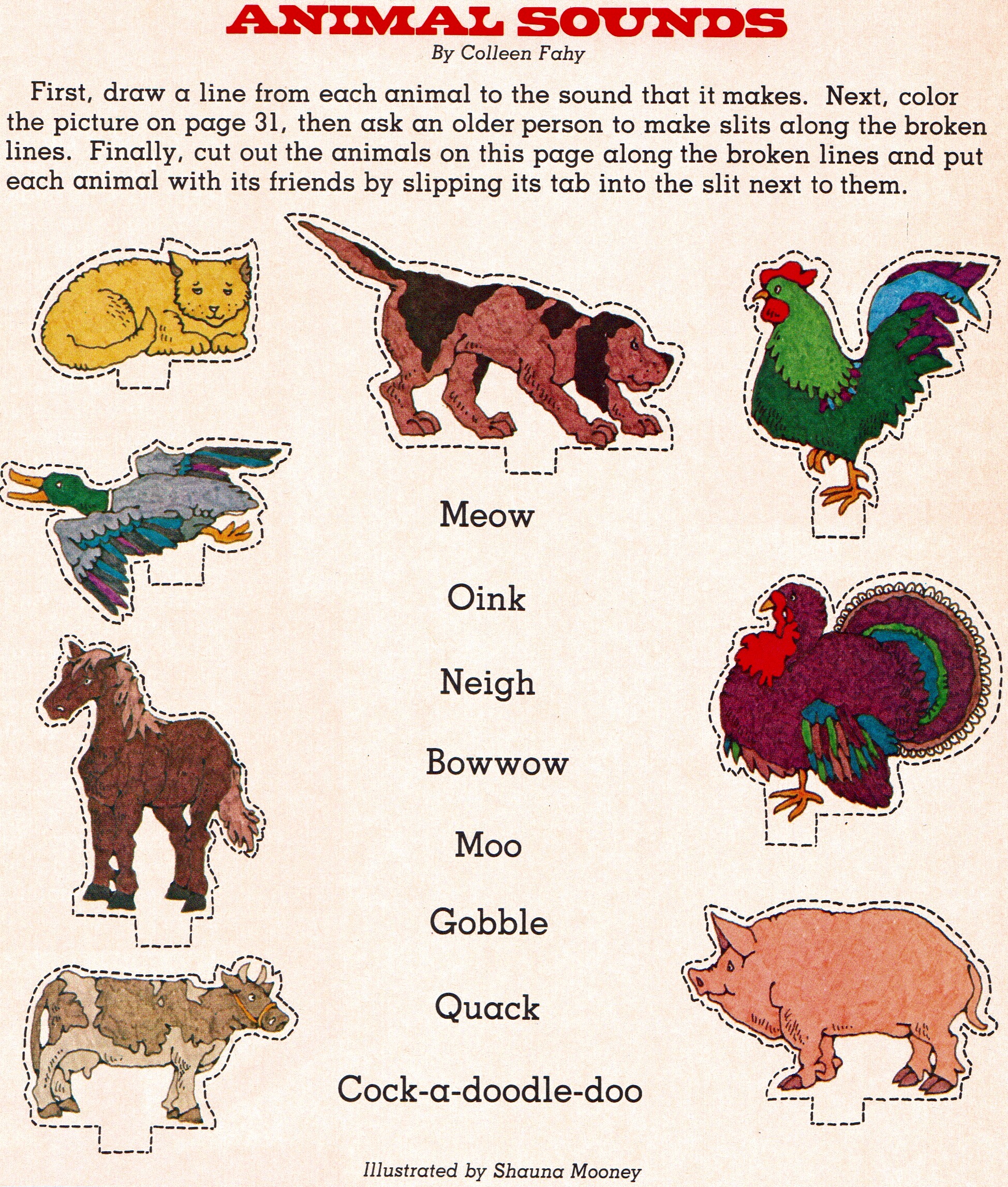
Animal Sounds
Friend May 1997 “Animal Jingles” Find the animals that makes the sound mentioned in each jingle.
Friend April 2025 “Animal Dance” Everyone dances like an animal. When the leader turns back around, everyone freezes! The leader watches to see who moves.
Friend August 2021 “Animal Games” Play an animal game with friends or family. Try hopping like a bunny or waddling like a duck. Take turns coming up with ideas! Or see who can make the best animal noises.
Friend July 2025 “Come, Follow Me Activities: Animal Actions” Under God’s direction, Jesus Christ created every creature on earth (see Doctrine and Covenants 77:2). Play an animal guessing game! One person pretends to be a certain animal. Everyone else tries to guess what animal they are. Once you guess it right, say something you like about that animal.
For younger children: Go on a walk with your little ones and point out animals you see. Or look at pictures of animals. Teach them that Heavenly Father and Jesus Christ created every creature on earth.
Friend April 2026 “Activity Time” Jesus Christ is the Living Water (see John 4:14). This means the joy and peace He gives us will never run out! His love can help us grow, just like water helps plants and animals grow.
2 Nephi CHAPTER 20 The destruction of Assyria is a type of the destruction of the wicked at the Second Coming—Few people will be left after the Lord comes again—The remnant of Jacob will return in that day—Compare Isaiah 10. About 559–545 B.C.
2 Nephi CHAPTER 21 The stem of Jesse (Christ) will judge in righteousness—The knowledge of God will cover the earth in the Millennium—The Lord will raise an ensign and gather Israel—Compare Isaiah 11. About 559–545 B.C.
2 Nephi CHAPTER 22 In the millennial day all men will praise the Lord—He will dwell among them—Compare Isaiah 12. About 559–545 B.C.
2 Nephi CHAPTER 23 The destruction of Babylon is a type of the destruction at the Second Coming—It will be a day of wrath and vengeance—Babylon (the world) will fall forever—Compare Isaiah 13. About 559–545 B.C.
2 Nephi CHAPTER 24 Israel will be gathered and will enjoy millennial rest—Lucifer was cast out of heaven for rebellion—Israel will triumph over Babylon (the world)—Compare Isaiah 14. About 559–545 B.C.
2 Nephi CHAPTER 25 Nephi glories in plainness—Isaiah’s prophecies will be understood in the last days—The Jews will return from Babylon, crucify the Messiah, and be scattered and scourged—They will be restored when they believe in the Messiah—He will first come six hundred years after Lehi left Jerusalem—The Nephites keep the law of Moses and believe in Christ, who is the Holy One of Israel. About 559–545 B.C.
“Since the line of Jesse is the royal line of kings from David’s time on, is there any question as to who this ‘branch’ is?” (Rasmussen, Introduction to the Old Testament, 2:45.)
Isaiah 53:2 For he shall grow up before him as a tender plant, and as a root out of a dry ground: he hath no form nor comeliness; and when we shall see him, there is no beauty that we should desire him.
Come, Follow Me—For Home and Church: Book of Mormon 2024 “2 Nephi 20-25” What does 2 Nephi 21:6–9 teach about what can happen when everyone follows the Savior? (see also 4 Nephi 1:15–18). How can we make our home more like this? Your children might enjoy looking at pictures of the animals mentioned in verses 6–7—animals that are usually enemies but will not hurt each other when Jesus comes again (see this week’s activity page). Your children could also draw pictures of themselves and these animals living peacefully with Jesus.
Come, Follow Me—For Primary: Book of Mormon 2020 “2 Nephi 11-25” Show the children pictures of animals mentioned in 2 Nephi 21:6–7, and ask the children to name the animals. Explain that these animals are usually enemies, but Isaiah taught that after Jesus Christ comes again, there will be a time of peace, called the Millennium, when animals will not hurt each other. How can we follow the example of these animals in the way we treat each other?
Come, Follow Me—For Home and Church: Book of Mormon 2024 “2 Nephi 20-25” Isaiah said that the Lord would set up an “ensign for the nations” to help people gather to Him (see 2 Nephi 21:11–12). Help your children understand that an ensign is like a flag. Perhaps they would enjoy drawing their own flag. They could include pictures or words that represent reasons they come to Jesus Christ and His Church. Let them talk about their flags, and help them think of how they can help others “gather” to Jesus Christ.
Come, Follow Me—For Primary: New Testament 2023 “John 1” Ask the children to use this week’s activity page to make an invitation they could use to invite a friend or family member to learn more about Jesus Christ. (Maybe include it in a Friend magazine or a Book of Mormon)
Come, Follow Me—For Home and Church: Book of Mormon 2024 “2 Nephi 20-25” After reading 2 Nephi 22:4–5 together, you might talk with your children about some of the “excellent things” the Lord has done. What are some of the Lord’s “doings among [us]” that we can declare? To help your children think about this question, you might sing together a song about the Savior, like “I Believe in Christ” (Hymns, no. 134). You could take turns completing a sentence like this one: “I believe in Christ; He _____.” How can we help other people know about what the Savior has done for us?
Come, Follow Me—For Home and Church: Book of Mormon 2024 “2 Nephi 20-25” How can you help your children “rejoice in Christ”? Maybe you could tell a story about Jesus Christ bringing joy to others, or you could show a video such as “Jesus Heals a Man Born Blind” or “Suffer the Little Children to Come unto Me” (Gospel Library). Your children could point out joyful moments in the story or video. Then, as you read together 2 Nephi 25:26, they could talk about why they “rejoice in Christ.”
Come, Follow Me—For Primary: Book of Mormon 2020 “2 Nephi 11-25” Put a picture of the Savior on the board, and read together 2 Nephi 25:26. Why did Nephi talk and write so much about Jesus Christ? Let each of the children write on the board, near the picture of Jesus, one thing about the Savior that brings them joy.
Ask the children to think of someone they would like to “persuade … to believe in Christ” (2 Nephi 25:23). How can we express to others the joy that the Savior brings into our lives? Let the children write or role-play some things they might do to help the person they thought of believe in Jesus Christ.
Come, Follow Me—For Individuals and Families: Book of Mormon 2020 How can you help your family members “rejoice in Christ”? Maybe you could invite them to write on slips of paper things about the Savior that bring them joy. Then, during future family home evenings or family scripture study, someone could read a slip. Family members could add slips throughout the year.
Come Follow Me Kid “We Rejoice in Christ”“Delight In” Treats – What does it mean to “delight in” something? Talk about things we “delight in” (the park, puzzles, games, treats, etc.). Set out some of their favorite treats/snacks. My kids are obsessed with hot chocolate, so we’ll probably get some of that and while we’re drinking it, talk about how warm and happy it makes us feel. When we “delight in” something, it makes us feel warm and happy like that. What do you think Nephi said he “delights in”? Nephi said that his soul delights in proving unto his people the truth of the coming of Christ (2 Nephi 11:4). Show a picture of Christ. Why do you think Christ is so important and how can He help us feel happy?
“Smiley Face Hat” Cut apart the pieces for the smiley face hat below. Explain what it means to “rejoice.” Put the smiley faces in a pile and let kids take turns choosing one. As each piece is chosen, discuss how that is something that can make us happy and rejoice. Glue them onto the hat after discussing.