2 Nephi 31-33

Posted on

2 Nephi CHAPTER 31 Nephi tells why Christ was baptized—Men must follow Christ, be baptized, receive the Holy Ghost, and endure to the end to be saved—Repentance and baptism are the gate to the strait and narrow path—Eternal life comes to those who keep the commandments after baptism. About 559–545 B.C.

2 Nephi CHAPTER 32 Angels speak by the power of the Holy Ghost—Men must pray and gain knowledge for themselves from the Holy Ghost. About 559–545 B.C.

2 Nephi CHAPTER 33 Nephi’s words are true—They testify of Christ—Those who believe in Christ will believe Nephi’s words, which will stand as a witness before the judgment bar. About 559–545 B.C.

Before Nephi died, and before he passed his responsibilities on to Jacob, he wrote some final words, and they are about the first principles and ordinances of the gospel.

Nephi taught that following the Savior’s example and teachings are the only way to “be saved in the kingdom of God” (2 Nephi 31:21).

Jesus Christ taught me how to return to Heavenly Father.

2 Nephi 31

We can return to God after this life by following the doctrine Jesus Christ taught: faith in Christ, repentance, baptism, the gift of the Holy Ghost, and enduring to the end.

Come, Follow Me—For Home and Church: Book of Mormon 2024 “2 Nephi 31-33” To help your children visualize the teachings in 2 Nephi 31, they could draw a path with a picture of Christ at the end. You could help them find or draw pictures that represent steps on that path, such as faith in Christ, repentance, baptism, the gift of the Holy Ghost, and enduring to the end. [Could also help them place some pictures along the path.] They could point to the pictures as you read 2 Nephi 31:17–20 together.

Idea for Reading and Listening to the Scriptures: Explain that the doctrine of Christ includes the things Jesus Christ taught that we need to do to return to Heavenly Father. Write on different sheets of paper faith in Christ, repentance, baptism, the gift of the Holy Ghost, and enduring to the end, (or use the pictures below if you have little children, making one copy per child) and scatter them around the room. Read to the children 2 Nephi 31:11–19, and invite the children to take turns jumping from paper to paper as they hear these principles mentioned. Help them think of an experience they have had with each principle. (Come, Follow Me—For Primary: Book of Mormon 2020 “2 Nephi 31-33: This is the Way”)

Or make these finger puppets for each child and have them put up the correct puppet as it is mentioned in the scriptures.

Friend April 2011 “Article of Faith 4” Draw a line from the principle or ordinance to the correct picture.

Friend April 2011

Friend July 2003 Fourth Article of Faith Picture Scramble. Cut out the pictures and glue them in place in the right order.

Friend July 2003

Ensign March 2020 “Family Study Fun: Spiritual Stepping Stones” Christ said, “Follow me, and do the things which ye have seen me do” (2 Nephi 31:12). Place a picture of Christ on the opposite side of the room. Write on narrow pieces of paper or cards the “stepping stones” to Christ: Faith in the Lord Jesus Christ, Repentance, Baptism, The gift of the Holy Ghost, Enduring to the end. Have someone put the steps in order. Place the steps on the floor in a “strait and narrow path” (2 Nephi 31:18) to Christ.

Discussion: Which stepping stone is next for each of you? How can we honor the steps we have taken? What can we do to strengthen our resolve to stay on the path?

Friend March 2024 “Come, Follow Me Activities” Nephi taught that we follow Jesus Christ when we have faith in Him, repent, are baptized, receive the gift of the Holy Ghost, and endure to the end (see 2 Nephi 31). Write each step on a different piece of paper, then spread them on the floor. One person closes their eyes and counts to 10 while everyone else stands on a paper. The person who counted then says one of the steps to follow Jesus. The person on that paper counts next.

For younger children: When we have faith in Jesus Christ, we follow what He says. Form a line and walk around. The person in front is the leader. Each person copies how the leader walks. Take turns being the leader!

Come, Follow Me—For Primary: Book of Mormon 2020 “2 Nephi 31-33” Explain that the doctrine of Christ includes the things Jesus Christ taught that we need to do to return to Heavenly Father. Write on different sheets of paper faith in Christ, repentance, baptism, the gift of the Holy Ghost, and enduring to the end, and scatter them around the room. Read to the children 2 Nephi 31:11–19, and invite the children to take turns jumping from paper to paper as they hear these principles mentioned. Help them think of an experience they have had with each principle.

Help the children learn the fourth article of faith. Sing together a song about one of the first principles of the gospel, such as “Faith,” “When I Am Baptized,” or “Choose the Right Way” (Children’s Songbook, 96–97, 103, 160–61).

Come Follow Me Kid “This is the Way” Click on the link to see lesson ideas to go with the following pictures.

Faith in the Lord Jesus Christ

Friend January 2009 “Becoming Like Jesus Christ” President Dieter F. Uchtdorf explains that faith in Jesus Christ and in His Atonement means relying completely on Him—trusting in His infinite power, intelligence, and love. When we have faith in Christ, we trust the Lord enough to follow His commandments—even when we do not completely understand the reasons for them. We need to rely, through the path of true repentance, upon the merits of Jesus Christ and the blessings of His Atonement.

Repentance

11) And the Father said: Repent ye, repent ye, and be baptized in the name of my Beloved Son.

Ensign January 2018 “Repentance is a Gift” Match each picture with a different step of repentance.

Baptism 

When I am baptized, I am following Jesus Christ.

2 Nephi 31:4–13

Come, Follow Me—For Home and Church: Book of Mormon 2024 “2 Nephi 31-33” There’s a picture of Jesus being baptized at the end of this outline. Maybe your children could use it to tell you what they know about this event (see also Matthew 3:13–17). Why does Jesus want us to be baptized like He was? Your children could listen for reasons as you read together portions of 2 Nephi 31:4–13. It might be helpful if someone who was recently baptized could share their experience.

Why was the Savior baptized?

  • To Be Obedient to the Father & To be an Example for Us 

7) But notwithstanding he being holy, he showeth unto the children of men that, according to the flesh he humbleth himself before the Father, and witnesseth unto the Father that he would be obedient unto him in keeping his commandments.

  • To Show us that We Need to Enter the Gate (Baptism) that Leads to the Path Towards Eternal Life

9) And again, it showeth unto the children of men the straitness of the path, and the narrowness of the gate, by which they should enter, he having set the example before them.

New Era April 2014 “The Gate and the Path”

Friend August 2019 “Coloring Page: A New Path” When I am baptized, I choose to walk a new path with Jesus. (See Romans 6:4.)

We Need to Follow His Example and be Baptized

5) And now, if the Lamb of God, he being holy, should have need to be baptized by water, to fulfil all righteousness, O then, how much more need have we, being unholy, to be baptized, yea, even by water!

10) And he said unto the children of men: Follow thou me 

Come, Follow Me—For Primary: Book of Mormon 2020 “2 Nephi 31-33” Display the picture in this week’s outline in Come, Follow Me—For Individuals and Families, and ask the children to share what they know about Jesus’s baptism (see Matthew 3:13–17). Put the following words in random order on the board: Jesus witnessed unto the Father that He would be obedient unto Him. Invite the children to read 2 Nephi 31:7 as a class and put the words into the correct order.

  • Ask the children what they would say to someone preparing to be baptized, and help them compile their advice onto simple cards they could give to someone. How can we continue to follow the example of Jesus after we are baptized?

Gift of the Holy Ghost

When we repent and choose to be baptized, like Jesus, then we can be confirmed and have the gift of the Holy Ghost too.

12) And also, the voice of the Son came unto me, saying: He that is baptized in my name, to him will the Father give the Holy Ghost, like unto me; wherefore, follow me, and do the things which ye have seen me do.

Friend June 2019 “The Holy Ghost is…”  The Holy Ghost is a member of the Godhead, a gift that comes with baptism, and a promise from Heavenly Father. He is a comforter, warning, teacher, messenger, friend.

[unitegallery 2019Jun]

Friend March 2020 “How Does Heavenly Father Speak to Us?”  A feeling that Jesus loves us and that the gospel is true, A comforting feeling when we are sad or lonely, A happy feeling after we have repented, A good feeling when we hear beautiful music or see inspiring art, A peaceful feeling that something is a good choice, A warning feeling that something is wrong

Endure to the End

They [must] then endure to the end, or, in other words, they continue throughout their lives in exercising faith in Jesus Christ, repenting, and renewing the covenants they have made. These are not just steps that they experience once in their lives; rather, when repeated throughout life these principles become an increasingly rewarding pattern of living. In fact, it is the only way of living that will bring peace of conscience and enable Heavenly Father’s children to return to live in His presence. (Preach My Gospel pg. 6)

Friend March 2020 “Come, Follow Me for Little Ones” What blessing can we receive if we endure to the end? (See 2 Nephi 31:20.)

I can feast upon the words of Christ.

2 Nephi 32:3–5

Come, Follow Me—For Home and Church: Book of Mormon 2024 “2 Nephi 31-33” To teach about “feasting” on the words of Christ, you could ask your children to act out how they would feast on their favorite food. In 2 Nephi 32:3, what did Nephi say we should feast on? How is feasting on God’s word different from just reading it? Maybe your children could act out the differences. Share with them the blessings you’ve received as you’ve feasted on the scriptures.

“Wherefore, I said unto you, feast upon the words of Christ; for behold, the words of Christ will tell you all things what ye should do.”

Come, Follow Me—For Primary: Book of Mormon 2020 “2 Nephi 31-33” Ask the children to name some of their favorite foods, and invite them to act out how they would feast on them. (To feast upon something is to enjoy it or to consume a great deal of it because it brings joy. )Read 2 Nephi 32:3, and ask the children to listen for what Nephi says we should feast on. What does it mean to feast on the scriptures? Explain that the scriptures are one place where we can find the words of Christ.

Ask the children to imagine a feast. What food would they want there? What would they eat first? Then invite them to imagine what feasting on the scriptures might mean as you read 2 Nephi 32:3. Why did Nephi use the word feast to teach us how we should study God’s word? Why didn’t he just say read? What does it mean to feast on the scriptures? Share with the children the blessings you’ve received as you’ve feasted on the scriptures

Write the following words on separate pieces of paper: sample, gorge, taste, nibble, snack, and feast. Hand the papers out to six students, without letting the other students see what is written. Have the six students come to the front of the class. Give them dishes and tell them to imagine there is food in them. Invite the six students to describe or demonstrate the word on their paper, and have the class try to guess the word. Reveal the six words. (Book of Mormon Teacher Resource Manual)

Come, Follow Me—For Primary: Book of Mormon 2020 “2 Nephi 31-33”

  • Write the words God and Lord on the board. Invite the children to open to a page of scripture and look for these words. Give them help if needed. Testify that as we read the scriptures, we can learn about God.
  • Complete the activity page with the children, and invite them to make a goal to do at least one thing to feast on the scriptures this week.

Friend March 2020 “Feasting on the Scriptures” Action Rhyme

The Wise Man and the Foolish Man Explain that “the wise man built his house upon the rock” means that wise man built his life upon the teachings of Jesus. The foolish man didn’t and his house (life) fell apart in the storms of life. Discussion Ideas: What things in our life are like the rain and wind? How does following Jesus’s teachings protect us and make our faith strong as a house built on a rock? Song: “The Wise Man and the Foolish Man” (Children’s Songbook, 281) Scripture: Matthew 7:24–29  Sing-along video

Friend March 2015 “The Wise Man and the Foolish Man”

Rock Art: Choose a smooth rock. With a marker or paint, write “Jesus Christ” on it. Talk about why it’s so important to build our lives on His teachings. Keep the rock in a place where you can see it often.

Heavenly Father wants me to pray always.

2 Nephi 32:8–9

Come, Follow Me—For Home and Church: Book of Mormon 2024 “2 Nephi 31-33” After reading 2 Nephi 32:8–9, talk with your children about why Satan doesn’t want us to pray. Why does God want us to “pray always”? Your children could make a list or draw pictures of situations in which they could pray. Then you could sing a song that teaches about prayer, such as “Did You Think to Pray?” (Hymns, no. 140). You could replace some of the words in the song with the words from their lists. How does God bless us when we pray always?

  • Talk with the children about times when they can pray, such as when they are scared, when they make mistakes, or when they need help in school. Why is it good to pray in these situations? Teach the children that no matter where they are, they can always pray in their hearts.

Friend October 2020 “Jesus Taught Us How to Pray”

Friend January 2023 “I Can Follow Jesus by Praying” When do you pray with your family? Find the items hidden below.

Come, Follow Me—For Primary: Doctrine and Covenants 2021 “Doctrine and Covenants 81-83”

  • Read to the children the Lord’s counsel to be “faithful … in prayer always, vocally and in thy heart, in public and in private” (Doctrine and Covenants 81:3). Explain what it means to pray in our hearts, and share a personal example. Help the children think of times when they can pray “in public and in private.”
  • Invite someone to read Doctrine and Covenants 81:3, and ask the children what it means to pray “in [your] heart.” Share an experience when you prayed aloud or in your heart and the Lord helped you. Also ask the children to share their own experiences. How can prayer bring us closer to Heavenly Father?

Come, Follow Me—For Primary: Book of Mormon 2020 “2 Nephi 31-33”

  • Ask the children when they pray. Do they pray in the morning? at night? before meals? Help the children think of actions to show when we can pray, such as when we wake up, go to bed, and eat—or any other time. Read to them the first line or two from 2 Nephi 32:9, and emphasize the phrase “pray always.”
  • Ask the children how they pray. What do they do with their head, hands, and so on? What sorts of things do they say? Ask them to imagine that you don’t know how to pray, and let them teach you. Why does Heavenly Father want us to pray?
  • The adversary tempts us not to pray. Consider how you can help the children resist this temptation and “pray always” (2 Nephi 32:9).
  • Choose a phrase about prayer from 2 Nephi 32:8–9, write it on the board, and cover each word with a piece of paper. Invite the children to take turns removing one paper at a time until they can guess what the phrase is.
  • Read 2 Nephi 32:8–9 together, and ask the children to share what they learn about prayer from these verses. What does it mean to “pray always”? (verse 9). How can we do this?
  • What might make someone not want to pray? Share an experience when you prayed even though you didn’t feel like it. How did you feel afterward? Invite a child to read the second half of 2 Nephi 32:8, and give the children time to ponder it. Why doesn’t Satan want us to pray? How can we remind ourselves to pray even when we don’t feel like it?

Additional Resources

Come, Follow Me—For Individuals and Families: Book of Mormon 2020 “2 Nephi 31-33: This is the Way”

Come, Follow Me—For Primary: Book of Mormon 2020 “2 Nephi 31-33: This is the Way”

The Cozy Red Cottage

The Red Crystal

The Red Crystal

Latter Day Kids “Jesus Christ is the Way” Lesson Ideas

Fun Review Activities: Fourth Article of Faith

See more Fourth Article of Faith ideas here. 


Reading the Book of Mormon

Posted on

The Importance of Reading the Book of Mormon

Friend January 2020 “The Precious Book of Mormon” President Nelson compares the Book of Mormon to treasure and encourages us to read it. He promises that changes and miracles will occur in our lives if we do.

Friend May 2017 “Book of Mormon Power” President Monson implores us to read the Book of Mormon and lists the benefits of doing so. Also includes a bookmark.

Friend January 2020 “A Special Book” Pablo knows the Book of Mormon is special. It teaches him about Jesus. It helps him feel Heavenly Father’s love. It is more important than any treasure. He reads from it every day. Pablo loves the Book of Mormon!

[unitegallery 2020Janua]

Friend April 2015 “The Book of Mormon Challenge” Blake had just finished reading the Book of Mormon when the stake president challenged everyone to read it again because of the many benefits it brings into the people’s lives.

Come Follow Me Kid Show the “Worth More Than its Weight in Gold” poster. Talk about why the Book of Mormon is more valuable than gold to us. Eat a treat wrapped in gold (Hershey’s
nuggets, gold coins, etc.).

Friend July 2024 “Older Kids’ Section”

It Helps Us Stay on Path to Eternal Life

Explain that because of Heavenly Father’s great love for us, he has given us a gift to help us achieve eternal life (the kind of life Heavenly Father has).

Friend February 2012 “The Book of Mormon: Our True Guide”  President Henry B. Eyring teaches how the Book of Mormon is our guide to return home. The article includes a simple maze activity.

2 Nephi 28:229:7–1130:3–6

Come, Follow Me—For Primary: Book of Mormon 2020 “2 Nephi 26-30” Explain that because of Heavenly Father’s great love for us, he has given us a gift to help us achieve eternal life (the kind of life Heavenly Father has).Show the children a Book of Mormon wrapped as a gift, and tell them that something valuable is inside. Let them hold the gift, and give clues to help them guess what it is; for example, it’s something the Lord has given us, it helps us believe in Jesus Christ, and so on. Read from 2 Nephi 30:6: “It is a blessing unto them from the hand of God.” Let the children open the gift, and then explain that we must open the Book of Mormon and read it to receive the blessings it contains.

The Red Crystal

Come, Follow Me—For Home and Church: Book of Mormon 2024 “2 Nephi 26-30” Tell your children why the Book of Mormon is of great worth to you, and let them share their feelings too.

Friend May 2024 “Older Kids Section”

Come, Follow Me—For Primary: Book of Mormon 2020 “2 Nephi 26-30” Read 2 Nephi 28:2 to the children. Explain that Nephi saw that the Book of Mormon would “be of great worth” to us, which means that it will help and bless us. Tell the children why the Book of Mormon is of great worth to you. Share your favorite verse or story from the Book of Mormon, and invite the children to share theirs. Show pictures from the Gospel Art Book to give them ideas.

It Helps Us with Life’s Difficulties

Friend March 2020 “Eddy and the Book of Mormon” Some kids laugh at Eddy when he reads at school because he has a hard time with some words. It makes him nervous and not want to read out loud. But as his family read the Book of Mormon each day (first they figured out a way to remember to read each day), Eddy learns about Nephi and how his brothers made fun of him for building a boat. That didn’t stop Nephi. He trusted God, and God helped him do hard things. Next time some kids laughed at him while Eddy read in class, he thought of Nephi, and that helped him not to worry about what the kids would say.

Friend January 2024 “Forgiving Like Nephi” Josh called Aisea a mean name after Aisea’s team won the game. The rest of the day, Aisea felt like a heavy weight was pulling him down. He did not like Josh anymore. During family scripture study that night he read about a time when Nephi’s brothers were unkind to him. “And it came to pass that I did frankly forgive them,” the scripture said.” Aisea thought about Josh. He didn’t want to hold onto his bad feelings for Josh forever. Aisea wanted to be like Nephi. He could forgive Josh, just like Nephi forgave his brothers. And if Josh said something mean again, he would just ask him not to. He felt warm and peaceful inside, and the heavy weight from before was gone.

It Helps Us Avoid Satan’s Temptations

The Book of Mormon is a Blessing: 2 Nephi 26-30

The Book of Mormon Exposes Satan’s Lies

2 Nephi 28

Come, Follow Me—For Individuals and Families: Book of Mormon 2020 “2 Nephi 26-30” “I prophesy unto you concerning the last days,” Nephi wrote (2 Nephi 26:14). In other words, he was writing about our day. And there’s reason to be concerned about what he saw: people denying the power and miracles of God, rampant envy and strife, the devil binding people with strong cords. [But he also spoke of] a book that speaks from the dust, that exposes Satan’s lies, and that gathers the righteous like a standard. That book is the Book of Mormon.

Satan Seeks to Deceive

Things Satan wants people to believe:

  • You don’t need to strive to improve yourself because you are already good enough. (Verse 21)
  • God will justify a little sin. He may punish you a little, but he will still allow you to be saved in His Kingdom. (Verse 8)
  • There is no hell or devil. (Verse 22)
  • God has already given all His words. You don’t need more. (Verse 29)
  • Beware of those who say miracles still occur. Miracles don’t need to happen anymore. (Verse 6)

What could the personal consequences be for believing each of the above lies? (You could wrap some thread around someone’s wrists to represent “a flaxen cord” as the family members mention possible consequences. Then read the following: [Satan] leadeth them by the neck with a flaxen cord, until he bindeth them with his strong cords forever. 2 Nephi 26:22)

Object lesson: Ask for a volunteer. Have the volunteer put their hands together. Wrap one layer of the masking tape around their fingers and thumbs. Ask them if they can break free. Explain that when we first make a mistake or sin we are easily able to break free of its grasp and repent. But Satan knows that if he continue to gets us to sin, little by little, eventually the sin will become accepted and then we become bound in captivity to the sin because it becomes a habit or an addiction. (Wrap the tape around the child’s hands several times, layering one area around the fingers and thumbs.) Ask the child to try and break free from the bindings. They shouldn’t be able to. Satan wants us to be miserable like he is, and he knows that sin binds us in captivity and destroys lives.

It Helps Us Gain a Testimony

Friend June 2020 “Testimony and the Book of Mormon” President Eyring tells how reading the Book of Mormon helps strengthen his testimony.

This image has an empty alt attribute; its file name is Screen-Shot-2020-06-15-at-9.08.51-AM.png

Friend September 2015 “A New Feeling” – Child feels Holy Ghost while reading about Jesus in the scriptures

Friend February 2019 “Ingrid’s Birthday Surprise” Ingrid gets a special present for her seventh birthday from her mom—a Book of Mormon. It was a special gift to help her prepare for her baptism. Ingrid read the entire Book of Mormon that year and prayed for and received a testimony of its truthfulness.

Friend January 2017 “The Book on the Shelf” When Walter reads the Book of Mormon he knows it’s words are true, and he learns that it contains answers to problems in life.

Friend June 2016 “Jason’s Study Buddy” Jason reads the entire Book of Mormon before his baptism. His testimony grows.

Moroni’s Promise

Friend December 2016 “Moroni’s Special Promise” Video can be found here.

Book of Mormon Stories “Chapter 54: The Promise of the Book of Mormon” Images and Video

Come, Follow Me—For Primary: Book of Mormon 2020 “Moroni 10: “Come unto Christ, and Be Perfected in Him”

Show the Book of Mormon, and read Moroni 10:4. Emphasize that we can ask God if the Book of Mormon is true, and He will send the Holy Ghost to testify to us. Help the children understand what a witness from the Spirit feels like. Tell about a time when the Holy Ghost bore witness to you about something. Describe how you felt and how you knew it was the Holy Ghost.

Friend April 2016 A family reads the Book of Mormon and then prays to get a testimony of its truth

Friend December 2020 “How I Know” Before bed, Damon’s father reads to the boys about Moroni’s promise and then he tells the boys how he prayed and gained his testimony of the Book of Mormon. Damon prays to know if the Book of Mormon is true and he feels warm and good inside.

Come, Follow Me—For Primary: Book of Mormon 2020 “Moroni 10: “Come unto Christ, and Be Perfected in Him”

Write on the board the words Read, Remember, Ponder, and Ask. Invite the children to find these words in Moroni 10:3–4. Sing a song about finding truth, such as “Search, Ponder, and Pray” (Children’s Songbook, 109). Ask the children to look for similarities between these verses and the song “Search, Ponder, and Pray” (Children’s Songbook, 109).

Friend December 2020 “Family Night Fun”

Latter Day Kids “Personal Revelation- Come Follow Me” This link has lesson ideas, videos, and discussion ideas about Moroni’s promise

Primary Manual 4: Book of Mormon “Lesson 44: Moroni and the Book of Mormon Promise” This lesson includes questions and lesson ideas about Moroni and his promise.

See more stories of gaining a testimony of the Book of Mormon here.

Reading the Book of Mormon

Primary 4 Book of Mormon Lesson 16   Show the children an umbrella (or pretend to have an umbrella) and a Book of Mormon. Ask how the two items might be similar. Help the children understand that an umbrella will not protect us from rain unless we open it and stand under it. Similarly, the Book of Mormon cannot increase our faith in Jesus Christ and help shield us from Satan’s temptations until we open it, prayerfully study it, and live its teachings.

Friend September 2024 “A Chat with Teancum about the Scriptures” Teancum tells about what he is learning from the Book of Mormon and how it helps him.

Liken the Scriptures

Friend October 2024 “Liken the Scriptures” I Can Play It!

I may not be asked to build a great big ship, Or sail my family ’cross the ocean blue, But if I had the faith and courage Nephi did, Imagine all the great things I could go and do!

Chorus: The Lord has a special message for me In every scripture story I read, And I can become who I’m striving to be When I liken the scriptures to me.

I won’t raise a tent to hear the prophet speak, But I can listen when he speaks today. And I don’t have a sword to bury ten feet deep, But I can cast my selfish words and deeds away. Chorus

Bridge: Like Enos I will fervently pray. Like the stripling warriors, I will obey. Like Abish I will share what I know, And like Ammon I’ll go where I’m called to go. Chorus

Read the Book of Mormon Daily

The Cozy Red Cottage

Goals to Read the Book of Mormon

Friend February 2022 “Goals for Baptism” After hearing about the Children and Youth program, Zoe set a goal to read the Book of Mormon before her baptism. As she read, she wanted to do more good things, so she joined the world wide fast about Covid, and she prayed and fasted for a testimony.

Friend January 2021 “Our Book of Mormon Goal” At Christmas, Mattea’s family all wrote down things that we were going to give Christ for the next year. Mattea’s grandma said she was going to read the Book of Mormon in four months. She had not gone to church since she was nine. All of Mattea’s aunts, uncles, and most of her cousins decided to read the Book of Mormon with her.

Friend January 2020 “Show and Tell: The Book of Mormon Edition” Real life experiences of children and families that set goals to read the Book of Mormon.

Friend January 2024 “Sami’s Scriptures” Sami’s family set the goal to read the Book of Mormon every day. Sami wondered how he would help because he didn’t know how to read. At first he followed along in a picture book, and during his turn he told the others what he saw in the pictures. Soon he was learning how to sound out words and he read the last word of every verse his family read. By the time they finished the Book of Mormon, two years from when they started, Sami had learned to read pretty well.

Liahona February 2024 “My Bishop’s Book of Mormon Challenge” When Travis was 11 years old, his bishop invited his class to read the entire Book of Mormon five times before serving their missions. That invitation started a habit of daily scripture reading and a love, knowledge, and testimony of the Book of Mormon. Each time he read it he understood it more and he came to know his Savior. He also learned that no matter the child’s ages, they can feel the Holy Spirit as they read or hear the Book of Mormon, even if they don’t understand its words.

Friend January 2024 “I Can Read the Scriptures”

Reading Charts

After you read, color part of the picture. You can read these scriptures that go along with each week’s reading from Come, Follow Me.

Book of Mormon Scripture Stickers

Come Follow Me: Book of Mormon

Friend January 2020 “What’s on Your Mind? Someone asks a question about how to do Come Follow Me at home when their family doesn’t do it? The Friend explains that they can do it themselves. They include a Book Mark to inspire them.

Friend January 2020 “I Can Read the Book of Mormon” You can use this coloring chart to follow along with the Come, Follow Me lessons. Read the verses on the reading chart each week. Then color in the matching spaces.

Ideas for Reading and Understanding the Book of Mormon

Friend March 2023 “My Book of Mormon Goal” Vebika set a goal to read the Book of Mormon before her baptism, but she struggled with reading and understanding the words in it. She decided to use the Gospel Library app on her mom’s phone to listen to the Book of Mormon. They slowed the voices down so she could read and follow along more easily. She also stopped along the way and watched the videos linked in the app. Every time she read, she marked it down on a chart. She also talked to her mom about what she was reading.

Friend January 2020 “8 Ideas for Reading the Book of Mormon”

Friend January 2024 “I Can Read the Scriptures”

Read with Friends and Family

Friend January 2020 “Gracie’s Goal” Gracie got a set of scriptures from her grandparents at her baptism. She set a goal to read the Book of Mormon by her next birthday, but she is struggling with the goal because some of the words and chapters are hard to understand. She told her grandma that she was having a problem keeping up with her goal. Her grandma suggested that they read the Book of Mormon together every night on the phone. Gracie was able to accomplish her goal and understand the Book of Mormon better with her grandma’s help.

[unitegallery 2020Jan]

Friend June 2017 “Book of Mormon Club” Sydney starts a Book of Mormon club where she and her friends discuss what they have learned.

Friend January 2018 “Book of Mormon Reading Club” Includes children’s thoughts about reading the Book of Moron. February, March, April, May, June, July, August, September, October, November, December,

Read the Scripture Readers

Friend January 2020 “Batbayar and the Book with Pictures” Reading was hard for Batbayar, so he struggled with reading the Book of Mormon. The missionaries brought him Book of Mormon Stories instead. Every night he prayed after reading. His heart felt good when he read, and when he prayed he felt like the stories were true, so he asked to be baptized.[unitegallery Jan2020]

I can be a witness that the Book of Mormon is true.

Doctrine and Covenants 5:1–7, 11, 16, 23–24

Come, Follow Me—For Primary: Doctrine and Covenants 2021 “Doctrine and Covenants 3–5: “My Work Shall Go Forth”

Martin Harris was promised that he could be one of the witnesses of the gold plates if he was faithful [and humbled himself]. We won’t see the plates like Martin did, but we can receive a spiritual witness of the Book of Mormon.

  • Write questions like the following on the board, and help the children find answers in Doctrine and Covenants 5:1–3, 7, 11What did Martin Harris desire to know? Who could Joseph Smith show the gold plates to? Why would seeing the plates likely not be enough to convince someone that the Book of Mormon is true?
  • Ask the children what a witness is and why a witness is important.
  • What did Martin Harris need to do to be a witness of the gold plates? (see Doctrine and Covenants 5:23–24).
  • Even though we haven’t seen the plates, what can we do to be witnesses of the Book of Mormon? (see Doctrine and Covenants 5:16Moroni 10:3–5).

God will reveal truth to me by the power of the Holy Ghost.

1 Nephi 10:17–1911:1

Come, Follow Me—For Home and Church: Book of Mormon 2024 “1 Nephi 6-10” How could you help your children understand what Nephi taught in 1 Nephi 10:19? Perhaps you could fold a picture of the Savior or another special object inside a blanket and invite your children to unfold it. As you read 1 Nephi 10:19, they could raise their hands when they hear the words “unfolded” and “Holy Ghost.” Then you could share an experience when the Holy Ghost helped you discover truth.

“Fiction or Nonfiction?” (January 2012 Friend) When Jennifer learned the difference between fiction and nonfiction she wondered about the Book of Mormon. She spent a lot of time reading it but didn’t know how she would ever know it was true. During Sacrament she said a prayer. Then she remembered the warm, happy feelings she had when she was baptized. She realized she felt the same way when she thought of the Prophet Joseph Smithy and when she read the Book of Mormon. She knew that Heavenly Father was telling her through the Holy Ghost that the Book of Mormon was true.

Friend January 1988 “Juliano’s Testimony” Juliano seeks to gain a testimony for himself. He reads the Book of Mormon and then prays to know if it is true. He didn’t know how the Holy Ghost would visit him because he was just a boy. Then he remembered a story the missionaries told him about a boy his age learning that he was to be the future keeper of the gold plates. He looked up the story in the scriptures and found out that it was Mormon. He felt a peaceful feeling spread through him and he knew that the Book of Mormon was true.

Friend January 2024 “My Own Testimony” Chloe gained a testimony of the Book of Mormon when she felt the Holy Ghost witness it was true while reading the Book of Mormon.

Come, Follow Me—For Primary: Book of Mormon 2020 Invite the children to talk about ways they can find answers to a question. Encourage the children to read 1 Nephi 10:17–19 and 11:1. What would Nephi say if someone asked him how to find answers to a question about the gospel? How does God teach us through the Holy Ghost? (see Doctrine and Covenants 8:2).

Friend May 2018 “How You Can Know What’s True” What do you do when you feel an urgent need to know or understand something?

Come, Follow Me—For Home and Church: Book of Mormon 2024 “1 Nephi 6-10” Have your children ever felt that the Holy Ghost helped them know that something was true? Let them share their experience. What would we say to a friend who thinks that they can’t receive answers through the Holy Ghost? What do we find in 1 Nephi 10:17–19 and 11:1 that could help that friend? What could they share from 1 Nephi 10:17–19 and 11:1 to help that friend?

Sing a song with the children about seeking truth, such as “Search, Ponder, and Pray” (Children’s Songbook, 109). Show pictures that illustrate words in the song to help the children remember how the Holy Ghost teaches us.

The Red Crystal


New Testament: Stories

Posted on

Table of Contents

Sermon on the Mount

Friend March 2019 “Jesus Taught about Prayer” Jesus taught the steps of prayer in the Sermon on the Mount”

Friend April 1988  “Scriptural Giants: The Faith of Mary and Marth”

The Good Samaritan

Friend May 2022 “Hudson the Good Samaritan”

The Last Supper – Sacrament

Friend April 2017 “Jesus Gave Us the Sacrament”

“The Sacrament Helps Us Remember Jesus” Friend September 2015 

Life of Jesus

Friend April 2017 “Jesus Gave Us the Sacrament”

 Paul

Friend August 2019 “Paul Repents”

[unitegallery 2019Augus]

Friend September 1986 “Saul Becomes Paul” Story

“Paul Testifies of Christ” – Link includes story of the prison earthquake miracle, and it also includes lesson ideas.

Friend October 2019 “Paul’s Missionary Journeys”

[unitegallery 2019Oct]

Coloring Page: Jesus Can Help Me Do Hard Things

Friend November 2019 “James Taught the Gospel” James, the brother of Jesus, taught the gospel and helped lead the church when he grew up. One of his teachings in James 1:5. says that if we have questions, we can ask God. Many years after James wrote this scripture, a boy named Joseph Smith read it. He prayed to know which church to join. Joseph’s prayer was answered!When I have questions, I can ask God, like James taught. (Memorize James 1:5 as a family. Talk about how this verse led Joseph Smith to receive the First Vision.)

[unitegallery 2019Nov]

Coloring Page: I Can Learn From the Scriptures


Baptism: Stories

Posted on

Preparing for Baptism

Friend October 2025 “Maria’s Baptism Journal” Maria was excited to be baptized. She had been preparing by reading the Book of Mormon everyday and made a poster to reminder her to pray every day. Her parents also gave her a journal to write the feelings and thoughts she receive from the Holy Ghost. That night she prayed about her decision to be baptized and received a yes and joy in her heart. She wrote about it in her journal. She continued to write down her spiritual experiences in her journal, including about her baptism day.

Friend January 2026 “Ready to Walk with Jesus” Hailey and Violet compare the river by their house to the things they are learning about baptism.

Baptism Memories

Friend January 2026 “A Chat with Emily about Baptism” Emily tells how she prepared for baptism (spiritually and physically), her special memories of her baptism (feeling the Spirit and inviting nonmember friends) , and how she is keeping her baptism covenants (going to church and taking the sacrament, and also praying daily, reading the scriptures, serving others).

Friend March 2023 “My Baptism Day” Megan tells about her baptism day.

Friend March 2023 “Baptism Memory Book”

Waiting to Get Baptized

Friend March 2017 “Worth the Wait” Sadie’s dad won’t let her get baptized until she is older. Sadie is sad about that, but she tries to think of the things she can still do at church.

Friend June 2018 “Heavenly Father Knows You” A group of people in a small town in ArgentIna had learned the gospel and wanted to get baptized but couldn’t because they lived far away from other towns; no church leaders had come to visit their town for some time. They were able to pool their money so one man could go find the missionaries. They were eventually able to get baptized in a portable swimming pool.

Clean Again

Friend March 2017 “A Great Feeling” Paulo didn’t want the feeling he had when he was baptized to go away, but the next day he yelled at his brother. Through repentance and the sacrament he was able to get the feeling back.

Friend May 2024 “Clean Again” Emily wanted to keep the good feeling she had when she was baptized. She felt sure she could do it.  But then her brother did something that made her angry and she yelled at him. I’ve ruined it, she thought. I couldn’t even choose the right for one day! But then she was reminded during her confirmation that because of Jesus she can repent and be forgiven, and when she takes the sacrament she can promise again to follow Jesus.

Friend January 2026 “A New Start” He liked the idea of being clean and new. But how would he stay clean after baptism because he was constantly forgetting things and making mistakes? His father explained that when he took the sacrament it would remind him of his baptism covenant and to repent and keep trying to follow Jesus.

Baptism Questions and Concerns

Friend June 2018 “Twin Jitters” Kaylee is nervous about getting baptized. She worries about being dropped or not being able to breath. Her twin brother is also nervous. Her grandmother suggests they get a blessing from their father. Afterwards they feel much better.

Friend July 2019 “Show and Tell” “When I was little, I was afraid of water. Even though people told me I didn’t need to worry about being baptized, I was scared. The missionaries told me that Jesus Christ was baptized to set an example, and I could feel my fear go away. When I was baptized, I felt a great joy.” Sarah T., age 11, Île de France, France

Friend February 2019 “He Calmed the Waters” Daniel lives on an island in the Pacific. He was worried about getting baptized because he had to get baptized in the ocean, and the waves can be big. The waters were rough on the day of his baptism, but during his baptism they were calm. Heavenly Father answered his prayer and helped him.

Convert Baptism

Friend July 2023 “Baptism Stories” As Mary turns 8 and prepares to get baptized she learns that her other family members got baptized at older ages because they were converts.

Friend February 2022 “Carol’s Three-Year Wait” After Carol and her friends found the church, their parents said they had to wait until they were older to get baptized. They took the bus every week to church for three years and then Carol and another friend were finally able to get baptized.

Friend February 2021 “A Big Day”

Friend February 2021 “Feeling Christ’s Love” When Elder Takashi Wada Of the Seventy was young he read the Bible in school and wanted to know more about Jesus. Then he met the missionaries and they gave him a Book of Mormon and her learned more about Jesus. He wanted to be baptized and follow Jesus.

Friend April 2019 “Feeling New” Rasmussen and his mom took the missionary lessons and read the Book of Mormon, and then Rasmussen’s mom decided to get baptized. After the baptism, Rasmussen is excited to turn eight so he can be baptized and feel new too.

[unitegallery April2019]

Friend August 2023 “How I Got Baptized”

Friend February 2025 “Mom’s Baptism” Scott’s mom got baptized on the same day he did. His mom hadn’t grown up going to church like Scott had. She had started going to church after she met Dad. The missionaries had come to their house a lot, but it had taken years before Mom felt ready to be baptized.

Friend July 2025 “A Little Like Heaven” When Tahira, from India, was visiting her uncle and aunt she went to church with them. It felt like heaven. She learned about Jesus and about families being together forever. She wanted to learn more, so the missionaries taught her. She knew the gospel was true, and her parents gave her permission to be baptized.

Inviting Others to Baptism

Friend November 2021 “Let’s Invite Everyone” Most of Jarom’s family were not members of The Church of Jesus Christ of Latter-day Saints. They did not know much about baptism. But they knew it was a special day for Jarom, so when he invited them to his baptism they said, “We will be there!”

Friend July 2019 “Will You Come to My Baptism” Oliver tells everyone about his upcoming baptism and invites them to it. He likes being a missionary.

Friend February 2024 “Friends Following Jesus” Saria went to a Christian school. That meant they all learned about Jesus Christ together even though not everyone went to the same church. When she invited her friends to her baptism they wanted to know why she wasn’t baptized as a baby. She didn’t know what to say. Later, Saria’s mother explained that we believe that when we’re baptized, we make a sacred covenant. And we need to be old enough to understand the promises we make. Saria realized that she and her friends had differences, but one thing was the same. They all loved Jesus and wanted to follow Him.

Friend February 2025 “Sundae’s Song” Sundae invited her friend Amy to her baptism. She sang a song and could tell that Amy was feeling the Holy Ghost.

Receiving Holy Ghost at Baptism

Friend February 2021 “Wrapped Up in Love” Abby received a soft white blanket from her grandparents at her baptism to remind her of how the Holy Ghost feels. After her baptism she felt warm and happy and knew she had made the right decision. She knew it must be the Holy Ghost.

Who Can Baptize?

Friend June 2021 “My Brother Baptized Me” Océane’s brother holds the Aaronic priesthood and her parents asked if she would like him to baptize her. She agreed and her brother practiced with her. At her baptism, every member of her family had a part, musical numbers, talks, witnesses and her father confirmed her. (Photo at link)

Baptism Witnesses

Friend February 2025 ” Margo and Paolo: A Special Job” Margo and Paulo are asked to be the witnesses at their cousins baptism.

Friend February 2026 “Bristol the Baptism Witness” Bristol tells how to be a witness at a baptism.

Baptism Faith

Friend September 2025 “Harvey’s Baptism Shirt” Harvey is excited to be baptized, but when they get to the church he realizes his white shirt was left in the taxi. He prayed that the taxi driver would bring it back, but if not, he would wear the one that came down to his knees that was in the closet because he wanted to get baptized. The taxi driver did bring the shirt and Harvey was grateful.

Baptism Covenant

Friend February 2026 “My Baptism” Henry tells about his baptism and the covenant he made with Heavenly Father. After his baptism the Bishop asked him to stand on a chair and look at a picture of Jesus Christ that was hanging on the wall. Henry could also see a reflection of himself in the glass of the picture’s frame. It taught him that Jesus will always be with him when he needs Him.


My Heavenly Father Loves Me: Song

Posted on

img_3461img_3462

My Heavenly Father Loves Me

(Children’s Songbook, pg. 228 )

Preparation

  • Items needed: a half sheet of poster board, glue, scissors, drawing compass or ruler, and one brad.
  • Print the visual aid items and assemble the activity using the following steps:
  1. Cut out the earth pieces, and place the two pieces together, with the middle edges overlapping until the scenes on both side match in the middle. Glue the pieces together.
  2. Place the earth on the half sheet of poster board and trace around the outside edge. After removing the earth, find the middle point on the earth picture and on the poster board using a compass or a ruler. (Note: it must be the exact middle in order for this activity to work)
  3. Cut out the triangle pieces inside the blue lines. Place the blank triangle on the earth just left of the top middle, making sure the tip is at the center mark. Trace around the triangle with a pencil and then cut out the piece from the earth.
  4. Place each triangle on the poster board circle outline in the correct order (see above picture). They will overlap each other in order for them to all fit, but the points of all the triangles need to be circling the center mark. Once all the parts are situated, lightly glue down each piece. Place the earth on top of the circle and check to make sure that the opening on the earth shows each picture correctly as you turn it. Cut out the poster board circle, trimming off any parts of the triangles around the edges. Laminate both the earth and the poster board circle. (UPS stores have laminators. They also can enlarge the images and print them bigger if needed.) Cut off the excess laminating around the edges, but do not cut out the laminate on the cut out slice of the earth.)
  5. Place the earth on top of the circle cutout. With a thick needle, poke a hole through the center mark on both items leaving the needle in place. Turn the earth and make sure everything is lined up. If both circles are lined up, put the brad through both holes, opening up the arms in the back. Note: The visual aids were found on Microsoft Word clipart and in the Friend magazine. The idea for this visual aid was posted on Sugardoodle from “The Choristers Corner,” but it didn’t include printable images.
  6. Be prepared to attach the back circle to the board with strong magnets or sticky tack. If you plan on having  the children help with the wheel turning, a tab can be added to the front circle edge to help the younger children turn it. If this song idea is used for family home evening, sing the song with the children throughout the week to help the children remember it.

Presentation

Remind the children that our Heavenly Father loves us, so he had Jesus make this beautiful world for us to live on. Explain that this song reminds us of many of the wonderful things we are blessed with on the earth.

Show the children the earth visual aid.

Senior primary:

Have the children listen for what word each pictures stands for as you sing the song for the children while turning the top circle on the earth visual aid. (See the underlined words below). Make sure the pictures are always at the top of the world. Sing the song again using the visual aid, and stop at each picture and have the children say the word. Sing the song again, two lines at a time, and have the children echo you. Then have them sing the whole song with you using the visual aids as clues.

After the children learn the song, you can use the actions to help remind them of the words instead of using the visual aid.


Whenever I hear the song of a bird

Or look at the blue, blue sky,

Whenever I feel the rain on my face

Or the wind as it rushes by,

Whenever I touch a velvet rose

Or walk by our lilac tree,

I’m glad that I live in this beautiful world

Heav’nly Father created for me.

Junior Primary

Sing a line while showing the visual aid. But before singing, tell the children to listen for the word each picture stands for. Sing that line again with the visual aid, but stop at the word and have the children say the word. Sing the line again in parts and have them echo you. Then have them sing the whole line with you. Do the same with the other lines. After they learn a new line, have the children sing it with previously learned lines.

After the children learn the song, you can use the following actions to help remind them of the words instead of using the visual aid.


Actions

Whenever I hear the song of a bird. (Cup hand around ear.)

Or look at the blue, blue sky, (Point at your eyes and then point at the sky.)

Whenever I feel the rain on my face (Stroke face, and then put hands up in front of you and wiggle your fingers as your hands move downward. )

Or the wind as it rushes by, (Wiggle your fingers as your hand move side to side.)

Whenever I touch a velvet rose. (Put finger out as if to touch something.)

Or walk by our lilac tree, (Make two fingers move as if walking.)

I’m glad that I live in this beautiful world. (Point to your smiling face, and then hold arms out with palms up.)

Heav’nly Father created for me.


Note: Accompaniment can be found at http://www.churchofjesuschrist.org/study/music/library/childrens-songbook/my-heavenly-father-loves-me?lang=eng


Lesson 38: Peace Among the Nephites

Posted on

image
Lesson 38: Peace among the Nephites

Preparation

  • Items needed: two large, clear plastic cups, string, a dowel rod or ruler, a clear glass of water, food coloring, a large clear glass bowl, pencils, a small scoop of dirt in a baggie, tape, tacky wax, chalk and eraser, one sheet of colored card stock, a black marker, and small bag of butter mints.
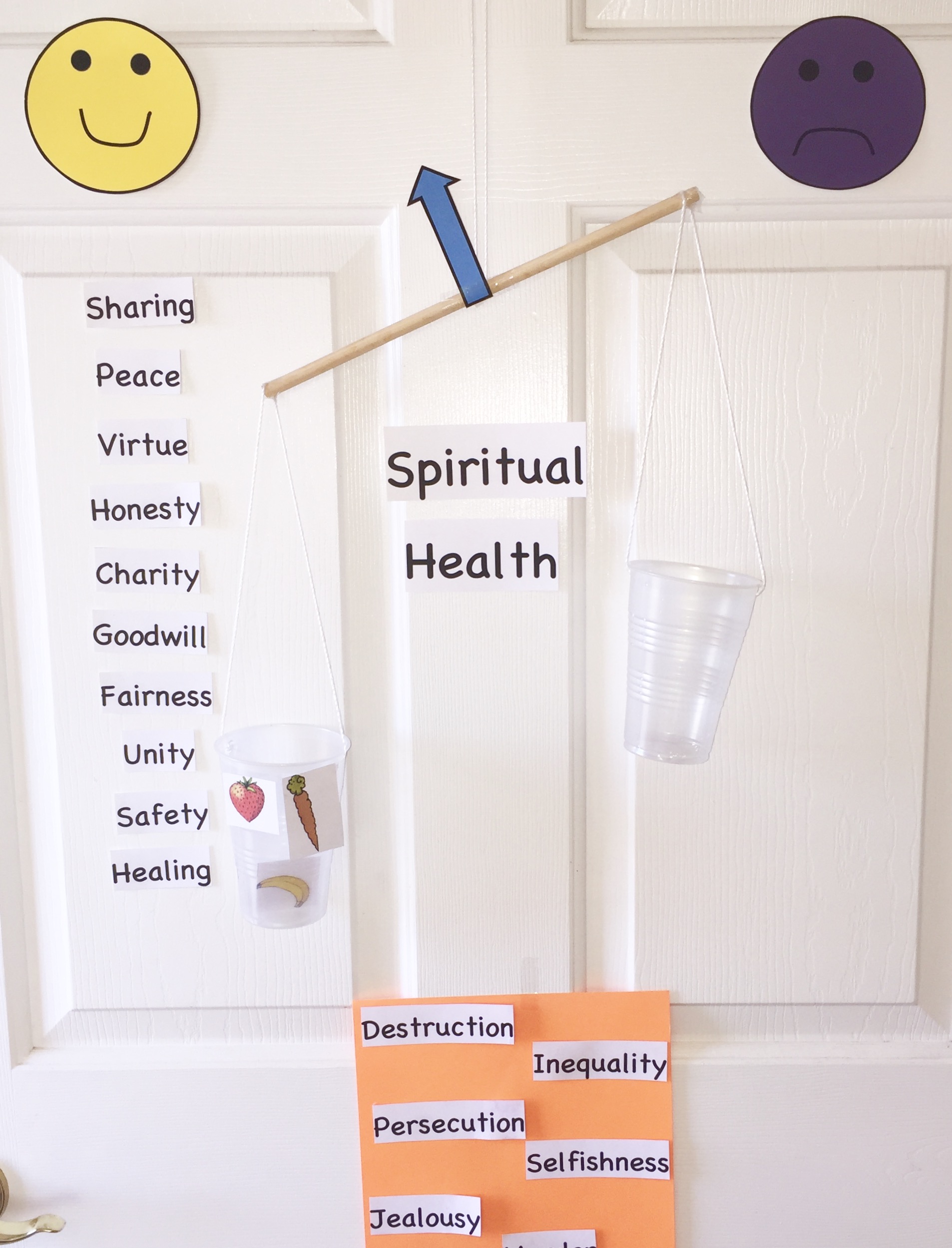
  • Measuring scale assembly instructions: Punch two holes beneath the top edge of each plastic cup (the holes should be evenly spaced and on opposites sides of the cup). Cut two 24 inch pieces of string. Stick one end of one of the strings through a hole on one of the cups, then stick the other end through the other hole. Tie the ends into knots. Do the same with the other cup and string. Cut another piece of string 40 inches long and tie the ends together so it forms a loop. Hang it around the center of the dowel rod and tape down the string on the dowel. Hang the top of the string loop on a door handle and make sure the dowel rod sits evenly. Make adjustments if needed. Loop each cup’s string over an end of the dowel rod and tape down the string on the dowel. The scale should sit evenly. Once again make adjustments if needed.
  • Print and cutout all the signs. Tape the end of the arrow to the center of the dowel rod so the arrow points up. Using tacky wax, attach all the small words to the cardstock in random order.
  • Print one crossword puzzle for each person in the class. Print and cut out some healthy food items and some junk food items (from clipartix). Print the scripture story pictures or display them on an electronic device.
  • Before class starts, hang the scale on a clip or tack at the top of the board. Attach the sign “Health” in-between the cups on the scale. Attach the smiley face to the left of the scale and the sad face to the right. Put the cup of water and the food colorings in the clear glass bowl to help protect against spillage.

Attention Activity

Show the children the scale. Explain that our physical bodies need the nutrients that are found in healthy food choices in order to sustain good health. Add pictures of healthy foods to the left cup, and the scale arrow will point to the smiley face which represents good health.

  • What happens if we decrease the amount of healthy foods we eat (take off the healthy foods) and increase our consumption of junk food like candy bars, chips, soda, (put these items in the right scale cup)? (Good health could decrease.)

Explain that just as our bodies need proper nourishment to be healthy and strong, our spirits also need proper nourishment to be healthy and strong. (Put the sign “Spiritual” above the health sign, and take off the junk food items from the scale.)

  • What does our spirit need in order to be healthy and strong? (Spiritual food such as scripture study, prayer, church attendance, etc.)

Scripture Story

(Show the children the story pictures as you tell the story.

  1. Explain that after Jesus departed from the Nephites, the disciples continued to teach the people, and within a few years all the people in the land were converted to the Lord.
  2. The people listened to the disciple’s teachings. They repented and were baptized, and they received the Holy Ghost. Their spirits were nourished. (Write the things they did to nourish their spirits on the healthy food pictures. Tape them on the left scale cup as you mention each item.)

Have the children look up 4 Nephi 1:12 to find out what other ways the people nourished their spirits. (Have the children write the items they find on the healthy food pictures and put them in the left cup.) (They kept the commandments, fasted, prayed, and they attended church to hear the word of God.)

Explain that when our spirits are strong and nourished we tend to make righteous choices, and making good choices helps our happiness levels increase. Explain that because the Nephites nourished their spirits and were committed to following Jesus’s teachings, their happiness level increased. According to 4 Nephi 1:16 there never was a happier people.

Activity

Show the children the cardstock with the words on it. Have them take off the words they associate with happiness and put them under the smiley face. Then hand out a crossword puzzle and a pencil to each child. Have the children take turns reading the clues and finding the word on the board that matches the clue. Put a check mark next to the word if it is the correct word. Have the children write the answer in the correct spot on their crossword puzzle. Explain that the clues and words tell us what the Nephites experienced as a result of living the gospel of Jesus Christ.

(See the following answers for discussion ideas on some of the words.)

Activity Answers

Fairness/Every man did deal justly one with another.

Sharing/They had all things common among them. (There were no poor.)

  • What does it mean that the people had “all things common among them”? Each person gave the extra he produced (crops, flocks, etc), and this extra was used for those who were in need of help.

Healing/All manner of miracles did they work.  (Read 4 Nephi 1:5)  The miracles included healing the lame, the blind, the deaf, and raising the dead.)

Peace/There were no contentions, strifes, or tumults in the land.  (Meaning there was no fighting, arguing, riots, or war.)

Charity/The love of God … did dwell in the hearts of the people.

Goodwill/There were no envyings.  (There was no jealousy. There was only gladness that others were blessed.)

Honesty/There were no … lyings.

Safety/There were no robbers or murderers.

Virtue/There were no whoredoms nor any manner of lasciviousness (crude behavior). (The people were chaste and clean.)

Unity/ There were no divisions of race or class. (There was no manner of “ites.” The people were no longer divided into Nephites and Lamanites but were united.)

Help the children understand that each one of the clues in the crossword puzzle relates to how we treat people. Help them see that the most important key to happiness is how we treat others. When we live the gospel, we treat each other with love and kindness, and as a result we enjoy greater peace and happiness in our lives.

Scripture Story Continued

3) The people were blessed in all their doings because of their righteousness. They prospered and built cities. They were strong and multiplied. The people lived in peace for many years. After nearly 200 years, two generations had passed on, and the people had multiplied and had spread out over all the land.

4) Then sin slowly started creeping into the land again.

Object Lesson

Show the children the glass of water, and put one drop of blue food coloring into the water. Have the children watch it spread throughout the glass and observe how quickly one little drop spreads. Explain that if people allow themselves to be exposed to a little sin, it can quickly grow and spread if left unchecked. We need to be careful about what we allow into our thoughts and lives.

4) The people had become very rich because of their prosperity in Christ, and they began allowing pride to take a hold in their lives. (4 Nephi 1:23-24)  The people began to wear expensive clothing, jewelry, and other fine things of the world. From that time forth the people did not have their goods and their substance common among them. (4 Nephi 1:25)

President Dieter F. Uchtdorf said this about pride: “At its core, pride is a sin of comparison, for though it usually begins with ‘Look how wonderful I am and what great things I have done,’ it always seems to end with ‘Therefore, I am better than you.’

The people began to focus on themselves instead of helping others. (Put the words “selfishness” and “poverty” on the right side of the board. Do the same for the italicized words as they are mentioned below.)

Have the children read 4 Nephi 1:26-27 & 29 to find the ways pride and sin began to spread. Put a different colored drop of food coloring in the water for every item mentioned. (The water should turn brown.)

  • They once again began to be divided into social classes. (Inequality)
  • They built many different churches to themselves (not to God). The churches were built up to help people get gain (Greed). They denied the true church of Christ.
  • These churches professed to know Christ but denied most parts of his gospel. (These people were no longer nourishing their spirits with the teachings of Christ and they were becoming spiritually weaker and weaker.) (Take out the items from the left side cup on the scale.)
  • The churches became open to all manner of wickedness. They allowed the wicked to participate in sacred ordinances.
  • One of the churches denied Christ and persecuted the members of the true church of Christ because of the members’ humility and belief in Christ. (Persecution) They despised them because of the many miracles which were wrought among them. (Hate) (Jealousy)

Point out that as the people let wickedness into their lives, it spread. Have the children observe the color of the water, and explain that instead of nourishing their spirits, they filled their lives with worthless, self-indulgent thoughts, and their choice became increasingly wicked. They were filling their lives with darkness and dirt. (Put the dirt in the cup on the right side of the scale.) The choices they made resulted in misery and unhappiness for many people.

5) Among the true church of Christ were three disciples that Jesus had given power to remain on the earth until his second coming. Before Jesus Christ departed, he had asked each of his twelve Nephite disciples what they desired of him. Nine requested to speedily return to him when their ministry on the earth was complete.

6) Three of the disciples asked to remain on the earth to bring souls unto Christ. Those three became translated beings who would not taste death.

7) Those who denied Christ began to try and exercise power and authority over the three disciples. They cast them into prison; but by the power of God which was in them, the prisons were broken and they came out. They also cast the disciples into fiery furnaces and into dens of wild beasts, and from each place they came out unharmed. (4 Nephi 1:30, 33)

  • Why didn’t the people repent, realize their mistake, and change their ways after seeing these mighty miracles of God? (Their hearts were set upon wickedness. They wanted to do all manner of iniquity.) (4 Nephi 1:34)

The people dwindled more and more in unbelief and wickedness from year to year. Point out that the people had been given the wonderful blessing of the gospel. Show the children the butter mints and explain that they represent gospel blessings. Give each child a couple of mints to eat. Point out how sweet and wonderful they are. Put two mints in the water near the side of the glass so they are visible to the class. Ask the children to watch what happens to them in the dirty water. (They will dwindle away and disappear.) Explain that the Nephite’s faith and blessings dwindled and wasted away as the people increased in wickedness.

8) Once again the people began to divide into different groups of “ites.” Those who did rebel against God were called Lamanites, Lemuelites, and Ishmealites. They did teach their children that they should not believe. The children were taught to hate the children of God, just as the Lamanites had taught their children to hate the Nephites. The wicked grew in numbers and became more numerous than the people of God. The more wicked part of the people began again to build up the secret oaths and combinations of Gadianton. The robbers of Gadianton spread over all the land. (4 Nephi 1:34-39) (Add “Theft” and “Murder” to the right side of the board.)

9) Eventually, even those who were called the people of Nephi began to be proud in their hearts because of their exceeding riches, and they become vain like unto their brethren the Lamanites. (4 Nephi 1:43) After three hundred years had passed from the time of Christ, both the Nephites and the Lamanites had become exceedingly wicked.

Conclusion

Explain that just as our bodies feel miserable and sick when we are unwell, we can experience misery and unhappiness in our lives when our spirits are not strong and healthy because we tend to make choices that lead to unhappiness. In the next lesson we will learn about the increasingly terrible and sorrowful things that occurred among the Nephites because of the poor choices they made as a result of allowing wickedness into their lives. (Put the words “War” and “Destruction” on the right side of the board.)

Point out the lists under happiness and unhappiness and ask the children which they would prefer. Remind the children that if they desire to live lives filled with the blessings of happiness and peace, they must strive to follow the Savior and his teachings. Remind the children that the gospel of Jesus Christ teaches us how to make good choices that lead to happiness.

Weekly Reading Assignment

Remind the children to do their scripture reading assignment for this week: 3 Nephi 28:1-9 &  4 Nephi 1:1-18, 2346


Lesson 37: Jesus Christ Teaches the Nephites to Pray

Posted on
image

Lesson 37

Jesus Christ Teaches the Nephites to Pray

Preparation

  • Items needed: chalk and eraser, several small popsicle sticks broken in half (or cut pieces of cardboard), tape, sticky wax, and one cardstock page. Optional: two small toy cars, one poster board.
  • Print the story pictures (or use a laptop or tablet to display the pictures at the appropriate times). Number the pictures in the order they were printed.
  • Print the neighborhood pictures. Cut out the cul-de-sac and the one-way road.
  • Before class starts, post the neighborhood pictures on the board or on a poster board (see the picture above for how they should be posted). The spaces between the pictures are the roads, but you may want to draw in cross walks, train tracks, etc.
  • Print and cut out the road signs, the warning signs, cars, and the boy figure. Glue or tape each road sign to a popsicle stick half. Using sticky wax, attach the road signs to the map in the locations indicated. Attach the red warning signs to a piece of card stock with sticky wax. Glue the matching cars together, back to back. Attach stick wax to each car.

Attention Activity

Show the children the neighborhood map. Point out the street signs, and ask what would happen if someone didn’t obey those directions. Demonstrate what might happen using the toy cars or the car pictures. Be sure to point out the dangers and the safety issues, and point out the benefits of observing and obeying street signs. Explain that just as road signs warn us of physical danger, help keep us safe, and help direct us towards the right ways to go, we have been given a special gift in our lives that gives us guidance and direction and helps keep us spiritually safe.

  • What is the special gift we have been given that warns us of spiritual danger and guides us towards the right ways to go so we can return safely home to Heavenly Father? ( The gift of the Holy Ghost ) (You may wish to relate the Holy Ghost promptings to some of the street signs such as “wrong way,” “stop,” “do not enter,” etc.)
  • What could happen if we don’t listen to the promptings of the Holy Ghost? Just like ignoring road signs may put us in harm’s way, if we ignore the Holy Ghost we may find ourselves in spiritual danger.

Explain that in today’s lesson they will learn about the importance of seeking for and obeying the promptings of the Holy Ghost in order to be directed safely back to our heavenly home.

Scripture Account

(Using the visual aids, tell the following story.)

After the Savior completed his first visit to the Nephites, the news of his visit spread among the people all that night. (Point out that the events discussed in previous lessons about the Savior visiting the Nephites all took place during one day.) Before leaving, Jesus had told the Nephites he would return and visit again the following day. Many people strove through the night to be at the place that he would appear (picture #1). Because the group that had gathered was so large, the twelve disciples divided the multitude into twelve groups. They taught the people to kneel down and pray to the Father in the name of the Son (picture #2). After praying, the disciples taught the people the words Jesus had spoken the day before. After instructing the people, they knelt again and prayed to the Father in the name of the Jesus.

Point out that the disciples (the twelve apostles Jesus had selected) prayed before the instruction and after it. Ask the children to think about why the disciples did that as they listen to the next part of the lesson.

Invite a child to read 3 Nephi 19:9 aloud as the class follows along. Tell the children to look for what the disciples prayed for. (The Holy Ghost)

  • Why did you think the disciples sought to be blessed with the Holy Ghost? The disciples knew the Holy Ghost could guide them and help them in their ministry. The Holy Ghost could also touch the hearts of the people they taught and help the people receive a witness of the truth of the disciple’s teachings.

After the disciples had prayed, they went down to the water’s edge and the multitude followed them. Nephi went into the water and was baptized. When he came out of the water he baptized the other disciples that Jesus had chosen (picture #3). (See lesson 33 for why they were baptized even though they had already received that ordinance sometime prior to Jesus’s visit.)  After they were baptized, the Holy Ghost fell upon them and they were filled with the Spirit and with fire. (3 Nephi 19:13–14)

Explain that the phrase “filled … with fire” is symbolic. The influence of the Holy Ghost can change the heart, purifying it by “burning away” the desire to do evil and filling it with a burning desire to do good.

After they received the Holy Ghost, the twelve disciples were encircled about as if by fire that came down from heaven. Angels came down also and did minister to them (picture #4). Then Jesus came and stood in the midst of them and ministered to them (picture #5).

Have the children look up and read 3 Nephi 19:16-17 and ask them to look for what Jesus’s first instructions to the people were after he ministered to the disciples. (He commanded the people to kneel on the earth, and then he commanded the disciples to pray (picture #6).)

  • Why do you think it is it important to pray before receiving spiritual instruction? One reason is to seek to feel the Spirit during the meeting. When we are taught by the Spirit we may gain an increased understanding and testimony about particular gospel truths, or we may get inspiration concerning a problem we are having.

As the disciples prayed, Jesus went out of the midst of them a little way off and bowed himself to the earth and thanked the Father for giving his disciples the Holy Ghost (picture #7). Jesus asked that the Holy Ghost be given to all who believed in his disciple’s words. (3 Nephi 19:19-21)

Jesus’s prayer teaches that not only should we express gratitude to Heavenly Father for our blessings, but we should also ask Heavenly Father to bless us and others with the Spirit. When we are baptized we are given the gift of the Holy Ghost, but it is up to us to invite the Spirit into our lives.

  • How do we invite the Holy Ghost into our lives? We can pray for the Spirit’s guidance. We can put effort into listening for and feeling his influence and guiding touch. We can follow his promptings.

As we prayerfully invite the Holy Ghost into all aspects of our life, he can guide us and help us avoid the things that are spiritually harmful– those things that will cause us pain and misery.

Jesus taught, “Verily, verily, I say unto you, ye must watch and pray always, lest ye be tempted by the devil, and ye be led away captive by him…for Satan desireth to have you, that he may sift you as wheat.”(3 Nephi18:18)

  • How can we pray always? To pray always means we can have a prayer in our hearts at any time or place. (3 Nephi 20:1)
  • What do you think the phrase “Satan desireth to have you, that he may sift you as wheat” means? Elder Bruce R. McConkie explained these words: “This is an… expression which was clear to the people in that day, more so than to people in our day. In essence… Jesus is saying… Satan wants you in his harvest. He wants to harvest your soul, and bring you into his granary.” He wants us to be under his control and influence.

Jesus said that if we are watchful (on guard or spiritually alert) and keep a prayer in our hearts, we can avoid getting drawn into the traps of Satan.

  • How can we be watchful? If we are familiar with the word of God that is found in the scriptures and in the words of the prophets, then we will know what is right and we will know what things to watch out for.  We can also be spiritually alert in listening for the promptings of the Spirit. The Spirit can warn us through thoughts or feelings if something is not right and is something we should not do.  The Spirit can also help bring to remembrance those things we have learned in the scriptures about what is right.

Do the following activity to help the children see how the Holy Ghost can bring to remembrance scriptures we have read in order to help guide us and warn us.

Story Activity

Remind the children of the map activity at the beginning of the lesson. Explain that you are going to tell them a story using the map. Show the children the signs and explain that they will be choosing a sign at certain points in the story. The signs represent warnings or guidance the Holy Ghost may give to help us go in the right directions.

(Put the figure of the boy on the board at “Jonathon’s house,” and move the figure during the story to each new location.)

Jonathon began his day as usual by reading his scriptures and saying his prayers. He asked Heavenly Father to help him to not make wrong choices.

During breakfast, Jonathon’s sister took the last piece of bacon that he had been reaching for, and she had already had more than him.

  • Which sign represents guidance the Holy Ghost my prompt Jonathon with? (Avoid contention) Jonathon remembered his prayer and a scripture he had read that contention is of the devil, and he didn’t lose his temper with his sister like he usually would have. The Holy Ghost helped him remember his prayer and the scripture he had read.

After breakfast, Jonathon took the bus to school. When he arrived he sat at his desk next to his friend Stewart. The teacher started the day by handing them their graded tests. Stuart asked Jonathon what he had gotten on the test. Jonathon hadn’t studied very hard for the test, and his low score reflected that. He was embarrassed to tell Stuart what his score was. He said a prayer in his heart to help him know what to say.

  • Which sign represents something the Holy Ghost might prompt Jonathan with? (honesty) Jonathon was honest and told Stuart he hadn’t done very well, but that he planned to study hard and do better on the next test.

The rest of the school day Jonathon continued to be watchful and to be careful to choose the right. After school, Jonathon went to play at Jared’s house. Jared’s mom wasn’t at home. Jared showed Jonathan his parent’s liquor cabinet and then said they should try a sip just to see what it tastes like.

  • Which sign represents something the Holy Ghost might prompt Jonathon with? (Avoid strong drink) Jonathon remembered a lesson and a scripture he had heard in Primary about the Word of Wisdom. He explained to Jared that he did not want to drink alcohol, and he explained why, and then he suggested something else they could do instead.

After playing at Jarod’s house, Jonathon went with his mom to the library to get some books. His favorite books were action adventure stories. He found a book that looked interesting, but when he flipped through some of the pages he realized it had some inappropriate language in it.

  • Which sign represents guidance the Holy Ghost my prompt Jonathon with? (Swear not) Jonathon felt yucky when he read the words in the book. He knew that reading the book would not be a good choice because he didn’t want those types of words in his thoughts, so he picked out some other books instead. The Holy Ghost had warned him through his feelings and thoughts.

After the library, Jonathan and his mom stopped by the neighborhood market to pick up some things for dinner. At the market, Jonathon asked his mom if he could get some cookies. She said no, but Jonathon thought that if he put them in the cart maybe his mom might go ahead and get them.

  • Which sign represents the warning the Holy Ghost my prompt Jonathon with? (obey parents) Jonathan realized that Satan was trying to tempt him to be disobedient, so he put the cookies back on the shelf.

Jonathon’s day had been full of times when Satan had tempted him, but he had been prayerful, watchful, and on guard against temptation, and because he listened to the promptings of the Holy Ghost, he was able to avoid going in wrong directions that would have led to spiritual harm and unhappiness.

Prayer was one of the safeguards Jonathon took. He said a prayer in the morning and he said a prayer in his heart and mind during the day when he needed additional help with specific problems.  As we continue with the next part of the scripture story we learn about something important that should be included in our prayers.

Scripture Account Continued

When Jesus had finished his prayer, he went to the disciples and he found them praying without ceasing. In 3 Nephi 19:24 it says: “they did not multiply many words for it was given unto them what they should pray.”

  • What does this scripture mean? Elder Bruce R. McConkie explains: “Perfect prayers are those which are inspired, in which the Spirit reveals the words which should be used.” The Holy Ghost can guide us to what we should pray for.
  • How can this help us resist temptation? The Holy Ghost can help us see areas in our life that need improving, areas where we are weak. He can help us know what to pray for, such as for help with changes we need to make and help to know how to strengthen our defenses.

When Jesus saw his disciples praying with the Spirit, “his countenance did smile upon them, and the light of his countenance did shine upon them, and behold they were as white as the countenance and also the garments of Jesus.” (3 Nephi 19:25)  The word countenance refers to a person’s behavior or to the way a person’s face expresses his or her character.

Jesus went a little way off and bowed himself to the earth again (picture #8) and thanked the Father for purifying his disciples, and he prayed for them and for those who would believe in their words that they would also be purified through their faith. (3 Nephi 19:28)

As we pray in faith and seek for and obey the promptings of the Holy Ghost, our lives can be purified, and we will be able to return safely home to our Heavenly Father.

Weekly Reading Assignment

Remind the children to do their scripture reading assignment for this week: 3 Nephi 18:18–25, 3 Nephi 19:1-36, and Alma 13:28–29

***(Note: Be prepared to explain the scripture 3 Nephi 19:18 if needed: “After Jesus had commanded the Nephites to kneel and pray, they prayed to Jesus calling him their Lord and their God.”)

Jesus had specifically  taught the people the day before to pray to the Father  in Jesus’s name, but in this unique instance the disciples prayed to Jesus Christ because he was with them in person as a representative of the Father (see 3 Nephi 19:22)

(The neighborhood pictures are based off a coloring page from the Crayola website.)


Lesson 36: Jesus Christ Gives the Sacrament to the Nephites

Posted on

image

Lesson 36: Jesus Christ Gives the Sacrament to the Nephites

Preparation

  • Items needed: A tray full of items that help people remember things (such as family pictures, a CTR ring, a finger string loop tied in a bow, a journal, a planner, a calendar, sticky notes, a notebook, etc.), a cloth to cover the tray, chalk and eraser, and a few rolls of clear tape. You will also need the following for each child: one small Ziplock baggie, two pieces of eight inch long ribbons or string, a piece of paper, a pencil, and a Book of Mormon.
  • Print the visual aids (or show them to the children using a tablet or laptop).
  • Print the game items onto heavy paper and cut them out. With an exacto knife, slice though each set of dotted lines on the sacrament tray so it has five slits.
  • Sacrament Book instructions: For each child, print one copy of the Sacrament Book pages (colored or black and white) onto heavy paper (also make one extra copy to use as an example). Cut out the answer pages by cutting straight across the dotted lines (you should only need to make two cuts per page using a paper cutter.) Turn the pages so they all face the same direction and then stack them together in numerical order. Hole punch the left side. Cut out each of the questions. Put one set of booklet pages and one set of questions in each baggie. Assemble one book to use as an example by loosely tying the pages together with the ribbons through the punched holes, and then by putting each question on top of its matching answer and taping down the left side edge of each question.

Attention Activity

Show the children the tray of items. Uncover it and ask the children what the items on the tray are used for. (They are used to help people remember certain things or important events.)

Cover the items back up. Hand out a piece of paper and a pencil to each child. Ask the children to write down all the items they saw on the tray without discussing it with each other. Uncover the tray and let them check their lists. Most likely the children won’t have remembered some of the items. Point out that we sometimes forget things in life, but Heavenly Father wanted us to always remember a very important event, so an ordinance was instituted to help us remember it. Tell the following story and see if the children can guess what important event the story represents. Before telling the story, write on the board what the items in the story represent: roots/temptation, river/sin, rescuer/Jesus Christ.

Story

A certain man, desiring to enjoy the beauties of nature, went for a woodland stroll by the side of a flowing river. Deep in thought about the magnificence of God’s handiwork, he didn’t see the tree roots jutting out near the water’s edge. He stumbled and fell headlong into the river. The water was deep, and the man couldn’t swim! He cried out. But who will hear me? he wondered as the water engulfed him in darkness. He surfaced and shouted again, but his hopes dimmed as he sank for the second time. His call was much weaker as he rose one more time, and he thought, No one can hear me now!

But someone did hear his cries, dived into the water, and brought him safely to the bank.

When the drowning man recovered, he looked up into the face of his rescuer and said, “Oh, thank you! Thank you for saving me. What can I do to show my love and appreciation?”

Then a sad thing happened. Although the man who had been saved lived, his rescuer died as a result of his exertion during the rescue.

Before the rescuer died, he explained that he wanted the man to live a wonderful life of doing good deeds so that the sacrifice of his life would not be in vain. (Elder Derek A. Cuthbert Adapted from a Brigham Young University devotional address, May 19, 1981.)

  • What important event does this story represent? (The Atonement of Jesus Christ.) Explain that the man’s rescuer represents Jesus Christ who gave his life for us so that we may repent of our sins and be saved. We show our love and appreciation for the Savior by doing what he has asked us to do.
  • What ordinance did the Savior institute upon the earth to help remind us of his sacrifice and of our baptismal promise to do the things he has asked us to do? (The sacrament)

Scripture Account

When Jesus was on the earth, he first instituted the sacrament in Jerusalem during what was known as the last supper. (Show picture #1) When Jesus visited the Nephites he instituted the sacrament at the conclusion of his first day among them. He commanded his disciples to bring forth some bread and wine. (In latter days we do not use wine as part of the sacrament for many reasons. The Lord declared “that it mattereth not what ye shall eat or what ye shall drink when ye partake of the Sacrament, if it so be that ye do it with an eye single to my glory-remembering unto the Father my body which was laid down for you, and my blood which was shed for the remission of your sins.” D&C 27:2)

When the disciples returned with the bread and wine, Jesus broke the bread and blessed it and then gave it to his disciples and commanded that they should eat. (Show picture #2) They ate and were filled. (3 Nephi 18:4) One of the meanings of “filled” is to be filled with the Holy Ghost. When the disciples (meaning the twelve apostles) were filled, Jesus commanded them to give the sacrament bread to the multitude. After the multitude had partaken of the bread, Jesus commanded his disciples that they should drink of the wine, and that they should also give the wine to the multitude that they might drink of it. After the disciples and multitude had drank of the wine, they were filled.

Jesus explained to the disciples that they should always observe the sacrament ordinance.

The symbolism in the sacrament ordinance reminds us of the atonement Jesus made for us. For example, the cloth covering the sacrament is symbolic of the cloth that Jesus was covered in when he was laid in the tomb. (Show picture # 3) When Jesus instituted the sacrament among the Nephites, he explained what the bread and water represent. He also discussed the covenants that we are renewing when we take the sacrament. Remind the children that a covenant is a two-way promise.

Tell the children that they are going to play a game that has questions and answers in it concerning Jesus’s teachings about the sacrament. (Make sure each child has a Book of Mormon.)

Game

Show the children the game items. Point out the scriptures on the cups. Explain that you are going to read a question, and they will have to figure out which scripture has the best answer in it. If a child thinks they have found the correct scripture, have them raise their hand and share the reference with the class. The other children have to agree that it is the correct scripture. If the child is correct, that child reads the scripture out loud, answers the question, and then puts the cup into the tray. Once a child has had a turn, they can help someone else find the correct scripture. Be sure to discuss the answers after each correct response. On the last question, have the person who raises their hand first with correct answer put the cup in the tray.

Game Questions and Answers

1. What does the broken bread remind us of?  (3 Nephi 18:6-7) Jesus’ broken and bruised body.

2. What does the wine (water) represent? (3 Nephi 18:9,11) Jesus’ blood that was shed for us.

When we partake of the bread and water we are committing to remember the atonement and make it part of our lives, repenting when we make mistakes.

3. Who receives the sacrament? (3 Nephi 18:5) All who are members of the church. (Point out the word “baptized” in the verse.)

Why should you be a member in order to receive the sacrament? Explain that when a person is baptized, he makes special covenants. The sacrament is a time to review and renew those baptismal covenants (make those promises again). (Little children can also take the sacrament as preparation for the future covenants they will make.) During the sacrament we should also be reviewing our actions for the week, repenting of wrong doings, and committing to do better. When we do this we can become clean again like at baptism.

4. When members of the Church partake of the sacrament what are they witnessing to Heavenly Father? ( 3 Nephi 18:10-11) That they will keep the commandments (renewing our baptismal covenants), and that they will always remember Jesus.

5. What are we blessed with when we always remember Jesus? (3 Nephi 18:7) We are blessed to have his Spirit to be with us always. This is a great blessing because the Holy Ghost can give us guidance and help with the difficult challenges and temptations we face in life.

Followup Questions:

  • Why is it important for us to always remember Jesus? When we remember Jesus, we remember the things he did for us. We remember his love for us, and we remember the things he taught. When we remember those things, our faith and love for Jesus grows and our desire to keep his commandments increases.
  • How can we remember the Savior during the week so that we can have his Spirit to be with us? We can remember to express our gratitude for Jesus in our prayers. We can read the scriptures daily to learn of His life, ministry, and teachings. We can strive to live what he has taught and keep his commandments.

Sacrament Book Activity

Show the children the baggies and explain that they are each going to make a flap book that can be read each week as they prepare to take the sacrament. The books will help remind them of the purpose of the sacrament. (A flap book has a question on the flap and the answers under the flap.)

Give each child one of the baggies containing the Sacrament Book pages. Have the children sit on the floor and put their pages in front of them. Explain that they need to match the eight questions with the eight answers. Have them put the question on top of its matching answer. After they have made their matches, read your example copy to them so they can check their answers. Have them fix any that are incorrect, and then give them pieces of tape to attach to the left edge of each of the question cutouts to make flaps that cover each answer. Have them stack their pages in numerical order. The pages that say “I will remember Jesus” go at the end of the book. Give each child two pieces of ribbon or string and have them tie together their pages through the holes. Point out the last few pages and explain that during the week they can draw or glue pictures of things they remember about Jesus on those pages. This will help them remember Jesus throughout the week. They can even add more pages if they desire.

  • What are some aspects of the Savior’s life and ministry that they might be included on the blank pages of the books? Jesus’s death and atoning sacrifice, his humble birth, his miracles, his teachings, his loving care towards others, etc.

Conclusion

The Savior taught that if we partake of the sacrament, always remember him, and keep his commandments then our lives will be built upon his rock, which is a solid foundation. But if we do not do these things then our lives are built upon a sandy foundation. (Show the picture of the castle on the sand.)

  • What will happen to the castle when the rain descends, and the floods come, and the winds blow and beat upon it? It will wash away into the dark, deep ocean.
  • What happens to us if our lives are not built upon a solid, safe foundation and the storms of life such as adversity and temptation come upon us? If our spiritual foundations are not firm and safeguarded then we can fall into the deep, dark depths of misery and hell. (3 Nephi 18:12-13)

Remind the children that the Lord wants us to live wonderful lives doing good and righteous works so that we can be happy on earth and someday gain eternal life. The sacred sacrament ordinance reminds us of our Savior and of his sacrifice and love for us. It is also a reminder to make the Atonement part of our lives and to keep our covenants so that we may return to live with Jesus and Heavenly Father again.

Weekly Reading Assignment

Remind the children to do their scripture reading assignment for this week: 3 Nephi 18:1–14


Lesson 35: Jesus Christ Heals the Sick and Blesses the Children

Posted on

FullSizeRender (6)

Lesson 35

Jesus Christ Heals the Sick and Blesses the Children

Preparation

  • Items needed: a marker or pen for each child, tape, magnets, a highlighter marker, thread or string, and several pieces of red or pink paper.
  • Print and cut out the visual aids pdf or word.
  • Directions for making the envelope and heart visual aid: Cut the thread into two, 20 inch lengths. Place the first page of cut out hearts face down in two rows in the same order as they were laid out on the page. The hearts should be about 1 ½ inches apart. Place one string on row one with the end of the string in the middle of the bottom heart. Put a piece of tape over the string on each heart so each heart is attached to the string. Do the same thing with the other row of hearts and string. Add the heart labeled “listens” to the top of row one. You should end up with a piece of string at the top that is four inches long on row one and five and half inches on row two. Using an x-acto knife, cut along the dotted line on the envelope. Tape the top of each string to the back of the envelope, each about two inches from a side. Put the string of hearts through the envelope opening you cut. Glue or tape the back edges of the envelope to a piece of heavy paper, leaving the top of the x-acto cut edge open. You should now have an envelope pocket. Stack the rows of hearts in order, and put the two stacks into the envelope.
  • Mobile Handout: Print (or copy) and cut out an envelope for each child. Cut two pieces of string, 13 inches long, per child. Cut out eight hearts per child by folding several pieces of pink or red paper into thirds lengthwise, then placing half of a blank heart along the folded edge, and finally cutting out the hearts using the half a heart as a pattern (or you can purchase precut packages of hearts).
  • Print the word search onto colored paper.
  • Optional: prepare the salt attention activity found here.

Attention Activity

  • In what ways do your mother and father show they love you? (They make rules to keep you safe. They help you and teach you. They give you hugs and kisses. Some parents may even write notes telling you how much they love you.)

Point out that people show love through their actions. Show the children the word search and have them find the words that are actions of love. (All the words are horizontal.) When a child finds a word, have that child come up and mark it with a highlighter or circle it with a pencil.

Word Search Answers: ATTENTIVE, TEACHES, CONSIDERATE, CONCERNED, PRAYS, SACRIFICES, PATIENT, LISTENS, HELPS, SUPPORTS, COMFORTS, FORGIVING

Put the envelope on the board with the opening facing downward. Explain that in today’s lesson they will learn about the love the Savior has for them. Point out that each of the action words in the crossword puzzle has been demonstrated by the Savior in our behalf. Jesus’s loving actions are like messages that remind us that he loves us.

Scripture Account

Put the flannel board image of Jesus on the board, and remind the children that in last week’s lesson they learned that Jesus taught the Nephites the beatitudes. As he prepared to leave at the end of the day, he perceived that the people did not fully understand what he had taught. Have a child read 3 Nephi 17:1–3 as the other children follow along. Have the children look for what the Savior told the Nephites they should do in order to gain more understanding.

  • What does it mean to ponder? (It means to thoughtfully consider something and deeply think about it.)

Point out the Savior’s instruction found in 3 Nephi 17:3 that the Nephites should “prepare [their] minds for the morrow,” for when Jesus would return to teach them again.

  • How do you prepare your mind for an important lesson such as a school assignment? You read and learn about the subject, you ponder on (or think about) what you have been taught in order to understand it more thoroughly, and you may even ask for help from a parent to help you understand it further.
  • What happens if you don’t prepare for an assignment by doing these things? (You may not properly understand the material.)

It is the same with the gospel; in order to understand the gospel we need to think about what we have been taught, study it thoroughly, and ask our Heavenly Father for help in understanding it. Through the Holy Ghost our minds can be enlightened and we can receive understanding. When we understand a concept better then we are ready to learn more and add to our understanding and knowledge.

  • In the scripture that was just read, what did the Savior do to show his love for the people? (He wanted the people to understand the things he had taught so they could progress spiritually.)

The Savior has taught us many things. These teachings can be found in the scriptures. Someone who loves us teaches us the things that will help us in life. (Take the heart out of the envelope that says “teaches.” It will be the first one in the pile on the left.)

  • Have a child read 3 Nephi 17:4-5, and then ask the children how the Nephites responded when the Savior expressed his intention to depart. (They wept and were sad. They wanted him to stay longer.)
  • Have a child read 3 Nephi 17:6-8. Ask the children how the Savior responded when he saw the Nephite’s sorrow. (He had compassion upon them and asked if they had any sick or afflicted among them. He explained that he would heal them because he had perceived their desire to have the miracles shown to them that he had performed in Jerusalem. He also perceived that they had the faith to be healed. )
  • How did the Savior demonstrate his love for the people? (He was filled with compassion for them. Compassion means he cared about their feelings. He was filled with sympathy and understanding.)

A person who loves us is considerate of our feelings. (Have a child take the heart out of the envelope that says “considerate.” It will be the first heart in the pile on the right.) (Alternate drawing from the left and right when the remaining hearts are mentioned.)

Have a child read 3 Nephi 17:9. Afterwards, put the picture of the sick and afflicted Nephites on the board.

  • What types of ailments did Jesus heal? (The lame (those unable to walk), the blind (those unable to see), the dumb (those unable to speak–which was most likely due to deafness))
  • What types of ailments might be included in afflictions of “any manner”? (All other types of physical illnesses and disorders, but also mental and emotional difficulties and disorders.)

Ask students to ponder ways in which they may be “afflicted” and what they would ask the Savior to heal if he were to bless them personally. Remind them that even though the Savior is not here to minister to them in person, his power to bless and heal is available through the priesthood. If it is his will that they be healed, and if they have faith, then they can be healed. If it is not his will, then we need to trust in the Lord and his purposes, but we also need to remember that the Lord will help us deal with the affliction if we ask for his help.

Point out that someone who loves us will be there for us when we have problems and difficulties. That person would offer comfort, support, and help. (Have children take the hearts out of the envelope that say “comforts”, “supports”, and “helps.”  Remember that they alternate from left to right and then back to left again.)

After Jesus Christ healed the sick, he had the children brought to him. He had the people gather around them and kneel.  He then said a prayer that was so wonderful and marvelous that the people could not even describe it. (Read 3 Nephi 17:14-17) (Optional: Do the salt object lesson.)

The hearts of the people were filled with joy when they heard the words that Jesus prayed to the Father in their behalf.

Point out that someone who loves us will pray for us. They will appeal to Heavenly Father for His help in watching over us, protecting us, and guiding us. (Have a child take the heart out of the envelope that says “prays.”)

After Jesus arose from his prayer, he noticed that the people were overcome with joy. The great faith of the multitude filled him with such joy that he wept.

A person who loves us is filled with joy when we make good choices; but they can also be filled with sadness when we make bad choices. Remind them that Jesus groaned inside himself because of the wickedness of the people of Israel. Explain that those who love us are concerned about us. They want us to make good choices. (Have a child take the heart out of the envelope that says “concerned.”)

After Jesus wept, he took the children one by one and lovingly blessed them and prayed to the Father for them. He tenderly took time for each individual child because of his great love for children.

  • Someone who loves us will share their time with us. They will pay attention to us and listen to us. (Have children take the hearts out of the envelope that say “attentive” and “listens.”)
  • How would you feel if Jesus Christ held you in his arms, blessed you, and prayed to Heavenly Father for you?

After blessing the children, the Savior told the people to look upon their little ones. The heavens opened and angels descended out of heaven and encircled the children. It appeared as if they were in a midst of fire. (Put the picture of the children on the board.) The angels ministered unto the children. The heavenly attention bestowed upon the children of the Nephites is further evidence of the special love Jesus has for children.

Ask the children if they can think of any other things Jesus has done that shows his great love for us. Have them look at the word search to get ideas, but they must explain how Jesus demonstrated that action. For example, Jesus demonstrated sacrifice by suffering and paying the price for our sins. Write on the blank hearts any other actions the children think of that are not included in the word search. Have the children then attach these hearts to the board with magnets or tape, making a pile underneath the other hearts.

Knowing that Jesus loves us helps us to have faith and trust in him. Because he loves us, we know that he wants what is best for us. He wants the things for us that will bring us eternal happiness and peace. If we have faith in Jesus and keep his commandments then we can someday live with him and Heavenly Father. again. One of the greatest joys is being able to be with the people we love and with those who love us.

Handout

Have the children make their own mobile with the blank hearts you have prepared. Hand out an envelope, a set of eight hearts, and a marker or pen to each child. Have them write eight of the ways Jesus has shown love for them on their hearts, and then have them tape the hearts to the string and tape the top of the string to the envelope opening. Remind the children that each heart is like a message from Jesus that reminds them that he loves them.

Weekly Reading Assignment

Remind the children to do their scripture reading assignment for this week: 3 Nephi 17:1-25


Lesson 34: Jesus Teaches the Beatitudes

Posted on
image

Lesson 34

Jesus Christ Teaches the Nephites the Beatitudes

Preparation

  • Items needed: a pencil for each child, five pieces of cardstock and several pieces of white paper, scriptures for each child, strong magnets or tape, scissors, sticky tack, small ziplock baggies or envelopes, a small container of salt mixed with dirt, and a small container of regular salt. Optional: cooked pasta
  • Print the visual aids. Fold each of the first six pages in half along the fold line. Tape together the folded pages along the edges (in the order printed) so they make one long line of figures with the picture of Jesus at the beginning.
  • Cut apart the pattern labels. Using sticky tack, attach the head labels to a piece of cardstock in random order. Do the same thing with the body labels. Cut out the jewels and attach them to another piece of cardstock using sticky tack.
  •  Cut apart the Law of Moses/Law of the Gospel strips on the lines. Attach the title strips to the top of a piece of cardstock. Using sticky tack, attach the rest of the strips to another piece of cardstock in random order.
  • Fold a white piece of paper into three even sections. Place the small paper doll pattern on top of the folded paper; then using it as a pattern, cut out a chain of three paper dolls. Cut out four pages of paper doll chains per child. The pages can be stacked to make the cuts. Tape the figures together so you have 12 dolls in a row. Fold each of the doll chains and place them into a baggie or envelope.
  • Print or copy one page of the black and white jewels and labels handout for each child.
  • Print the lesson pictures, or use a computer laptop or tablet to show the images to the children.

Attention Activity

Give a volunteer the scissors and a piece of paper. Ask him or her to cut out a perfectly shaped paper doll (without making any folds in the paper). Once the child is done, ask if it was hard to make a perfectly shaped doll that was equal in shape and size on both sides. Show the child the paper doll pattern. Ask if it would have been easier to make a perfectly shaped paper doll if the child had been given a pattern to follow.

(Read 3 Nephi 12:48) Explain that we are to strive to become like our Father in Heaven who is perfect, and we have been given a pattern to follow and instructions on how to work towards that goal.

  • What is the pattern we have been given? Our Savior, Jesus Christ. Jesus set an example for us to follow, and because the Father and the Son are one in purpose and characteristics, if we become like the Son we also become like the Father.

We have also been given instructions to follow. When the Savior lived on the earth, he taught the Sermon on the Mount (show picture). When he appeared to the Nephites after his death and resurrection, he taught them a similar sermon (show picture). This sermon gives us directions to follow towards the formation of the kind of person each of of us needs to become.

Show the children the folded up papers with the picture of Jesus on the outside. Spread out the folded papers and attach it to the chalkboard with the magnets under the words “Blessed are the…” Explain that each scripture reference comes from the sermon the Savior taught the Nephites, and each tells us a characteristic we need to develop in order to become like Jesus.

Point out the sign “Blessed are the…” on the chalkboard and explain that the beginning of Jesus’s sermon includes what is known as the “Beatitudes.” Beatitude means to be blessed or happy. Show the children the jewels, and explain that they are labeled with the promised blessings we will receive if we develop the characteristics mentioned in the sermon. Have the children read 3 Nephi 13:19-20. Explain that the temporary worldly things we might treasure on earth do not even compare to the wonderful eternal blessings our Heavenly Father has in store for us if we live righteous lives

Display the three cardstock pages that contain the head labels, the body labels, and the jewels. Explain to the children that they are going to do an activity where they will find the instructions the Savior gave, and then they will label the fold-out figures on the board with those instructions.

Activity Instructions:

  1. Have a volunteer read the first scripture reference (with class members following along in their scriptures). Then have the child find the label that matches it and put the label on the head of the first figure. (Note: The last doll pattern on the board is an activity. When the final label is left, put it on the doll head and then explain the activity.)
  2. Next, have the children find the label to what they think the beatitude means. If they are correct, have a child attach the piece to the body of the figure.
  3.  Then ask the children what things they can do to become that kind of person. Write on the arms and legs of the figure the things the children mention.
  4.  Next, have the children find the jewel that has the promised blessing on it that goes with the beatitude, and have a child put it in the doll’s hand.

Before starting the activity, give each child one of the fold-up paper doll figures and a pencil, and explain that they are going to copy down each trait onto their figures to help them remember the type of person they need to become. (The children may need to sit on the floor and turn their chair to use it as a table.) Have them first draw a picture of themselves on the top figure, so when the dolls are folded, that is the image they see. Then have the children write the traits on the head and the ways to become that kind of person on the arms and legs of each figure as it is discussed. Explain that at the end of the lesson they will get their own copy of the body labels and jewels.

  1. Poor in Spirit (3 Nephi 12:3)
  2. A person who realizes they need spiritual assistance. To be poor in spirit means that a person realizes they are spiritually in need (they need help strengthening their spirit and making the things of God a priority in their life), and they are humble enough to turn to Heavenly Father for help.
  3. How can we show Heavenly Father that we realize we are in need of his help to develop spiritually? Pray, study his words in the scriptures, go to church.
  4. Theirs is the Kingdom of Heaven.
  1. They that Mourn (3 Nephi 12:4)
  2. Feelings of deep sorrow and regret for the sins they have committed. Blessed are they that mourn for the sins they have committed because godly sorrow worketh repentance. (2 Cor. 7:10)
  3. How do we show that we feel sorry for the sins we have committed? Pray and ask for forgiveness, right the wrong, do not do it again.
  4. They shall be comforted. Repentance brings comforting forgiveness.
  1. Meek (3 Nephi 12:5)
  2. Someone who is gentle, kind, and patient. To be meek is to be gentle and kind. It is also someone who has self-control and is not quick to become provoked or angry.
  3. In what ways can we demonstrate meekness? We can be patient with family members and friends. We can be kind to those who wrong us.
  4. They shall inherit the earth. The earth will someday be sanctified and celestialized (D&C 88:18), so those who inherit the earth will be those who are worthy to inherit the celestial kingdom.
  1. [They who do] Hunger and Thirst after Righteousness (3 Nephi 12:6)
  2. A person who desires to fill their life with goodness. We should have a desire to fill our lives with the things of God like we desire to fill our bodies with food and water.
  3. In what ways can we fill our lives with righteousness? Learn gospel principles by studying the scriptures and by listening to our teachers and leaders. Keep the commandments. Avoid evil and temptation.
  4. They shall be filled with the Holy Ghost. When we do good and righteous things, the Holy Ghost can be our constant companion
  1. Merciful (3 Nephi 12:7)
  2. Someone who is compassionate and forgiving.
  3. In what situations can we show mercy?
  4. They shall obtain mercy. They shall receive mercy in the Day of Judgment (when we are judged according to the deeds we did on earth). (3 Nephi 13:14-15)
  1. Pure in Heart (3 Nephi 12:8)
  2. Someone who is genuinely clean and good in thought and action.
  3. What are some examples of good thoughts and actions?
  4. They shall see God. In order to be with our Heavenly Father we must be pure of heart, for no unclean can enter into the kingdom of heaven.
  1. Peacemakers (3 Nephi 12:9)
  2. Those who encourage harmony and peace. Peacemakers look for ways to help solve problems peacefully. (Show the children the picture of the boy being a peacemaker.)
  3. What are some other situations that you can be a peacemaker?
  4. They shall be called the children of God. Those who are troublemakers, quarrelsome, or contentious, and those who go against law and order are following paths opposite those who choose to be obedient to their covenants to take upon themselves the name of Christ.
  1. Persecuted for My Name’s Sake (3 Nephi 12:10)
  2. Someone who stands up for the right despite opposition. Explain that the message in 3 Nephi 12:10 continues in verse 11 and 12 and says, “Blessed are ye when men shall revile you and persecute (tease, make fun of, or torment), and shall say all manner of evil against you falsely, for my sake (because of the  desire to follow Jesus and obey the commandments,); For ye shall have great joy and be exceedingly glad, for great shall be your reward in heaven; for so persecuted they the prophets who were before you.”
  3. In what ways can we stand up for our beliefs in Jesus Christ and his gospel? Be obedient to the commandments even when others are not choosing the right. Let others know what your beliefs are.
  4. Theirs is the Kingdom of Heaven.
  1. Salt of the Earth (3 Nephi 12:13) What does salt do? It enhances flavor. (Optional: Show an example of this with some cooked pasta.)
  2. Someone who influences and enhances people’s lives for good. Just as salt enhances food and makes it taste better, we should influence people for good. Why wouldn’t you want to use the contaminated salt? (The dirt would give the food a bad flavor, and it could be unsafe to ingest.)  Explain that through contamination, salt loses its desirable taste and flavor. If we contaminate our lives with the dirt and evil of the world, then we could become a negative influence on others, and we could cause great spiritual harm.
  3. How can we be a good influence and example to others?
  4. Glorify your Father in Heaven. This blessing actually goes with the scripture about being a light, which also means to be a good example. (3 Nephi 12:16) “Therefore let your light so shine before this people, that they may see your good works and glorify your Father who is in heaven.” Glorify means to worship and praise. People seeing your good works will have a desire to worship God and follow his commandments.
  1. Has Sincere Intents and Actions (3 Nephi 13:1-4)
  2. A person who has proper motives and intentions when doing good works such as the following:  Service:  Read 3 Nephi 13:1-4. (Explain that giving alms means to give money or food to the poor.) In this scripture, the Savior tells us we need to serve the needy, but we must do it with pure intentions and motives. We must not do it for personal, selfish motives such as to look good or to get praise. Prayer: Read 3 Nephi 13: 5-7. The Savior tells us we also need to pray with pure intent and not use vain repetition (fancy words used without thought or feeling to try and look good and get praise). The prophet Mormon warned that if anyone shall pray and not with real intent of heart … it profiteth him nothing, for God receiveth none such. (Moroni 7:9) Fasting: Read 3 Nephi 13:16-18.           Point out that each of the scriptures that were read indicate that we are not to be hypocrites. A hypocrite is a person who says one thing and does another. An example of a hypocrite is a person who pretends to be good and spiritual by doing public service, fancy public prayers, or public fasting but really has little desire to help others or serve God.
  3. What are some ways we can avoid being hypocrites? If we say we believe in something such as honesty, kindness, forgiveness, that is the way we should be.
  4. [The Father shall] Reward thee openly. When we do good works in secret and not to get gain the Father will reward us openly.
  1. Obeys the Law of the Gospel
  2. Someone who abides by the fullness of the gospel. During the sermon to the Nephites, the Lord talked about the Law of Moses. The Law of Moses had been established with the Israelites, but it did not contain the fullness of the gospel. It was a strict preparatory gospel of ordinances and performances. The Israelites had been rebellious, and the Law of Moses was meant to keep them in remembrance of God and their duty towards him. (Mosiah 13:27-32) It was also meant to help the people look forward to the coming atoning sacrifice of Christ. When the Savior’s mortal mission was completed, the law was fulfilled—the atonemeant had occurred. (Read 3 Nephi 12:46-47) Old things had passed away and the Law of the Gospel of Jesus Christ was now in place, which is the fullness of the gospel.
  3. Activity: Show the cardstock labeled with the “Law of Moses” and “Law of the Gospel” strips. Show the children the other strips and tell them to find two laws that seem to match and put the higher law under the “Law of the Gospel” sign. Explain why it is a higher law. For example, it is easy to love your neighbor, but it is harder to love your enemy; it’s easy not to kill, but it’s hard not to get angry; it is easy to have the desire to make someone to pay for hurting you, but it is harder to have mercy and forgive. Have the children read the scripture references to check the answers. Also have them write the Law of the Gospel items on the arms and legs of their paper doll.
  4. Have the children read 3 Nephi 12:20 and look for the blessing we gain when we follow the Law of the Gospel. Saved and enter into the Kingdom of Heaven.

Conclusion

If we follow the pattern and instructions Christ has set for us (point to the fold out), we can become like the Savior and live in a “blessed and happy” state now and throughout eternity.

Encourage each child to go home and choose one of the items to work on this week. Tell them to fold open their paper doll figures to that item and post it somewhere in their room to remind them of their goal. Give each child a copy of the body labels and small jewels. Explain that they can cut out the body label and attach it to their doll figure before starting the goal to remind them of what it means. At the end of the week they can color and cut out the jewel that matches their goal and put it on the doll to remind them of the blessing they can obtain from obtaining that characteristic. Encourage the children to continue to work on a different characteristic each week.

Weekly Reading Assignment

Remind the children to do their scripture reading assignment for this week: 3 Nephi 12:1-48 and 3 Nephi 13:1-24.

(The new reading chart can be found here.)