DANIEL CHAPTER 1 Daniel and certain Hebrews are trained in the court of Nebuchadnezzar—They eat plain food and drink no wine—God gives them knowledge and wisdom beyond all others.
Come, Follow Me—For Primary: Old Testament 2022 “Daniel 1–6” Daniel and his friends refused the meat and wine the king offered them because they wanted to follow God’s commandments and avoid harming their bodies. Today the Word of Wisdom helps us avoid substances that would harm our bodies.
Share with the children “Daniel and His Friends” (in Old Testament Stories), or summarize Daniel 1:1–17. Invite the children to act out the story. Help them understand how the Lord blessed Daniel and his friends for choosing to obey Him (see verse 17). What blessings do we receive from God when we choose the right?
Show the children pictures of things the Word of Wisdom teaches us to eat or use and things it tells us not to eat or use (see Doctrine and Covenants 89). Invite the children to pretend to eat the good things and say no to the bad things. Testify that the Lord blesses us when we care for our bodies. Sing together a song about caring for our bodies, such as “The Lord Gave Me a Temple” or “The Word of Wisdom” (Children’s Songbook, 153, 154–55). What does this song teach us?
Invite the children to take turns drawing a picture on the board that represents something taught in the Word of Wisdom. Let the rest of the children guess what each person is drawing. Talk about the Lord’s commandment in section 89 that relates to the drawing.
“Daniel Obeys the Lord” (June 1998 Friend) A retelling of the story of Daniel and his friends refusing to eat the king’s food. Includes flannel board figures.
Teach the children that our bodies are gifts from Heavenly Father and He wants us to take good care of them.
To help the children understand the Lord’s commandments in Doctrine and Covenants 89:10–17, draw or show pictures of good things we can eat or good things we can do to keep our bodies healthy (see also this week’s activity page). Also help the children understand that alcohol, tobacco, tea, coffee, and other harmful drugs hurt our bodies and the Lord has warned us not to use them. Invite the children to choose something they can do this week to keep their bodies healthy.
Invite the children to take turns drawing a picture on the board that represents something taught in the Word of Wisdom. Let the rest of the children guess what each person is drawing. Talk about the Lord’s commandment in section 89 that relates to the drawing.
Use the following example, or others you think of, to show how we are blessed by obeying the Word of Wisdom (see Doctrine and Covenants 89:18–21). Do a simple exercise together, such as walking or running in place, and then pretend to “be weary” or “faint” (verse 20). Testify of the Lord’s promises.
Show a picture of the temple, and ask the children to describe what they see. Use a song about physical health, such as “The Lord Gave Me a Temple” (Children’s Songbook, 153), to teach the children that our bodies are like temples for our spirits and God wants us to keep our bodies healthy. Help the children think of ways we can care for our bodies, and let the children act them out.
The Lord Will Help You Keep the Word of Wisdom
Friend March 2024 “Drops of Faith” Jacob keeps falling asleep in school because he gets up so early to make it to school on time. The principle suggest drops of coffee in the morning to keep him awake. Jacob decides to use drops of faith instead. Every morning they said a prayer that Heavenly Father would help him not be sleepy at school.
Being an Example to Others of Making Healthy Choices
Friend March 2024 “A Good Example” When Elder Mathias Held Of the Seventy joined the church he was a businessman. His father worried because he wouldn’t be joining with others in drinking at business meetings. His co-workers were supportive, and pretty soon many of them stopped drinking as well.
The Word of Wisdom Helps Me be Healthy in Body and Spirit.
The Word of Wisdom helps me be healthy in body and spirit.
To introduce section 89, perhaps you and your children could look at a picture of a temple or sing a song about physical health, such as “The Lord Gave Me a Temple” (Children’s Songbook, 153), to teach that our bodies are like temples for our spirits. Help your children act out ways they can care for their bodies.
Friend August 2019 “Your Body is a Temple” Activity comparing how the body is like a temple.
To learn about the Lord’s commandments in Doctrine and Covenants 89:10–17, you and your children could draw or look at pictures of good things we can eat or do to keep our bodies healthy (see the picture and activity page at the end of this outline).
What has the Lord warned us not to use? Help the children understand that alcohol, tobacco, tea, coffee, and other harmful drugs hurt our bodies and the Lord has warned us not to use them. Invite the children to choose something they can do this week to keep their bodies healthy.
Invite the children to take turns drawing a picture on the board that represents something taught in the Word of Wisdom. Let the rest of the children guess what each person is drawing. Talk about the Lord’s commandment in section 89 that relates to the drawing.
For Older Kids: Create fill-in-the-blank statements using phrases from Doctrine and Covenants 89, such as “ is ordained for the use of man and of beasts” or “And shall and not faint” (verses 14, 20). Invite the children to work in pairs to find the answers in section 89. The children could sort the statements into the following categories: good things for our bodies, bad things for our bodies, and blessings.
The other family members will move to either the “good” or “not good” side of the room, depending on the description in that verse. Is the substance good for our bodies or not?
What harm can come from not obeying the Word of Wisdom? (Answers may include illness and disease, poverty, dishonesty, addictive habits, automobile accidents, inactivity in the Church, and sins resulting from loss of good judgment.) Explain that in Joseph Smith’s time people did not know all that we know now about the bad effects of smoking and alcohol use. But the Lord knew about these bad effects, and he warned the people (see D&C 89:4). The Lord also knew that people who disobey the Word of Wisdom lose the desire to obey the other commandments and to become like Jesus Christ. Physical desires become more important to them than spiritual desires.
I Will Be Blessed as I Obey the Word of Wisdom.
Use the following example, or others you think of, to show how we are blessed by obeying the Word of Wisdom (see Doctrine and Covenants 89:18–21). Do a simple exercise together, such as walking or running in place, and then pretend to “be weary” or “faint” (verse 20). Testify of the Lord’s promises.
Friend August 2025 “Treasures of Knowledge” God has promised us “wisdom and great treasures of knowledge, even hidden treasures” when we keep the Word of Wisdom (Doctrine and Covenants 89:19). That means He will bless us to learn and grow and give us spiritual blessings, which are like treasures in our lives. Find the treasures hiding in the picture. How have you been blessed by living the Word of Wisdom?
Help the children role-play how they might respond if someone, even a friend, offers them something that is against the Word of Wisdom. How does obeying the Word of Wisdom protect us?
Elder Gary E. Stevenson counseled young people to plan in advance what they will do when tempted with alcohol or drugs. Then he taught, “You will find that temptation has less control over you. You will have already made the decision of how you will react and what you will do. You won’t need to decide every time” (“Your Priesthood Playbook,” Ensign or Liahona, May 2019, 48). Encourage the children you teach to decide now—for the rest of their lives—to live the Word of Wisdom.
Friend August 2021 “How to Say No” What do you do when someone offers you something that you know is against the Word of Wisdom? Write what you could say in the bubbles below.
Friend August 2025 “Saying No” A boy turns down a cigarette because he remembers that Heavenly Father wouldn’t want him to smoke because it’s bad for the body.
Discussion: What promises are included in Doctrine and Covenants 89:18–21? How can taking care of our bodies improve our spiritual relationship with the Lord?
What does the Word of Wisdom say is good for our bodies?Game
Have family members draw pictures of ways to care for their body (like eating healthy foods or playing outside). Help your little ones say, “I can take care of my body.”
Your family members might enjoy drawing or finding pictures of foods and other substances mentioned in Doctrine and Covenants 89. Then you could play a game—family members could take turns selecting pictures at random, putting the things we shouldn’t use in the trash and the things we should use on a plate. How have the promises in verses 18–21 been fulfilled in our lives?
When the elders in the School of the Prophets first heard Joseph Smith read the Word of Wisdom, they immediately “tossed their pipes and plugs of chewing tobacco into the fire” (Saints, 1:168). At that time, the Word of Wisdom was considered more of a caution than a commandment, but they wanted to show their willingness to obey. Perhaps you have already “tossed” from your life the substances the Word of Wisdom warns against, but what else can you learn from this revelation?
The other family members will move to either the “good” or “not good” side of the room, depending on the description in that verse. Is the substance good for our bodies or not?
Discussion: What promises are included in Doctrine and Covenants 89:18–21? How can taking care of our bodies improve our spiritual relationship with the Lord?
Friend July 1986 “Body Building” For each good food mentioned in the scripture, the player takes an additional body part. He must put back a body part for each harmful substance mentioned in the scripture. Players take turns drawing reference strips. The player who first builds a complete body is the winner. (See additional instructions below in pink section.)
We accepted the Helping Hands Team challenge (Feb. 2021) to eat foods that are different colors. We love helping our grammy plant, water, harvest, and eat the delicious vegetables and fruits in her garden!
Newland, Wynne, and Magnus T., ages 8, 5, and 2, Florida, USA
Friend March 2023 “A Tasty Goal” Sara wanted to follow the Word of Wisdom better (see Doctrine and Covenants 89). She made a goal for Children and Youth to eat more fruits and vegetables. Can you find two rows that have all of the same foods but in a different order?
Friend May 2018 “Food and Fun” Some of the blessings of living the Word of Wisdom are wisdom and knowledge (see D&C 89:19). Can you solve these brain-teasers?
The Atonement of Jesus Christ cleanses me and helps perfect me.
Watch this video to learn about the Atonement.
It could be said that the Book of Mormon is largely an account of people who changed because of the Atonement of Jesus Christ.
Activity
Divide into three groups and give each group one of the scriptures below to read (or read or watch the illustrated Book of Mormon StoriesEnos,Alma the Younger, Anti-Nephi, Lehies. Have each group share how that person or group changed because of the Atonement of Jesus Christ.
In addition to suffering for our sins, the Savior also suffered our pains, sicknesses, and other infirmities so He would know how to comfort us.
Activity
Read the scriptures below and have the children list the things that Jesus suffered in the blue box below. (It will open in a new tab.)
Mosiah 3:7 And lo, he shall suffer temptations, and pain of body, hunger, thirst, and fatigue, even more than man can suffer, except it be unto death; for behold, blood cometh from every pore, so great shall be his anguish for the wickedness and the abominations of his people.
Mosiah 15:5 And thus the flesh becoming subject to the Spirit, or the Son to the Father, being one God, suffereth temptation, and yieldeth not to the temptation, but suffereth himself to be mocked, and scourged, and cast out, and disowned by his people.
Alma 7:11 And he shall go forth, suffering pains and afflictions and temptations of every kind; and this that the word might be fulfilled which saith he will take upon him the pains and the sicknesses of his people.
Isaiah 53:3 He is despised and rejected of men; a man of sorrows, and acquainted with grief: and we hid as it were our faces from him; he was despised, and we esteemed him not.
Invite them to think of times when they have felt some of these things.
According to Alma 7:12, why did Jesus suffer all of this?
12 And he will take upon him death, that he may loose the bands of death which bind his people; and he will take upon him their infirmities, that his bowels may be filled with mercy, according to the flesh, that he may know according to the flesh how to succor his people according to their infirmities.
What does succor mean? (Give assistance and support in times of hardship and distress.)
Friend November 2022 “Focus on the Temple” President Nelson talks of Jesus appearing to the Nephites at the temple because it’s his house. Also, he talks about the acceleration of temples being built to help strengthen us.
Friend April 2020 “Building Again” After experiencing a terrifying fire where Sam’s house burnt down along with most of the town, Sam didn’t know if anything would be okay again. One day at learning center, Sam built a temple out of blocks of wood. His mother said it could be the first decoration in their new house because, “The temple is a place of peace. It can remind us that no matter what happens, we’ll be OK.”
Friend April 2020
Friend October 2025 “A Peaceful Place” Kevin wanted to go to the temple to do baptisms, but he had had a difficult day and was feeling stressed. He decided to go anyway. When he got to the temple he began to relax. It was quiet and peaceful in the temple. Everyone was whispering and he began moving slower and speaking softer too. After he did baptisms he felt even happier and more peaceful because he had helped people make covenants with God.
The Temple is a Holy Place Where We Can Feel the Lord’s Presence
Friend February 2020 “A Temple for Italo” After traveling to go to the temple, his mother told Italo to pay attention to the special spirit he felt while he waited for his parents outside on the temple grounds with others. He did feel a special feeling while waiting, and he saw a sign that said it was God’s house. He drew a picture of the temple because he wanted to remember how he felt there and to remind him that he wanted to go inside some day.[unitegallery 2020Febr]
Tell the children that on every temple is written “Holiness to the Lord. The House of the Lord.” If possible, show them a picture of these words on a temple. Why is the temple a special place? Read phrases from Doctrine and Covenants 97:15–16 that teach about the temple being the Lord’s house, and share your feelings about the temple.
Ask the children to imagine that a friend is trying to find their house. How can we help our friend know which house is ours? How do we know that the temple is the Lord’s house? Read Doctrine and Covenants 109:12–13 with the children, and tell them how you know that the temple is the house of the Lord. Show pictures of temples, and let the children share their feelings about the Lord’s house.
Friend February 2023 “Is God in There?” Elder Vaiangina Sikahema made a very long trip to the temple to be sealed with his family when he was a child. It was worth it to be at God’s house.
Friend November 2022 “Focus on the Temple” President Nelson talks of Jesus appearing to the Nephites at the temple because it’s his house. Also, he talks about the acceleration of temples being built to help strengthen us.
The Temple is a House of Learning
In the temple we learn about Jesus Christ and how to become like him
The tabernacle not only allowed the children of Israel to have the presence of God with them, but it also taught them things they could do to become more like God.
Younger Children: Display a picture of the ancient tabernacle (see this week’s outline in Come, Follow Me—For Individuals and Families). Ask the children to find different parts of the tabernacle in the picture, such as the candlestick or the altars, and explain that these things were meant to help the Israelites think about the Lord (for more information about the tabernacle, see Exodus 40:17–34). What holy places do we have today that help us think about the Lord?
Older Children: Invite the children to use Exodus 40:17–33 to identify things that were part of the tabernacle and find some of them in a picture of the ancient tabernacle (see this week’s outline in Come, Follow Me—For Individuals and Families). Invite the children to draw their own pictures of the tabernacle. Talk about how each part of the tabernacle could teach about the Savior or Heavenly Father. For example, the ark of testimony could remind us of God’s commandments, the altar could remind us of Jesus Christ’s sacrifice, the candlestick could remind us that the Savior is the Light of the World, and so on.
Complete the activity page with the children. As you do, sing a song with them about the temple, such as “I Love to See the Temple” (Children’s Songbook, 95).
The Tabernacle A video explaining the Tabernacle and its importance.
Friend October 2021 “Our Strong Foundation” President Nelson talks about the Salt Lake Temple foundation needs strengthened to shore up weak areas. Then he says, “We must build the foundation of our lives on the rock of our Redeemer, Jesus Christ. Then when spiritual earthquakes happen, we will be able to stand strong.”
Friend August 2025 “Blessings of the Temple” In the house of the Lord, we focus on Jesus Christ. We learn of Him. We make covenants, or promises, to follow Him. We come to know Him. (President Russell M. Nelson) (See more at link)
As we keep our temple covenants, we gain greater access to the Lord’s strengthening power.
Come, Follow Me—For Primary: Old Testament 2022 “Isaiah 1–12” Isaiah foresaw a time when the temple, “the mountain of the Lord’s house,” would attract people from “all nations.” You can use this prophecy to help the children look forward to the time when they can go to the temple.
Ask the children to draw a picture of their home. Then read together Isaiah 2:2, and invite them to draw a picture of “the Lord’s house,” which is a temple. Read verse 3 together, and invite them to add to their pictures many people coming to the temple, including their families. Why do we want to go to the Lord’s house? Share your testimony of the blessings that come as we learn about the Lord in His house.
The Temple is God’s House Where He Will Teach Us His Ways
Come, Follow Me—For Primary: Book of Mormon 2020 “2 Nephi 11-25” Read 2 Nephi 12:3, and explain that in this verse a prophet named Isaiah prophesied that there would be temples in the last days. Read the verse again, and and invite the other children to listen for reasons why Isaiah said we need temples. Emphasize that when we go to the temple, the Lord “will teach us of his ways” and help us “walk in his paths.”
2 And itshall come to pass in the last days, that the mountain of the Lord’s house shall be established in the top of the mountains, and shall be exalted above the hills; and all nations shall flow unto it.
3 And many people shall go and say, Come ye, and let us go up to the mountain of the Lord, to the chouse of the God of Jacob; and he will teach us of his ways, and we will walk in his paths: for out of Zion shall go forth the law, and the word of the Lord from Jerusalem.
To illustrate the phrase “we will walk in his paths” from 2 Nephi 12:3, you could make a path on the floor, leading to a picture of a temple. As your children walk on the path, they could name things they can do to walk in the Lord’s paths.
Perhaps your children could draw a picture of themselves going to the temple. They could also sing or listen to a song about the temple, such as “I Love to See the Temple” (Children’s Songbook, 95). Help them find phrases in the song that teach what the temple is and what we do there.
Friend March 2024 “Come, Follow Me Activities: Paper Temples” Isaiah taught that temples are special places where we learn about Heavenly Father and Jesus Christ (see 2 Nephi 12:3). Make your own temple! Fold a piece of paper into thirds. Cut one end into a triangle. Unfold the paper and draw yourself in the middle.
For younger children: Look at a picture of a temple together. Talk about how you can feel love in God’s house just like in your own home.
Friend September 2019 “Funstuff: Temples in Our Day” Pioneers worked very hard to build temples. In fact, the Salt Lake Temple took 40 years of hard work and sacrifice to finish. Try drawing this holy temple using the letter A!
Draw a path on the board, and place a picture of the temple or the Savior at one end (see Personal Development: Children’s Guidebook, 2–3). Let the children take turns drawing themselves walking on the path. As they do, invite them to repeat this phrase from Isaiah 2:3: “We will walk in his paths.” What can we do to walk in the Lord’s paths?
Come, Follow Me—For Primary: Old Testament 2022 “Isaiah 1–12” Isaiah’s prophecy about “the mountain of the Lord’s house” reveals some of the blessings that come from worshipping in the temple, along with other blessings to come in the last days. Ponder how you will inspire the children to seek these blessings.
Ask the children to read about what Isaiah saw in Isaiah 2:2–3 and draw a picture of what they think it might have looked like. Explain that Isaiah called the temple “the mountain of the Lord’s house.” Why is a mountain a good symbol for the temple?
In ancient times, it was common for a prophet to go to the top of a mountain to commune with the Lord God. Thus, the term “mountain of the Lord” symbolically denotes any location where the Lord makes His divine will known to His holy prophets. Church News
Invite the children to read Isaiah 2:2–3, 5 and identify in each of these verses something that inspires them to go to the temple someday. Then read verse 4 together, and discuss how the temple helps bring about the peace described in this verse. Help them think of ways they can prepare now to go to the temple someday.
Come, Follow Me—For Primary: Old Testament 2022 “Genesis 28-33” In a dream, Jacob saw a ladder leading up to heaven. (Imagine the bottom of the ladder as the earth and the top of the ladder as heaven or the presence of the Lord.)The steps on the ladder can represent covenants we make with God, because these covenants help prepare us to return to His presence.
Read Genesis 28:12–13 to the children. Explain that the steps on the ladder can represent covenants that help us return to Heavenly Father. Invite the children to pretend they are climbing a ladder as you talk about times when we promise to obey God, such as when we are baptized, take the sacrament, or go to the temple. Help the children think of ways they can prepare to make covenants when they are baptized.
Read Genesis 28:15 to the children, emphasizing the words “I am with thee” and “I will not leave thee.” Explain that God has promised to always be with us as we try to choose the right. Help the children think of things they can do to feel closer to Heavenly Father and Jesus Christ.
Invite the children to read Genesis 28:10–15 and then draw a picture of Jacob’s dream. Ask them to share their pictures. Explain that the ladder represented a way for Jacob to return to God. What has God given to help us return to Him? (see this week’s activity page). Remind the children of their baptismal covenant. How does living this covenant bring us closer to God?
Show a picture of a temple, and write on the board key phrases from Genesis 28:15–17, such as: “I am with thee,” “The Lord is in this place,” “The house of God,” or “The gate of heaven.” Invite the children to find these phrases. Tell the children about how the temple and temple covenants help you feel close to the Lord.
Institute Old Testament Student Manual Genesis-2 Samuel “Genesis 24–36” “Because he had met the Lord and entered into covenants with him there, Jacob considered the site so sacred that he named the place Bethel, a contraction of Beth-Elohim, which means literally ‘the House of the Lord.’ He said of it: ‘… this is none other but the house of God, and this is the gate of heaven.’ (Gen. 28:17.)
What places serve as “the gate of heaven” for us today? “Temples are to us all what Bethel was to Jacob. Even more, they are also the gates to heaven for all of our unendowed kindred dead.
Identify the Promises Isaac promised Jacob(see vv. 3–4)The Lord promised Jacob(see vv. 13–15)Jacob promised the Lord(see vv. 20–22) In Genesis 28, Isaac promised Jacob certain blessings, the Lord promised Jacob certain blessings, and Jacob promised the Lord he would do certain things. Identify the promises in this chapter and put them in a chart similar to the one shown.
Draw Your Ladder to Heaven
Draw a ladder in your notebook. Label the rungs or steps with ordinances you must receive and covenants you must make with God in order to obtain eternal life.
Show your drawing to your parents or Church leaders to see if you have left anything out.
Write about what you are doing in your life right now to obtain these covenants or what you are doing to be worthy of the blessings of the covenants you have already entered into.
Story: Jacob had a dream about a ladder leading up to heaven. The steps on the ladder represent the steps we take to get closer to God. (See Genesis 28:10–16.)
Song: “Stand for the Right” (Children’s Songbook, 159)
Activity: Make a pretend ladder on the ground with chalk or sticks. Take turns saying one thing that we promise Heavenly Father when we get baptized. Each time, move one step forward on the ladder. (See Doctrine and Covenants 20:77and Mosiah 18:8–10.)
The hymn “Nearer, My God, to Thee” (Hymns, no. 100) was inspired by Jacob’s dream. Your family could sing this song and discuss what each verse teaches.
How have making and keeping temple covenants brought “power from on high” into our lives? Perhaps family members could share how they feel about the temple or share experiences when they have felt blessed with “power from on high” through worship in the temple.
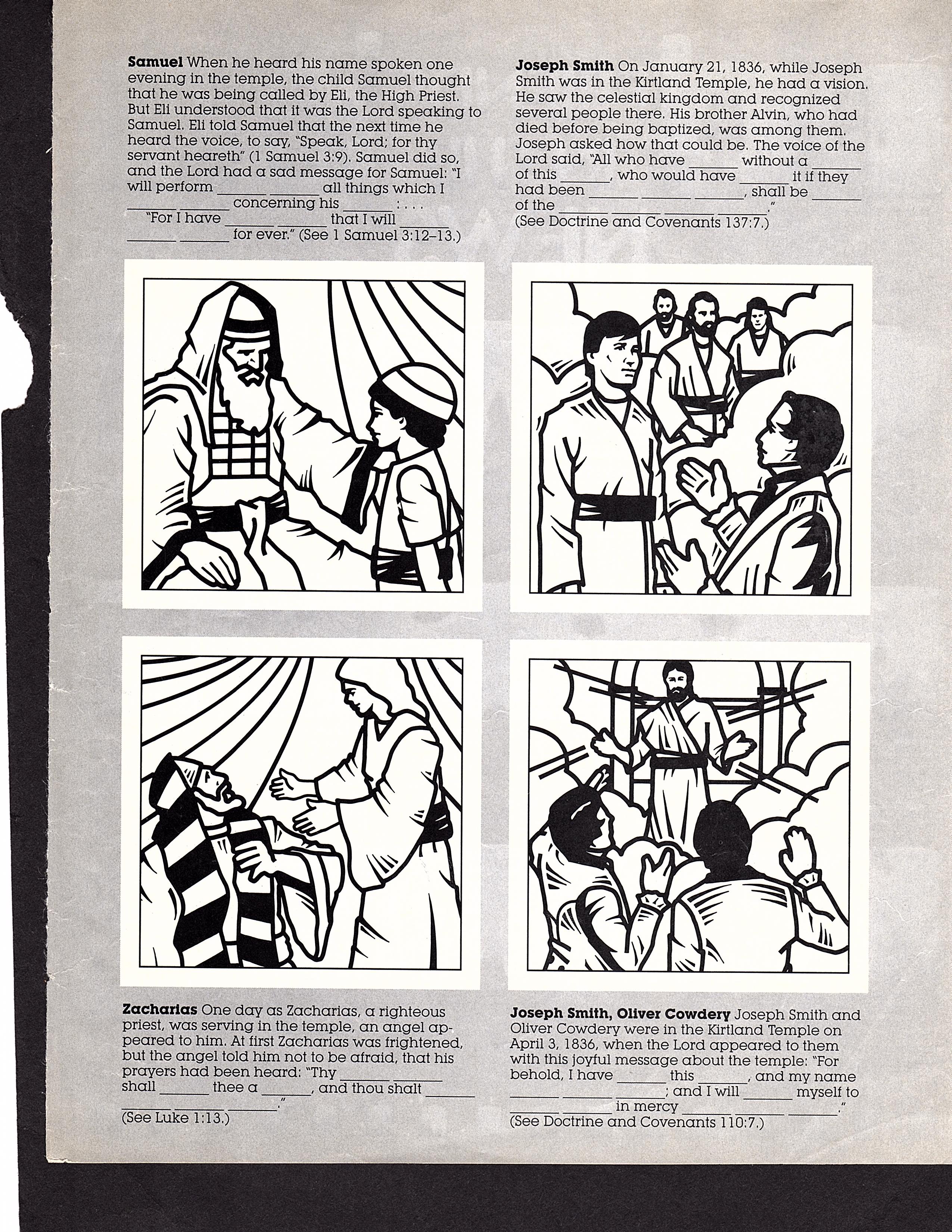
The Kirtland Temple is important in Church history. Jesus Christ appeared there, along with ancient prophets. These prophets committed priesthood keys to Joseph Smith that are needed to do God’s latter-day work.
Invite the children to search Doctrine and Covenants 110:11–16 (or watch the below video) to find the names of three ancient prophets who appeared in the Kirtland Temple. Then help them find words in these verses that describe what each prophet “committed,” or gave, to Joseph Smith and Oliver Cowdery. You can find a helpful description in “Chapter 40: Visions in the Kirtland Temple” (Doctrine and Covenants Stories, 156–57).
Share phrases from Doctrine and Covenants 110 that help you and the children to understand the sacredness of these events.
Show several keys of different sizes or shapes (or refer to the ones on the chalkboard).
Why do we use keys? How do we use them?
What do you think these keys will open?
What would happen if we lost a key to something that was locked?
Explain that priesthood keys are very important in the Church, but they are not keys like the ones displayed. They are not made of metal and cannot be held in your hand or put in your pocket. When we speak of priesthood keys, we mean the power and authority, given to the prophet and other priesthood leaders through the laying on of hands, to direct God’s work on earth. The President of the Church holds all the keys of the priesthood, and other priesthood leaders hold some of them. Priesthood holders may perform priesthood ordinances only as authorized by those who hold the appropriate priesthood keys. For example, before a father can baptize his child, he must receive permission from the bishop.
Remind the children that during the Apostasy the priesthood was not on the earth. The priesthood and the keys to direct the power of the priesthood needed to be restored so the Church could be restored and Church members could receive all the blessings of the gospel.
Who restored the Aaronic Priesthood to Joseph Smith? (Show the picture of John the Baptist restoring the Aaronic Priesthood.)
Who restored the Melchizedek Priesthood to Joseph Smith? (Peter, James, and John; show the picture of the Melchizedek Priesthood restoration.)
Explain that one of the reasons the Kirtland Temple was built was to provide a place where the Lord and his servants could restore additional keys of priesthood authority.
Show the children some keys, and talk about what keys do. Let the children take turns holding the keys and pretending to open a locked door. As they do, explain that Joseph Smith received priesthood keys in the Kirtland Temple. These keys unlock power and blessings so we can do God’s work in His Church, such as sharing the gospel and doing temple work.
To help the children understand the keys that Elijah committed to Joseph Smith, sing together a song about Elijah or family history, such as “Truth from Elijah” (Children’s Songbook, 90–91). Tell about an experience that helped turn your heart to your ancestors. Ask the children to share something they know about a grandparent or other ancestor.
Elder Gary E. Stevenson said, “All of Heavenly Father’s children [had] been locked out from the saving ordinances of the gospel of Jesus Christ—until a divine restoration was effected by [Moses, Elias, and Elijah]” (“Where Are the Keys and Authority of the Priesthood?” Ensign or Liahona, May 2016, 30).
Share this description of priesthood keys by President Russell M. Nelson: “In your pocket there might be a key to your home or car. Priesthood keys, on the other hand, are intangible and invisible. They ‘switch on’ the authority of the priesthood” (“Personal Priesthood Responsibility,” Ensign or Liahona, Nov. 2003, 45–46). To illustrate the importance of priesthood keys, discuss with the children the problems of losing a house key or car key. How is this similar to the problems of priesthood keys being lost? Help the children understand who holds priesthood keys today and how these keys are used to unlock blessings for all of God’s children (see “Priesthood Keys,” True to the Faith, 126–27).
To further explain the keys restored in the Kirtland Temple, show the video “By the Hand of Elijah the Prophet” (ChurchofJesusChrist.org). Discuss what we can do to participate in the work that Elijah’s keys made possible. Or show the video “Gatherers in the Kingdom” (ChurchofJesusChrist.org) and talk about how we can help gather Heavenly Father’s children back to Him.
What might help “turn the hearts” of your children to their ancestors? You can find some fun ideas at FamilySearch.org/discovery. You could work together to identify ancestors who need temple ordinances and plan to perform those ordinances at the temple. You could also talk about how the work restored by Elijah in the Kirtland Temple increases your love for your ancestors.
Sing with the children “The Spirit of God” (Hymns, no. 2), and tell them it was sung at the Kirtland Temple dedication—and in temple dedications today. Why was this a good song for the Kirtland Temple dedication?
Friend September 2021 “Scripture Time Fun for Little Ones” Work together as a family to draw a picture of a temple. Then sing “I Love to See the Temple” (Children’s Songbook, 95). Talk about why the temple is important to you. Help your little ones say, “The temple is a special place.”
Moroni told Joseph Smith that Elijah would come to “reveal … the Priesthood” (verse 1). This refers to the sealing power of the priesthood that allows families to be united eternally and enables us to receive ordinances for our ancestors in the temple.
Display a picture of a temple, and help the children name some of the things we do in temples. Explain that baptisms for the dead, eternal marriage, and sealing families in the temple are all possible because of the priesthood keys Elijah restored.
Perhaps you and your children would enjoy looking at some pictures of your family, possibly including a picture of your family at a temple (or see Gospel Art Book, no. 120).
You could then read Doctrine and Covenants 2 and share with each other your thoughts about why we have temples and why Heavenly Father wants families to be together forever.
Consider singing together “Families Can Be Together Forever” (Children’s Songbook, 188). What does this song say we can do to be with our family forever?
Ask the children to read or listen to the prophecy in Doctrine and Covenants 2:1. Ask them to look for who the Lord would send in the last days and what this person would reveal. Display a picture of Elijah in the Kirtland Temple (see Gospel Art Book, no. 95), and talk about how this prophecy was fulfilled 13 years after Moroni’s visit (see Doctrine and Covenants 110:13–15).
Explain that Elijah restored priesthood keys that allow families to be sealed together eternally. Show some objects that could help the children understand what it means to seal something, such as a can of food or a plastic storage bag with a zipper lock. How do these objects help us understand what it means for a family to be sealed?
Friend April 2020 “Alonso’s Forever Family” Alonso learned that because of Jesus’s resurrection people who have died will live again. He also learned about being sealed to his family. His parents had both died and he was living with his grandma. He couldn’t wait to go to the temple and be sealed to his parents. He saved any money he got so he and his grandma could make the trip to the temple. He was so grateful that families can be together forever
Come, Follow Me—For Primary: Old Testament 2022 ” Malachi’s prophecy about Elijah the prophet was fulfilled when Elijah appeared to Joseph Smith in the Kirtland Temple and gave him the priesthood keys that allow families to be sealed together forever. You might consider inviting someone in the ward who has responsibility for temple and family history work (such as a member of the elders quorum presidency or Relief Society presidency) to help you teach this doctrine to the children. Remember to be sensitive to the feelings of children whose families have not been sealed.
Write each phrase from Malachi 4:5–6 on a separate slip of paper. Give the slips of paper to the children, and ask them to put the phrases in the correct order. Read the verses together, and discuss questions like these: Who did the Lord promise to send? When did He say this person would come? What did the Lord say that this person would do? Why would this person need to come? Where was this prophecy fulfilled? (see Doctrine and Covenants 110:13–16).
Write on the board a question like What does it mean for the hearts of the children to turn to their fathers? (see Malachi 4:6). Invite the children to ponder this question as they watch the video “Their Hearts Are Bound to You” (ChurchofJesusChrist.org). Then invite the children to share their thoughts about the question on the board. Discuss together experiences you or the children have had learning about family history.
Show the picture of Elijah from this week’s outline in Come, Follow Me–For Individuals and Families. Invite the children to share what they know about the event this picture depicts (see also Doctrine and Covenants 110:13–16). Testify that the sealing power Elijah restored allows families to be united eternally—including families who didn’t have that opportunity in mortality. If you have participated in a sealing, either for yourself or for a deceased person, talk about what you felt during that ordinance. Ask the children to share their feelings about their families and about God’s plan to help families be together forever.
Friend October 2019 “The Temple Challenge” Temple Scramble: This girl has taken a family name to the temple. Can you put the pictures in order?
Friend October 2018 “Temple Time” The work we do in temples blesses our ancestors and the families of other people. Look through your family tree on FamilySearch.org and find as many temples as you can. Also, make a puzzle of a temple. (Activity Idea: For each temple you find in your family tree, put a piece of the puzzle together.
SECTION 131
1–4, Celestial marriage is essential to exaltation in the highest heaven; 5–6, How men are sealed up unto eternal life is explained; 7–8, All spirit is matter.
SECTION 132
Revelation given through Joseph Smith the Prophet, at Nauvoo, Illinois, recorded July 12, 1843, relating to the new and everlasting covenant, including the eternity of the marriage covenant and the principle of plural marriage. Although the revelation was recorded in 1843, evidence indicates that some of the principles involved in this revelation were known by the Prophet as early as 1831. See Official Declaration 1.
1–6, Exaltation is gained through the new and everlasting covenant; 7–14, The terms and conditions of that covenant are set forth; 15–20, Celestial marriage and a continuation of the family unit enable men to become gods; 21–25, The strait and narrow way leads to eternal lives; 26–27, The law is given relative to blasphemy against the Holy Ghost; 28–39, Promises of eternal increase and exaltation are made to prophets and Saints in all ages; 40–47, Joseph Smith is given the power to bind and seal on earth and in heaven; 48–50, The Lord seals upon him his exaltation; 51–57, Emma Smith is counseled to be faithful and true; 58–66, Laws governing plural marriage are set forth.
Heavenly Father Made it Possible for Families to be Together Forever.
Through Joseph Smith, the Lord restored the ordinances and authority needed to make these relationships eternal (see Doctrine and Covenants 132:7, 18–19).
Through the Lord’s sealing power and the ordinances of the temple, our family relationships can last eternally if we keep our covenants.
Help the children think of examples of things that do not last forever—food that spoils, flowers that wither, and so on. Show a picture of your family, and share how you feel about them. Testify that the Lord has made it possible, through the ordinances of the temple, for families to last forever.
Open the Doctrine and Covenants to section 132, and tell the children that this is a revelation to Joseph Smith about marriage and families. Show them verse 19, and point to the words “through all eternity” as you read them. Invite the children to read these words with you.
Help the children make paper dolls representing members of their family (see this week’s activity page). Cut them out, and put them in an envelope or attach them together with a paper clip to represent the sealing power that can make our families eternal.
Regardless of our current family situation, we can make choices now that will prepare us to receive the blessings of an eternal family in the future.
Ask some of the children to read Doctrine and Covenants 131:1–4 and others to read 132:15. Help them discover what these verses teach about marriage. Select key phrases from 132:19 (such as “if a man marry a wife,” “everlasting covenant,” “sealed,” “abide in my covenant,” “through all eternity,” and “forever and ever”), and ask the children to find these phrases in the verse. What do these phrases teach us about marriage?
Sing “Families Can Be Together Forever” (Children’s Songbook, 188), or review “Chapter 55: A Revelation about Marriage” (Doctrine and Covenants Stories, 198). Ask the children to listen for and be prepared to share what we must do so that our families can be eternal. Testify that no matter our current family situation, we can prepare ourselves to be part of an eternal family.
Ask some of the children to read Doctrine and Covenants 131:1–4 and others to read 132:15. Help them discover what these verses teach about marriage. Select key phrases from 132:19 (such as “if a man marry a wife,” “everlasting covenant,” “sealed,” “abide in my covenant,” “through all eternity,” and “forever and ever”), and ask the children to find these phrases in the verse. What do these phrases teach us about marriage?
Sing “Families Can Be Together Forever” (Children’s Songbook, 188), or review “Chapter 55: A Revelation about Marriage” (Doctrine and Covenants Stories, 198). Ask the children to listen for and be prepared to share what we must do so that our families can be eternal. Testify that no matter our current family situation, we can prepare ourselves to be part of an eternal family.
Sing “Families Can Be Together Forever” (Children’s Songbook, 188).
Jesus taught that families are important. In the temple, we can be sealed to our families forever (see Doctrine and Covenants 132:19).
Make a family tree! Have each family member make a paper leaf and write their name on it. On another paper, draw a tree trunk. Then glue or tape the leaves to the top of the tree.
Friend September 2021 “Scripture Time Fun for Little Ones” Have everyone bring their hands together over their heads like a temple spire. Then lower your arms to encircle each other in a family hug. Talk about blessings families can receive in the temple. Help your little ones say, “I can be with my family forever.”
Friend March 2018 “What’s on Your Mind” A child wants to know how his family will be together forever if his parents are divorced.
Friend June 2017 “Hope for My Family” Henry B. Eyring: The hope of feeling family love now and throughout eternity.
Ensign August 2016 “The Hope of Eternal Family Love” Because of Jesus Christ’s Atonement and the restoration of priesthood power to seal families, we can live with our families forever! What do you love about your family? Follow these instructions to make this paper chain to celebrate your family. Fold a piece of paper in half twice so you have one long strip. Draw a person with hands reaching the folded edges. Cut the person out. Don’t cut where the hands touch the folded edges. Unfold it. Write or draw something you love about each family member. Tape multiple chains together if you have a larger family!
Make a family banner with the family name on it, and then draw pictures of what is important to your family, like the temple, love, Jesus, etc.
Sing together the second verse of “Families Can Be Together Forever” (Children’s Songbook, 188) or another song about families. Help the children think of ways they can prepare to be married in the temple someday and have an eternal family.
You are a child of heavenly parents. Even before you came to this earth, you were part of Their family. And that will never change! So no matter what, you will always be part of a forever family!
Heavenly Father loves you and your parents very much. He wants you all to return to Him. He will keep blessing and guiding you and your family. Pray to Him about your worries, and He will comfort you.
Come, Follow Me—For Primary: Old Testament 2022 ” Because of the priesthood keys of sealing that Elijah gave Joseph Smith in the Kirtland Temple, families can be united for eternity. As you teach this truth, be sensitive to the feelings of children whose families have not been sealed in the temple.
Read Malachi 4:5 to the children. Then tell them that this promise was fulfilled when Elijah appeared to Joseph Smith in the Kirtland Temple (see “Chapter 40: Visions in the Kirtland Temple,” in Doctrine and Covenants Stories, 157). Show a picture of this event (see Gospel Art Book, no. 95), and invite the children to point to Elijah and to Joseph Smith. Explain that because Elijah came, we can be sealed as families in the temple. Share your testimony of the importance of being sealed as families.
Tell the children about your love for your family; show a picture, if possible. Invite a few children to share their feelings for their family. Sing together a song about families, such as “Families Can Be Together Forever” (Hymns, no. 300), and testify that Heavenly Father wants families to be sealed together and that this is one reason we have temples. Help children understand that because of Jesus Christ, we can even be sealed to family members who were not able to go to the temple in this life. Invite the children to draw a picture of their family together in heaven.
Friend April 2020 “Alonso’s Forever Family” Alonso learned that because of Jesus’s resurrection people who have died will live again. He also learned about being sealed to his family. His parents had both died and he was living with his grandma. He couldn’t wait to go to the temple and be sealed to his parents. He saved any money he got so he and his grandma could make the trip to the temple. He was so grateful that families can be together forever
Friend April 2020
Friend February 2019 “My Eternal Family” Addie was born in South Korea and adopted by a family in Washington USA. She was then sealed to her new family.
Friend July 2016 “Forever Brothers” Markus is sealed to his adoptive family.
Friend February 1987 Family sacrifices much to attend the temple and be sealed together.
Friend February 1987 Family is sealed together, including their baby brother who had died.
Friend July 2016 “No Matter Who You Are” Andi worries because her family aren’t members and they haven’t been sealed in the temple, but her teacher reminds her she is also a child of God.
Friend July 2021 “A Postponed Trip” Freddie’s dad is going to South Korea because Freddie’s grandfather needs surgery. Freddie is sad that he doesn’t get to go because he is afraid his grandfather will die and he won’t get to see him again. His dad reminds him that families are forever and he will get to see his grandfather again.
Friend April 2023 “Forever and Always” James missed his baby sister, Rosie, who had died recently. For home evening, James’s parents decided to go to the temple for home evening and talk to James about being sealed there, which meant they would be with Rosie again and be a family forever.
Friend October 2023 “Remembering Abuela” Lyan and her family were celebrating “Day of the Dead” . But this year was different because her grandmother was one of the family members they would remembering. Lyan missed her grandmother. But her mother helped her remember that because of Jesus Christ, they would all be resurrected. And since they were sealed in the temple, they would all be together as a family someday.
Friend August 2024 “Brothers Forever” Ryan and his family traveled by bus two days to the temple to be sealed together as a family. When they were sealed together as a family, someone stood in for Ryan’s younger brother who had died at age one.
Friend September 2021 “Scripture Time Fun for Little Ones” Have everyone bring their hands together over their heads like a temple spire. Then lower your arms to encircle each other in a family hug. Talk about blessings families can receive in the temple. Help your little ones say, “I can be with my family forever.”
Temple Marriage
“Lesson 34: Genesis 28–30,” Old Testament Seminary Student Material According to Genesis 28:1–2, Isaac instructed his son Jacob to marry one of the daughters of Laban and not a Canaanite woman. The Canaanites worshipped idols and engaged in other practices that were offensive to God. A daughter of Canaan would not be worthy to join Jacob in entering into a marriage covenant with the Lord. If Jacob were to marry a daughter of Canaan, he would be marrying out of the covenant.
When we are married in the temple, we make covenants with the Lord. Marriage in the temple is covenant marriage. If we keep our covenants, we qualify for all the blessings that were promised to Abraham.
Tell the children about someone you know who has died. Explain that when people die, their spirits leave their bodies and go to the spirit world. Read 1 Peter 3:19 and explain that when Jesus died, he went to visit the spirit world. There, He asked the righteous spirits to teach the gospel to other spirits who had not yet accepted the gospel (see Doctrine and Covenants 138:30).(Come, Follow Me—For Primary: New Testament 2023 “1 and 2 Peter”)
Draw on the board a circle with a line through the middle. Write Spirit Paradise on one half of the circle and Spirit Prison on the other half. Invite one of the children to read 1 Peter 3:18–20; 4:6 (see 1 Peter 4:6, footnote a, for revisions from the Joseph Smith Translation). Explain that when Jesus died, He went to spirit paradise. He instructed the righteous spirits there to teach the gospel to the spirits in spirit prison. (Come, Follow Me—For Primary: New Testament 2023 “1 and 2 Peter”)
President Joseph Fielding Smith: “[The Father] is going to give to every man the privilege of hearing the gospel. Not one soul shall be overlooked or forgotten. This being true, what about the countless thousands who have died and never heard of Christ, never had an opportunity of repentance, never met an elder of the Church holding the authority?…The Lord has so arranged his plan…that all who have died without this opportunity shall be given it in the spirit world.”
Come, Follow Me—For Individuals and Families: New Testament 2023 “1 and 2 Peter” What can your family do to feel connected to your ancestors? Perhaps you could celebrate deceased ancestors’ birthdays by preparing their favorite meals, looking at pictures, or telling stories from their lives. If possible, you could also plan to receive ordinances for your ancestors in the temple (for help, visit FamilySearch.org).
Help the children understand that when the Saints found a new home in Nauvoo, the Lord told them to build a temple (see “Chapter 50: The Saints in Nauvoo” Doctrine and Covenants Stories, 183–84, or the corresponding video on ChurchofJesusChrist.org). Invite the children to pretend they are building a temple.
Read with the children this phrase: “My holy house, which my people are always commanded to build unto my holy name” (Doctrine and Covenants 124:39). Let the children hold a picture of an ancient temple (see Gospel Art Book,no. 52 or this week’s activity page) and a picture of a temple in your area. Explain that Heavenly Father and Jesus Christ have always commanded Their people to build temples—in ancient times and in our day. Share words and phrases from Doctrine and Covenants 124:28–29 to help the children understand why the Lord wants us to build temples.
Invite the children to complete this week’s activity page to help them understand that we are God’s people and that God’s people have always been commanded to build temples.
Cover a picture or drawing of the temple. Invite the children to read Doctrine and Covenants 124:38–41 for clues about what is in the picture. Let the children uncover the picture and discuss what these verses teach about why the Lord wants us to build temples.
Invite the children to read Doctrine and Covenants 124:28–30 to look for reasons the Lord gave Joseph Smith for building the Nauvoo Temple. Share your feelings about the temple and any experiences you may have had doing baptisms for the dead. Help the children determine how long it will be before they are old enough to do baptisms for the dead in the temple.
If you have a temple recommend, show it to the children, or invite a youth in the ward to show the children his or her recommend. Tell the children why a temple recommend is important and what we need to do to obtain one. Encourage them to begin preparing now to obtain their own recommend.
Baptism for the Dead
Gospel Topics “Baptism for the Dead” Jesus Christ taught that baptism is essential to the salvation of all who have lived on earth (see John 3:5). Many people, however, have died without being baptized. Others were baptized without proper authority. Because God is merciful, He has prepared a way for all people to receive the blessings of baptism. By performing proxy baptisms in behalf of those who have died, Church members offer these blessings to deceased ancestors. Individuals can then choose to accept or reject what has been done in their behalf.
Jesus Christ said, “Except a man be born of water and of the Spirit, he cannot enter into the kingdom of God” (John 3:5). Even Jesus Christ Himself was baptized (see Matthew 3:13–17).
Many people have lived on the earth who never heard of the gospel of Jesus Christ and who were not baptized. Others lived without fully understanding the importance of the ordinance of baptism. Still others were baptized, but without proper authority.
Because He is a loving God, the Lord does not damn those people who, through no fault of their own, never had the opportunity for baptism. He has therefore authorized baptisms to be performed by proxy for them. A living person, often a descendant who has become a member of The Church of Jesus Christ of Latter-day Saints, is baptized in behalf of a deceased person. This work is done by Church members in temples throughout the world.
Gospel Media “Baptism for the Dead/ Now You Know” The below video refers to church members as Mormons. A discussion about the church name, and the nickname others give the church, may be needed in order to avoid confusion.
An epistle from Joseph Smith the Prophet to the Latter-day Saints at Nauvoo, Illinois, containing directions on baptism for the dead, dated at Nauvoo, September 1, 1842.
1–4, Joseph Smith glories in persecution and tribulation; 5–12, Records must be kept relative to baptisms for the dead.
SECTION 128
An epistle from Joseph Smith the Prophet to The Church of Jesus Christ of Latter-day Saints, containing further directions on baptism for the dead, dated at Nauvoo, Illinois, September 6, 1842.
1–5, Local and general recorders must certify to the fact of baptisms for the dead; 6–9, Their records are binding and recorded on earth and in heaven; 10–14, The baptismal font is a similitude of the grave; 15–17, Elijah restored power relative to baptism for the dead; 18–21, All of the keys, powers, and authorities of past dispensations have been restored; 22–25, Glad and glorious tidings are acclaimed for the living and the dead.
All of God’s Children Need the Chance to be Baptized.
In August 1840, a grieving Jane Neyman listened to the Prophet Joseph speak at the funeral of his friend Seymour Brunson. Jane’s own teenage son Cyrus had also recently passed away. Adding to her grief was the fact that Cyrus had never been baptized, and Jane worried what this would mean for his eternal soul. Joseph knew how she felt; he had wondered the same thing about his beloved brother Alvin, who also died before being baptized. So the Prophet decided to share with Jane, and everyone else at the funeral, what the Lord had revealed to him about those who had died without receiving the ordinances of the gospel—and what we can do to help them.
The doctrine of baptism for the dead thrilled the Saints; their thoughts turned immediately to deceased parents, grandparents, and other family members. Now there was hope for them! Joseph shared their joy, and he used joyful, enthusiastic language to express what the Lord taught him about the salvation of the dead: “Let the mountains shout for joy, and all ye valleys cry aloud; and all ye seas and dry lands tell the wonders of your Eternal King!” (Doctrine and Covenants 128:23).
Show a picture of Jesus Christ being baptized (see Gospel Art Book, no. 35), or show the video “The Baptism of Jesus” (ChurchofJesusChrist.org). Ask the children if they have ever seen someone get baptized. What do they remember about it? Use the picture or video to show the children that when we are baptized, we go all the way under the water and then back up, just like Jesus did. Open to Doctrine and Covenants 128:12, and explain that Joseph Smith taught that being baptized reminds us of the Resurrection.
Tell the children about someone you know (such as an ancestor) who died without being baptized. Read Doctrine and Covenants 128:5, and let them take turns holding a picture of a temple baptismal font (see this week’s outlinein Come, Follow Me—For Individuals and Families). Testify that Heavenly Father allows us to be baptized on earth for people who are dead. This way all of God’s children can be baptized and make covenants with Him.
Help the children think of things they cannot do for themselves. Who helps them do these things? Show a picture of one of your ancestors who died without being baptized. Tell the children about this person, and explain that this person needs our help to be baptized.(Come, Follow Me—For Primary: New Testament 2023 “1 Corinthians 14–16” )
Ask the children if they have any family members who have been to the temple to perform baptisms for the dead. Show pictures of a temple baptismal font. Ask the children if they know what happens here. Explain that in the temple we can be baptized for people who have died without being baptized. Then those people can choose whether to accept the baptism.(Come, Follow Me—For Primary: New Testament 2023 “1 Corinthians 14–16” )
Read 1 Corinthians 15:29. What were the Saints in Paul’s day doing that we also do today? Ask the children why we are baptized for the dead. If necessary, explain that many of our ancestors did not have the opportunity to be baptized and confirmed during this life. In the temple, we can be baptized and confirmed for them. (Come, Follow Me—For Primary: New Testament 2023 “1 Corinthians 14–16” )
Gospel Topics “Baptism for the Dead” Jesus Christ taught that baptism is essential to the salvation of all who have lived on earth (see John 3:5). Many people, however, have died without being baptized. Others were baptized without proper authority. Because God is merciful, He has prepared a way for all people to receive the blessings of baptism. By performing proxy baptisms in behalf of those who have died, Church members offer these blessings to deceased ancestors. Individuals can then choose to accept or reject what has been done in their behalf.
Friend November 2021 “They’re Waiting for Me!” Giselle lives in India, and she can’t wait until the temple is built there so she can do baptisms for her ancestors who have died without knowledge of the gospel. (Photos at link)
Friend July 2022 “The Light and Peace of the Temple” President Eyring’s daughter was asked to do many baptisms for the dead. They had a feeling of light and peace as they left the temple. Temple service lifts and changes us.
Baptism for the dead creates “a welding link” between me and my ancestors.
Divide the class in two groups, and ask the first group to read Doctrine and Covenants 128:1 to find out what subject occupied Joseph Smith’s mind. Ask the other group to read verse 17 and find out what subject he considered “the most glorious.” Let them share what they find, and talk about why this subject is so glorious. If possible, invite a youth who has done baptisms for the dead to share his or her experience and explain why we do this work.
Consider using an object lesson to show that we need to help our ancestors who were not baptized. For example, display a gift or a treat, but place it out of reach of one of the children. Tell that child that he or she can have the object but can’t move from his or her seat. Ask the other children what they can do to help the child receive it. Read together Doctrine and Covenants 128:15, and talk about how it relates to the object lesson.
Invite the children to make a paper chain with names of their parents, grandparents, great-grandparents, and so on (see the activity page for this lesson). If the children don’t know their ancestors’ names, encourage them to find out the names and write them on the chain at home. Read together Doctrine and Covenants 128:18 to find out what the “welding link” is that makes our family history “whole and complete.” Tell a story about an ancestor that helps you feel connected to him or her. Or show the video “Courage: I Think I Get It from Him” (ChurchofJesusChrist.org).
Show the children a temple recommend, and tell them how you obtain one. Help them look forward to getting their own temple recommends so they can go to the temple and be baptized for their own ancestors.
Gospel Topics “Baptism for the Dead” Jesus Christ taught that baptism is essential to the salvation of all who have lived on earth (see John 3:5). Many people, however, have died without being baptized. Others were baptized without proper authority. Because God is merciful, He has prepared a way for all people to receive the blessings of baptism. By performing proxy baptisms in behalf of those who have died, Church members offer these blessings to deceased ancestors. Individuals can then choose to accept or reject what has been done in their behalf.
Jesus Christ said, “Except a man be born of water and of the Spirit, he cannot enter into the kingdom of God” (John 3:5). Even Jesus Christ Himself was baptized (see Matthew 3:13–17).
Many people have lived on the earth who never heard of the gospel of Jesus Christ and who were not baptized. Others lived without fully understanding the importance of the ordinance of baptism. Still others were baptized, but without proper authority.
Because He is a loving God, the Lord does not damn those people who, through no fault of their own, never had the opportunity for baptism. He has therefore authorized baptisms to be performed by proxy for them. A living person, often a descendant who has become a member of The Church of Jesus Christ of Latter-day Saints, is baptized in behalf of a deceased person. This work is done by Church members in temples throughout the world.
Gospel Media “Baptism for the Dead/ Now You Know” The below video refers to church members as Mormons. A discussion about the church name, and the nickname others give the church, may be needed in order to avoid confusion.
Friend April 2020 “The Temple and You” Before the Church was restored, many people believed that if someone in their family died without being baptized, they would never see them again. But because of the Restoration, we can be baptized for them in the temple. We can be sealed together for eternity!
Friend January 2020 “For Older Kids” Each temple baptism font rests on the backs of twelve oxen. They stand for the twelve tribes of Israel and remind us that the Lord wants to gather all people into His Church. Unscramble the letters to find out which temple this font is in.
Friend October 2017 “Finding Lydia” Lydia isn’t excited to be graduating from Primary and going to Young Women’s, but she becomes more excited when her mother finds some family names for her to do baptisms for in the temple, and one is named Lydia.
Friend July 2016 “Abraham Abraham” A boy does baptisms at the temple for the first time and learns its importance.
Friend October 2019 “The Temple Challenge” Sister Jones, the general primary president, challenges a 12 year old boy to find a family name to take to the temple. He later writes to her letter telling of his success and of his opportunity to be baptized in the temple for his 3rd great grandfather and how that felt. He also tells her of his desire to do more.
Create a paper chain with names of people in your family (see this week’s activity page), and bring it to show the class. Tell a few things about the people on your chain. Read to the children from Doctrine and Covenants 128:18, and explain that Joseph Smith taught that “there is a welding link … between the fathers and the children.” Help the children make their own family chains, and invite them to take the chains home and have their parents help them add names of ancestors.
Ask the children to share something about one of their grandparents. Tell one of your favorite stories about your parents or grandparents. Show pictures if possible. Encourage the children to learn more about their grandparents and other ancestors.
Friend October 2019 “The Temple Challenge” Sister Jones, the general primary president, challenges a 12 year old boy to find a family name to take to the temple. He later writes to her letter telling of his success and of his opportunity to be baptized in the temple for his 3rd great grandfather and how that felt. He also tells her of his desire to do more.
Friend November 2021 “They’re Waiting for Me!” Giselle lives in India, and she can’t wait until the temple is built there so she can do baptisms for her ancestors who have died without knowledge of the gospel. (Photos at link)
Friend October 2019 “The Temple Challenge” Temple Scramble: This girl has taken a family name to the temple. Can you put the pictures in order?
Friend March 2021 “For Older Kids” In the temple, we do baptisms for those who died without having the chance to be baptized when they were alive. Remembering your own baptism can help you understand how happy the people we’re baptized for in the temple feel! Write down what you remember about your baptism.
Friend April 2020 “The Temple and You” Before the Church was restored, many people believed that if someone in their family died without being baptized, they would never see them again. But because of the Restoration, we can be baptized for them in the temple. We can be sealed together for eternity!
Friend January 2020 “For Older Kids” Each temple baptism font rests on the backs of twelve oxen. They stand for the twelve tribes of Israel and remind us that the Lord wants to gather all people into His Church. Unscramble the letters to find out which temple this font is in.
Friend September 2019 “It’s Temple Time!” What to expect when doing baptisms for the dead, from start to finish.
Friend August 2025 “Blessings of the Temple”The blessings of the temple help to gather Israel on both sides of the veil. Gathering Israel means helping all of Heavenly Father’s children return to Him. The temple helps us do that! Can you help everyone find their way through the maze to the temple?(See more at link)
For the Strength of Yuth August 2026 “Aim High” “God desires all of us to strive for His highest possible blessings by keeping His highest commandments, covenants, and ordinances, all of which culminate in His holy temples.” President Dallin H. Oaks,
Show the children a glass of water. How does water bless us?(It quenches our thirst, it cleanses, it provides life for plants and all living things. Without water we would die.)
Tell the children about Ezekiel’s vision of water flowing out of the temple (see Ezekiel 47:1–12). Show the picture in this week’s outline in Come, Follow Me—For Individuals and Families (see also the video “And the River Will Grow,” ChurchofJesusChrist.org). Tell the children about blessings you receive that, like the river in Ezekiel’s vision, flow from the temple.
These verses describe Ezekiel’s vision of water flowing from the temple and healing the Dead Sea—a sea so salty that fish and plants cannot live in it. Children might enjoy drawing a picture of this vision. What could the water flowing from the temple symbolize? How does the temple help heal us? (see Ezekiel 47:8–9, 11).
Temple blessings can heal our hearts and families.
Here are some of the key blessings associated with LDS temples:
Participation in Ordinances: Temples are the only places where certain sacred ordinances — such as the Endowment, sealing of couples in marriage for eternity, and baptism for the dead — can be performed. These ordinances are considered essential for individual progression and salvation.
Eternal Families: The temple is where families can be sealed together, meaning they can be together forever, not just “until death do us part.” This sealing extends to children as well, who are considered to be sealed to their parents for eternity.
Learning and Instruction: In the temple, individuals receive instruction and make covenants related to the Plan of Salvation and their relationship with God. These teachings provide guidance for personal development and spiritual growth.
Personal Revelation: Many members of the LDS Church report that the peaceful, sacred atmosphere of the temple is conducive to receiving personal revelation and divine guidance.
Service to Others: In the temple, members perform vicarious ordinances on behalf of those who have died, providing them with the opportunity to accept these ordinances in the afterlife. This service to others is considered a significant blessing and a manifestation of love and selflessness.
Peace and Comfort: Many Latter-day Saints find that attending the temple provides a sense of peace and comfort, offering a spiritual refuge from the world. It can be a place to seek comfort, find answers to prayers, and feel closer to God.
Communion with the Divine: Temples are considered “Houses of the Lord,” and as such, are places where individuals can feel a special closeness to God and Jesus Christ.
Protection and Power: The covenants and ordinances performed in the temple are believed to provide spiritual protection and power from God, including the power to resist temptation and overcome worldly challenges.
List on the board some key words and phrases related to Ezekiel 47:1–12, such as temple, river, desert, Dead Sea, multitude of fish, and fruitful tree. Invite each child to pick one of these things to draw. Then read the verses together, and invite the children to share their drawings when their elements are mentioned. What blessings came from the river in this vision? (see verses 8–9, 12). Help the children see how these blessings are like the blessings Heavenly Father and the Savior offer those who keep temple covenants.
Show the video “And the River Will Grow” (ChurchofJesusChrist.org). Or read together what Elder Dale G. Renlund taught about Ezekiel’s vision in “Family History and Temple Work: Sealing and Healing” (Ensign or Liahona, May 2018, 47–48). Tell the children how family history work and the temple have brought you the Savior’s healing. Invite the children to share their feelings about the temple.
Choose verses from section 109 or 110 that you feel highlight the blessings of the temple (such as the ones listed below from this week’s outline in Come, Follow Me—For Individuals and Families). List these blessings on the board, and invite the children to search the verses you chose to find those blessings. How might we explain to someone why the temple is important to us?
Invite the children to talk about something that makes them happy. Show a picture of someone smiling in front of a temple (such as the picture in this outline), and ask the children why the person might be so happy. Testify that the temple is the Lord’s house, and tell about a time when you felt happy because of the temple.
Read to the children the last part of Ezra 3:12, explaining that when the Jews laid the foundation of the temple, “many shouted aloud for joy.” Invite the children to shout for joy. Help them think of reasons we can be joyful about the temple. For example, in the temple we make promises with God that allow our families to be together forever.
How did the Jews celebrate when the foundation of the temple was laid? Select all that apply:
They sang.
They shouted with joy.
They danced.
They praised and thanked the Lord.
Sing with the children a song about the temple, such as “I Love to See the Temple” (Children’s Songbook, 95). After each line, pause to ask a child to share something he or she loves about the temple.
Friend November 2021 “Family History Blessings” Antonella got a Family Search account when she was baptized. She’s learned more about her family and loves her family even more now. She also wants to help others unite their families for eternity.
Invite the children to work together to find phrases in Ezra 3:10–13 that show how the Jews felt when the temple in Jerusalem was being rebuilt. How can we show our joy at having temples on the earth today? Help the children think of ways they can prepare to go to the temple.
Share with the children your feelings about the temple. How has the temple helped you feel closer to Heavenly Father and the Savior? Why do we celebrate when a temple is dedicated? Give the children time to write down how they feel about the temple, and encourage them to share what they wrote with their families.
For modern examples of rejoicing at the building of temples, see the videos “Practice, Celebration, Dedication: Temple Blessings in El Salvador” and “The Laie Hawaii Temple Youth Cultural Celebration” (ChurchofJesusChrist.org).
Story: The temple in Jerusalem was destroyed. Years later, the people rebuilt it. They were so happy! They “praised the Lord” and “shouted aloud for joy” (Ezra 3:11, 12).
Song: “I Love to See the Temple” (Children’s Songbook, 95)
Activity: Fold a piece of paper in half. Draw or glue a picture of the temple on the front. Then open the fold and draw or glue a picture of yourself inside. Write the words, “I’ll go inside someday.” Talk about how going to the temple can make us happy.
Reverence and Respect for the House of God
Jesus Cleanses the Temple Video
“Lesson 8: Jesus Christ Cleanses the Temple,” Primary 7: New Testament Draw a horizontal line across the chalkboard. Write RESPECT above the line and DISRESPECT below. Ask the children to pretend a friend is coming to their home. Tell them you are going to draw a “respect line” on the chalkboard. Mention things the friend does (see below), and have the class decide if the friend is showing respect or disrespect for you and your home. Draw a continuous line, intersecting the horizontal line on the chalkboard, moving up for situations showing respect and down for ones showing disrespect. Use situations such as the following:
The friend:
Waits quietly outside until invited in.
Walks in with muddy feet.
Thanks you for the invitation to come.
Shouts and yells loudly in your home.
Greets your parents politely.
Demands something to eat.
Treats your possessions carefully.
Ignores your parents when they speak to him or her.
Invites you to visit at his or her house.
Your “respect line” may look something like this:
Have the children answer the following questions to themselves:
When you visit a friend’s home, what does your “respect line” look like?
When you come to Primary, what does your “respect line” look like?
What does your “respect line” look like when you are in your own home?
Help the children understand that this temple was a sacred place, just as our temples and church meetinghouses are today, and Jesus wants us to respect these holy places.
Draw another “respect line” on the chalkboard as the children give examples of actions that show respect or disrespect in the church building. We show reverence for the temple by …
Divide students into groups of two or three. Invite the groups to write on a piece of paper as many ways to complete the statement as they can. After a minute or two, ask one group to share its list with the class. While the first group shares, ask the other groups to put a check mark next to each item on their lists that is mentioned. Next, have another group share the items on its list that were not mentioned by the first group. Repeat this process until all of the groups have shared. New Testament Seminary Teacher Manual “John 2”
Sing together a song about the temple, such as “I Love to See the Temple” (Children’s Songbook, 95). What phrases in this song teach us why the temple is sacred?
Give each child a picture of a temple, or invite them to draw one. Sing together a song about temples, such as “I Love to See the Temple” (Children’s Songbook, 95). Invite the children to hold up their pictures each time they sing the word “temple.” Point out to them other words in the song that teach us something important about the temple. Tell the children how you feel about the temple and how you know it is the house of the Lord.
Show the picture Jesus Cleansing the Temple (Gospel Art Book, no. 51), and tell the story recorded in Matthew 21:12–14. Help the children find money and animals in the picture. Then discuss why the Savior wanted the money changers and the people selling animals to leave the temple.
Show pictures of temples (for examples, see Gospel Art Book, nos. 117–19), and ask the children to share how they feel when they see a temple. You might explain that the temple is a place where we go to make promises with God, seek answers to prayers, and feel close to God. Help the children identify feelings from the Holy Ghost telling them that the temple is a special place. Ask the children to act as they would if they were inside the temple. For instance, they could talk in whispers and sit reverently.
Sing together a song about the temple, such as “I Love to See the Temple” (Children’s Songbook, 95), and invite the children to make a goal to go inside the temple someday.
The temple is a sacred place that I should respect.
Invite the children to read Matthew 21:12–14. Show the picture Jesus Cleansing the Temple (Gospel Art Book, no. 51), and ask them which verse is depicted in the picture.
New Testament Seminary Student Manual (2023) “Matthew 21:12–16” Jesus went to Jerusalem to celebrate the Passover and visited the temple. Worshippers who came to Jerusalem needed to exchange their money for currency that could be used at the temple to purchase animals for the sacrifices that would be made in their behalf by the priests. Even though this business was necessary and served a good purpose, handling it at the temple was disrespectful and irreverent. The phrase “a den of thieves” suggests that the moneychangers and merchants were more interested in making a financial profit than in worshipping God and helping others worship.
Invite the children to share how they have felt when they have gone inside a temple, visited temple grounds, or looked at pictures of temples. What helped them know the temple is a sacred place? You might share with the children why you love the temple. Why is it sacred to you?
Invite one or more youth to come to class and talk about how they have prepared to enter the temple. If they have been to the temple, ask them to talk about how they felt when they were there.
Cut a picture of a temple into puzzle pieces, and give each child one piece. Ask the children to write on the back of their puzzle piece one thing they can do to prepare to enter the temple. As each child shares an idea, add his or her piece to the puzzle.
On the board, write the following: can help me prepare to serve in the temple. Invite the children to suggest ways to complete this sentence. Some ideas might include “Keeping my baptismal covenants” or “The Holy Ghost.”
Write the word apostasy on the board. Invite the children to find a definition in “Apostasy” in the Guide to the Scriptures (scriptures.ChurchofJesusChrist.org). Invite them to read Isaiah 24:5; 30:9–11 and make a list of things people were doing in Isaiah’s time that led them to apostasy. Then invite the children to change the items in the list to things we can do to stay true to the Lord.
Divide the class into pairs, and assign each pair to read one of the following passages: Isaiah 24:3–5; Isaiah 29:7–10; or Isaiah 30:8–14. Invite them to draw pictures that represent what they read. As they share their drawings, help them discuss what Isaiah’s words teach about why we should stay true to the Lord.
When individuals or groups of people turn away from the principles of the gospel, they are in a state of apostasy.
Doctrine and Covenants Seminary Teacher Manual “The Great Apostasy” Jesus Christ established His Church during His mortal ministry. Following His death and Resurrection, the Savior commissioned His Apostles to guide the Church with His priesthood authority and keys. Due to intense persecution and the death of the Apostles, people were left without divine direction from living prophets. Jesus Christ’s teachings and doctrine were altered, resulting in a period called the Great Apostasy. This lesson can help students understand the need for a restoration of Jesus Christ’s true Church in the latter days.
Apostasy and Restoration Story
#1) The gospel has been on the earth since the time of Adam, whenever there has been a righteous man who has authority to administer in God’s name, and a people who are willing to listen to and accept the gospel.
#2) When people reject and rebel against the commandments of God, they are in a state of apostasy (a turning away from truth). They lose the blessings of divine guidance and authority. This happened several times during the Old Testament time period. Another time period apostasy occurred was after the Savior was resurrected.
#3) After Jesus’ death and resurrection, the apostles continued to teach people about Jesus and his gospel. Many people joined the church, but soon apostasy began to creep into the church. Some of the people began to turn away from the truth and teach false ideas based on their old religious beliefs.
#4) During this time period, there was also persecution going on from outside the church. Many church members were persecuted and killed because of their beliefs. One by one the apostles were all killed by these persecutors. After the apostles died, the priesthood keys and authority were no longer on the earth. Because of the wicked state of the people, they were not restored to the earth at that time. Without prophets and apostles to lead and guide, more and more error crept into church doctrine. Knowledge and understanding about many important doctrines were lost, including the knowledge of the purpose of life.
#5) Ordinances were also changed. Baptisms began to be preformed on babies instead of waiting until a child had grown to the age of accountability. Because of the changes to doctrine and ordinances, and the loss of priesthood keys and authority, the true church was no longer on the earth.
Object Lesson: Show the family the chocolate cake ingredients you gathered. Tell them you don’t have the recipe, but it doesn’t matter because you think you can remember how to do it. Tell them you also want to make a few changes and add some things to the cake that you think will make it taste better. Mix ingredients in random amounts, and add a few of the extra items. Ask the family if they think your concoction will make a delicious chocolate cake? Why not? Without the right ingredients and recipe, the end result won’t be as hoped for.
Tell the family that just as the cake needed the correct ingredients, it is also necessary for a church to consist of the correct components, which includes correct doctrines and ordinances, and power and authority from God.
How and when was the gospel of Jesus Christ restored to the earth again? In 1830, through Joseph Smith
#6) When Joseph Smith was young, he noticed how the different churches interpreted the same things in different ways. He wanted to know which of all the teachings and churches were correct.
#7) As he prayed for an answer, God the Father and Jesus Christ appeared to him. The restoration process then began. Joseph Smith, who had been chosen for this responsiblity because of his faithfulness in the preexistence, helped restore the gospel of Jesus Christ to the earth once again. Because of the restoration we now have vital truths, knowledge, and the true priesthood authority that had been lost.
New Testament Scripture Stories “After the New Testament” (Apostasy and Restoration)
Jesus taught people His gospel. He taught them to obey Heavenly Father’s commandments.
Jesus chose twelve men to be Apostles and gave them the priesthood. He started His Church. Many people loved Jesus. They were righteous and obeyed His teachings.Satan did not want people to follow Jesus. He tempted people to hate Jesus, and some of them nailed Him to a cross and killed Him.Three days after Jesus died, He was resurrected. He was alive again! He talked with His Apostles and told them to teach the gospel to all people. Jesus also visited the righteous people in the Americas. Then He went to heaven to be with His Father.The Apostles were the leaders of the Church of Jesus Christ. They went to many lands and taught people about Jesus. Many people believed in Him and were baptized. The Apostles gave righteous men the priesthood. There were many members of the Church.Satan wanted to destroy the Church. He tempted people to stop believing in Jesus. The Apostles and many other members of the Church were killed. Soon there were no leaders to guide the Church. Heavenly Father took the priesthood away from the earth.The church that Jesus had started was gone. People started churches of their own. They changed many of the teachings of Jesus. They also changed some of the commandments.Hundreds of years went by. There were many churches on earth, but none of them was the true Church of Jesus Christ. Members of these churches believed in Jesus, but the churches did not have the true gospel. They did not have the authority of the priesthood. They did not have prophets or apostles.Jesus had said He would come to earth again. But first His Church had to be restored. The priesthood also had to be restored. These blessings were restored through the Prophet Joseph Smith.Heavenly Father has again called prophets and apostles to lead the Church in our day. Jesus gives revelations to the prophets and apostles to tell us what He wants us to know and do.
After reading 2 Thessalonians 2:3 with the children, let them help you build a tower out of plastic cups or blocks. Tell the children that the cups or blocks represent important parts of the true Church, such as gospel truths, the priesthood, temple sealings, and prophets. After Paul and the other Apostles died, these things were lost, and the true Church was not on the earth for many years. Invite a child to knock the tower over, and explain that this was called the Apostasy or “falling away.” When Jesus Christ brought His Church back, it was called the Restoration. (Come, Follow Me—For Primary: New Testament 2023 “1 and 2 Thessalonians”)
Help the children list on the board some of the truths and blessings we enjoy because of the gospel. Erase these things one by one, and ask the children how their lives would be different without these things. Explain that these truths were lost during the Great Apostasy. Why was it important that the Church of Jesus Christ be restored to the earth in the latter days? Invite the children to “restore” or rewrite the truths and blessings on the board. (Come, Follow Me—For Primary: New Testament 2023 “1 and 2 Thessalonians”)
1. Fasten a large sheet of black paper and a large sheet of yellow paper to the wall or chalkboard. On the black paper, post the pictures Boy Jesus in the Temple (GAK 205), John the Baptist Baptizing Jesus (GAK 208), Christ Ordaining the Apostles (GAK 211), Sermon on the Mount (GAK 212), and The Last Supper (GAK 225). Attach the following pictures to the bottoms of six chairs: Joseph Receives the Gold Plates (GAK 406), John the Baptist Conferring the Aaronic Priesthood (GAK 407), Melchizedek Priesthood Restoration (GAK 408), Kirtland Temple (GAK 500), Baptism (GAK 601), and Blessing the Sacrament (GAK 603). Invite an adult ward member to come to Primary dressed in a simple costume representing New Testament times. Ask him or her to tell the story of the organization of the Church in New Testament times while referring to the principles and ordinances depicted by the pictures. Ask the person to bear testimony of Jesus Christ.
Sing “The Sixth Article of Faith” (p. 126). As the New Testament visitor teaches the children about the Church in New Testament times and the Apostasy (see Gospel Principles, chap. 16), remove the pictures one by one. Just as the paper is left black, so was the world left in spiritual darkness. Invite a returned missionary to tell the children about the First Vision and bear testimony of Joseph Smith. Sing “Joseph Smith’s First Prayer” (Hymns, no. 26) or “The Sacred Grove” (p. 87). Invite the children to find the GAK pictures attached to their chairs. Have them read the story on the back of the picture and decide what principle or ordinance was restored. Post the pictures on the yellow paper. The Restoration, represented by the yellow paper, brought great light into the world. Bear your testimony of the Restoration and sing “The Church of Jesus Christ” (p. 77).
How might you help your children understand what it means for the Savior’s Church to be restored? Maybe they could build a simple tower with blocks or cups and “restore,” or rebuild, it. Or, if your children have ever had to replace something because it was lost or damaged, you could compare that experience to the Savior restoring His Church. Help them find specific things mentioned in the Restoration proclamation that the Savior restored.
Friend December 2015 “The Restoration Puzzle” Story about how to teach restoration using a puzzle.
To restore something means to put it back together. Read “The Restoration of the Fulness of the Gospel of Jesus Christ: A Bicentennial Proclamation to the World” in Gospel Library to learn more about how the Church was restored. Then play a restoration game! Find or draw a picture and cut it into puzzle pieces. Trade puzzles with a family member and restore each other’s pictures. Why was it important that Joseph Smith restored Jesus Christ’s gospel?
For the Strength of Youth January 2025 “Fun Stop” Jesus Christ restored His Church through the Prophet Joseph Smith. Activity: The image on the left is the “true” image. Help “restore” the image on the right to the original version by marking 10 things that have been lost, added, or changed.
Jesus blessed the children when He walked in Galilee, He brought a young girl back to life. He blessed the blind to see. But some forgot! His Church was lost with its authority. Now priesthood pow’r is back on earth to bless a child like me.
Heav’nly Father and His Son came to the Sacred Grove. They brought the Church to earth again so all could feel Their love. Moroni and Elijah came—and Peter, James, and John—With precious keys and blessings that for centuries were gone.
Temples all around the world, Apostles, revelation: These all are part of God’s great gift—the gospel’s restoration. The sacrament I take each week, baptism, confirmation: I’m thankful for God’s gift to me—the gospel’s restoration.
Now gospel truths are back once more, For Jesus’ Church has been restored.
To illustrate what the phrase “the heavens are open” means, maybe you could share a message with your children, first behind a closed door and then through an open door. Let them take turns sharing a message too. What messages does Jesus Christ have for us? What experiences have helped us know that the heavens are open to us?
Come, Follow Me—For Home and Church: Doctrine and Covenants 2025 “The Restoration of the Fulness of the Gospel of Jesus Christ” How do you commemorate the 200th anniversary of an event that changed the world? That’s the question the First Presidency and Quorum of the Twelve Apostles pondered as April 2020 approached, marking 200 years since Joseph Smith’s First Vision. “We wondered if a monument should be erected,” President Russell M. Nelson recalled. “But as we considered the unique historic and international impact of that First Vision, we felt impressed to create a monument not of granite or stone but of words … , not to be carved in ‘tables of stone’ but rather to be etched in the ‘fleshy tables’ of our hearts [2 Corinthians 3:3]” (“Hear Him,” Ensign or Liahona, May 2020, 90).
The monument of words they created is titled “The Restoration of the Fulness of the Gospel of Jesus Christ: A Bicentennial Proclamation to the World.” It’s a monument not just to the First Vision but also to everything Jesus Christ has done—and is still doing—since then. The Restoration of His gospel started when one person turned to God and heard Him. It continues that same way: one heart, one sacred experience at a time—including yours.
As you read parts of the Restoration proclamation with your children (or watch the video of President Nelson reading it), help them find sentences that begin with phrases like “we proclaim,” “we declare,” or “we testify.” What truths are our prophets and apostles declaring? Perhaps you and your children could share your own testimonies of some of these same truths.
It might be interesting to your children to explore some of the questions Joseph Smith had that led to the Restoration of the Savior’s gospel. Help them find some examples in Joseph Smith—History 1:10, 29, 68. How are we blessed today because God answered Joseph Smith’s questions?
You might also give your children a chance to talk about questions they have. What do we learn from Joseph Smith about how to find answers? (see Joseph Smith—History 1:8–17; see also verses 3 and 4 of “This Is My Beloved Son,” Children’s Songbook, 76).
Who were the “heavenly messengers [who] came to instruct Joseph”? Your children might enjoy looking for pictures of them in the Gospel Art Book (see nos. 91, 93, 94, 95). How did each of these messengers help “re-establish the Church of Jesus Christ”? The scriptures suggested in this week’s activity page can help your children answer this question.
Invite the children to tell you what they know about Joseph Smith. If needed, share with them “Joseph Smith’s First Vision” (in Doctrine and Covenants Stories, 9–12). Read Isaiah 29:12, and explain that even though Joseph Smith was not considered “learned” by many people, Jesus Christ restored the gospel through him.
Display items that represent some of the Lord’s marvelous works during the latter days, such as a picture of the First Vision or of Joseph Smith receiving the priesthood (see Gospel Art Book, nos. 90, 93, 94) or a copy of the Book of Mormon. Invite the children to choose an item and share why it is marvelous to them.
Imagine a glass full of clear, pure water. If we bump the glass, some water might spill out and the glass wouldn’t be full anymore. In the beginning the fulness of the gospel was on the earth. For many years prophets taught the gospel. When Jesus Christ was on the earth, He established His Church. He taught the fulness of the gospel: faith in Jesus Christ, repentance, baptism by immersion, the gift of the Holy Ghost, and obedience to the commandments. Jesus showed all people how we should live. He became the Savior of us all. The gospel glass was full.
But as the years passed, parts of the gospel were lost because wicked people changed it or didn’t obey it. The fulness of the gospel was no longer on the earth. Heavenly Father promised His children He would give them the fulness of the gospel again. He called Joseph Smith to help Him restore the fulness of the gospel.
The Restoration of the gospel is a “marvellous work.”
Show pictures of some of the marvelous events that happened as the gospel was restored (see Gospel Art Book, nos. 90–95, or this week’s activity page). Read together Isaiah 29:14, 18, 24, and invite the children to find words and phrases that relate to the events in the pictures. Ask the children how they can help with the Lord’s “marvellous work” (verse 14).
Friend April 2020 “Helping with the Restoration” In 1820, Heavenly Father and Jesus Christ appeared to Joseph Smith. The Restoration of the gospel began that day 200 years ago. It continues today! Here are four ways you can help with the Restoration and prepare for the time when Jesus will return:
Share a brief experience to help the children understand what restoration means. For example, talk about something that was lost and how you found it. Help the children compare this to the Restoration of the gospel. According to Isaiah 29:13–15, why do we need the Restoration? What marvelous works did the Lord do to restore His gospel?
Friend May 2007 “Restoration” Whitney’s mother wants to restore her grandmother’s old armoire because it reminds her of her grandmother. Whitney suggests they could paint it white and add fancy handles. But her mother says, “No, I want to restore it. Restore means to bring something back to the way it was originally. I want it to look just the way it did when my grandmother used it.” (Activity: Cut out the puzzle pieces and put them together to form a picture. When you have all of the pieces in the right places, the picture will be “restored”!
The words of Lehi’s seed (his descendants) speaking from “low out of the dust” with a “familiar spirit” and being “sealed up in a book” (2 Nephi 26:14–17; see also Isaiah 29:4).
What does voices from the dust mean? The prophets who wrote the Book of Mormon are long gone and their bodies have turned to dust, but we hear their words by reading the Book of Mormon.
Read 2 Nephi 27:25–26, looking for what the Lord promised He would do. Nephi prophesied that the Book of Mormon would come forth to help with the problems of the last days (see 2 Nephi 27:6).
President Russell M. Nelson stated that this “marvelous work would include the coming forth of the Book of Mormon and the Restoration of the gospel” (“Scriptural Witnesses,” Ensign or Liahona, Nov. 2007, 46).
Through Joseph Smith the following truths were restored: eternal families, Godhead, Book of Mormon as a witness of the truth of the Bible and Jesus Christ, priesthood authority, baptism of children not babies, salvation for the dead, our eternal potential as children of God, and modern revelation. (Chapter one of Teachings of the Presidents: Gordon B. Hinckley)
Display several objects or pictures that represent truths unique to the Church of Jesus Christ, such as a picture of the restoration of the priesthood (see Gospel Art Book, nos. 93–94). Ask a child to pick one of the objects or pictures and describe how it is a blessing in our Church. Explain that while Christians throughout the world belong to many different churches, we belong to the same Church that Jesus Christ established on the earth.
Blessings of the gospel Activity: Read the clues below (not the answer) and let the children pick which picture it is describing.
Prophet: Because of this blessing of the gospel we have the privilege to hear Gods words and direction about current issues and challenges we face. This gift is God’s living spokesman.
Book of Mormon: Because of this blessing of the gospel we know the purpose of life. We also know what we need to do to gain eternal salvation and how to live happy lives.
Temples: This blessing of the gospel allows us the opportunity to receive saving ordinances for ourselves and our dead. We can also be sealed to our family so that we can be with them forever.
Priesthood: Because of this blessing of the gospel we can receive healing blessings for the sick, blessings of comfort and guidance, and have authority to act in Gods name and perform saving ordinances, such as baptism.
Baptism Because this blessing of the gospel, when performed by proper priesthood authority, we can receive a remission of our sins and enter into the gate that leads to eternal life.
Holy Ghost Because of this blessing of the gospel we can receive personal revelation and guidance throughout our lives. We can also receive comfort during difficult times.
To encourage discussion about Doctrine and Covenants 1:17, you and your children could imagine you are preparing for a trip. What would you pack? If you knew ahead of time that it would rain or that your car or bus would get a flat tire, how would that affect the way you prepared for the trip?
Help the children think of some of the problems in the world today. Review Doctrine and Covenants 1:15–16 with them, and help them identify some of the problems that the Lord prophesied would occur.
Invite them to discover in verses 17 and 30 what the Lord has done to help us face the challenges of our time. If necessary, explain that a “calamity” is a disaster or terrible thing.) How do God’s commandments help us deal with the challenges of our time?
As part of the Restoration, the gospel will be preached to all the world. (Sr)
Ask the children to read Revelation 14:6–7 and to write on the board words or phrases from these verses that are meaningful to them. Ask them to share why they chose those words or phrases. Explain that these verses describe the Restoration of the gospel in our day. Ask them how they can take part in the work of preaching the gospel to the world.(Come, Follow Me—For Primary: New Testament 2023 “Revelation 6–14”)
The Church of Jesus Christ of Latter-day Saints is the kingdom of God on earth.
Daniel Chapter 2 Nebuchadnezzar’s dream is revealed to Daniel—The king saw a great image, a stone cut from the mountain without hands destroyed the image, and the stone grew and filled the whole earth—The stone is the latter-day kingdom of God.
Come, Follow Me—For Primary: Old Testament 2022 “Daniel 1–6” When Daniel gave his inspired interpretation of Nebuchadnezzar’s dream, he saw a stone “cut out of the mountain without hands” (Daniel 2:45). This stone represents The Church of Jesus Christ of Latter-day Saints, which is destined to fill the earth.
Read Daniel 2:31–35, 44–45 with the children, and invite them to draw a picture of what Nebuchadnezzar saw in his dream. Ask the children what they learn from these verses about the stone in the dream.
“Lesson 146: Daniel 1–2,” Old Testament Seminary Teacher Material (2018) Who did Daniel say the head represented? (Nebuchadnezzar and the Babylonian Empire.) What else did Daniel reveal about the king’s dream? (The other sections of the image represented kingdoms that would rise after Babylon fell.)
Many kingdoms” next to verses 41–43. Point out that the time of many kingdoms includes the latter days (see verse 44, footnote a).
What might the phrase “cut out of the mountain without hands” in verse 45 mean? (The kingdom was established by God, not by man.)
Explain that this stone represents The Church of Jesus Christ of Latter-day Saints. Ask the children to name some things Heavenly Father did to set up His Church in the latter days. To give them ideas, show pictures of events in the Restoration of the Church (see Gospel Art Book, nos. 90–95).
Why is it important for you to understand that the Church was established by God and not by man?
What does Daniel’s prophecy teach us about the Church? (After students respond, write the following truth on the board: The Lord established His Church—The Church of Jesus Christ of Latter-day Saints—and it will continue to grow until it fills the whole earth.)
Give each child a crumpled-up piece of paper to represent the stone in Nebuchadnezzar’s dream. Ask each child to share how he or she knows that the Church was restored by God. As the children share, invite them to give their “stones” to you. Wrap the stones together using tape or string to form a large stone. Testify that as we strengthen our testimonies and share the gospel with others, we unite our faith to help the kingdom of God “[fill] the whole earth” (Daniel 2:35).
Activities & Games
Friend April 2020“Find It” Because of the Restoration, people all over the world can know about Jesus Christ’s gospel! How many copies of the Book of Mormon can you find? Extra challenge: How many country flags can you find? Do you recognize any of the flags? Check answers below.
Answers: 8 copies of the Book of Mormon; 16 country flags
Because of the Restoration, today people all over the world can know about Jesus Christ’s gospel! How many copies of the Book of Mormon can you find? Extra challenge: How many country flags can you find? Do you recognize any of the flags? Check answers below.
Wherever you go in the world, Primary is the same. It’s like having a whole world of friends!
Answers: 8 copies of the Book of Mormon; 16 country flags
Friend April 2020 “Learning about the Restoration “The missionaries are teaching this family about how the gospel of Jesus Christ was restored. Find the items below that represent parts of the Restoration.
Ensign February 2020 “Celebrating the Restoration” Invite people to create artwork about the early events of the Restoration. It could include paintings, illustrations, sculptures, photographs, and so on. Ask them to choose an event or theme from the Restoration for their art. Schedule a time and place to display them all together and invite others to come and see them. Or, organize a simple parade with different individuals or groups representing different events, revealed truths, or blessings of the Restoration. If circumstances allow, invite each individual or group to share the significance of the event, truth, or blessing they represented. Perhaps you could have a parade just for children. (See more ideas at link.)
This verse could inspire a discussion about events of the Restoration of the gospel—how the Book of Mormon is truth that “[sprang] out of the earth” and how heavenly messengers came “down from heaven” (see also Moses 7:62). The video “Preparation of Joseph Smith: Tutored by Heaven” (ChurchofJesusChrist.org) depicts some of these events.
Gather Together all Things in Christ (Ephesians 1:10)
To teach about this verse, Elder David A. Bednar used the example of a rope (see “Gather Together in One All Things in Christ”). Consider showing family members a rope and letting them hold and examine it while you share parts of Elder Bednar’s message. How is God gathering all things together in Christ? How are we blessed because of this gathering?
“A rope is an essential tool with which all of us are familiar. Ropes are made from strands of fabric, plants, wire, or other materials that are each individually twisted or braided together. Interestingly, substances that may be quite unexceptional can be woven together and become exceptionally strong. Thus, effectively connecting and binding ordinary materials can produce an extraordinary tool.
Importantly, this vital gathering of truth is centered in and focused upon the Lord Jesus Christ because He is “the way, the truth, and the life.”
Gathering Activity– Read/discuss/summarize Ephesians 1:10. The manual says, “Through the latter-day Restoration, God is gathering all things in one, including all the principles and ordinances of the gospel. To demonstrate this idea, you could hide objects or written phrases around your home that represent things that have been restored in our day (like priesthood keys, temple ordinances, scriptures, and spiritual gifts). Family members could search for them and ‘gather’ them together. Why are we thankful to live in the ‘dispensation of the fulness of times’?” Explain that we live in a time when lots of good things have been “gathered.” Hide the pictures around the room. Have family members look for them to “gather” them together. After they’ve all been found, have family members take turns explaining how the items they found can help us or why they’re grateful for them.
Foundation Picture: Show “The Living Christ” foundation picture from The Friend below. Have them think about towers they’ve built (or if time/interest, actually build a tower out of blocks). What happens when the bottom part of the tower is taken away? Ephesians 2:20 says that Jesus Christ is the “chief cornerstone.” Point out where the picture of Christ is in the foundation picture (where the chief cornerstone is). What would happen if Christ was taken away? Remind them of how important He is to us and how much He loves us
Enos CHAPTER 1 Enos prays mightily and gains a remission of his sins—The voice of the Lord comes into his mind, promising salvation for the Lamanites in a future day—The Nephites sought to reclaim the Lamanites—Enos rejoices in his Redeemer. About 420 B.C.
How can you help your children make their prayers more meaningful? Consider showing them a picture of Enos praying; let them describe what they see. They could then close their eyes and imagine they are talking to Heavenly Father face-to-face. What would they like to talk about? What might He want to say to them? [Invite the children to think about talking face-to-face with Heavenly Father each time they pray.]
As you read aloud Enos 1:1–5, younger children could pretend to be Enos by acting out hunting, kneeling to pray, and so on. Older children could listen for a word or phrase that describes Enos’s prayers. What do these words tell us about Enos’s prayers? Share an experience when your soul “hungered” and you “cried unto” the Lord (Enos 1:4).
How can you help your children understand that Heavenly Father will hear and answer their prayers? Consider inviting them to list some things they typically pray for. Then you could help them find what Enos prayed for in Enos 1:2, 9, 13–14, and 16 (see also “Chapter 11: Enos,” Book of Mormon Stories, 30–31). [Discuss how the children can follow Enos’s example in their prayers; for instance, you could talk about why Enos was willing to pray for the Lamanites—who were his enemies—and invite the children to pray this week for someone who has been unkind to them. Come, Follow Me—For Primary: Book of Mormon 2020 “Enos-Words of Mormon”]
Discuss some modern equivalents of each of these (forgiveness; family, ward members, and the bishop; bullies at school; understanding the scriptures; and so on.)
Kneel together and see if you can give a thoughtful, meaningful prayer for all that you identified.
Discussion: Why are our prayers more meaningful when we are more specific in our expressions? What else can you do to make your family and personal prayers more thoughtful?
Come, Follow Me—For Home and Church: Book of Mormon 2024 “Enos-Words of Mormon”Sing together a song about prayer, such as “A Child’s Prayer” (Children’s Songbook, 12–13). Perhaps your children could raise their hands every time they hear the word “pray” or “prayer” or another repeated word. Tell your children about some of the ways that Heavenly Father has answered your prayers.
Friend March 2020 “Come Follow Me for Little Ones” Read Enos 1:4–5 together and help your little ones say, “I can pray to Heavenly Father anytime, anywhere.” You could use five fingers to review the parts of prayer: 1) start with “Dear Heavenly Father,” 2) thank Him for blessings, 3) tell Him about your day, 4) ask Him for what you and others need, 5) end “in the name of Jesus Christ, amen.” Or create actions for the rhyme, “I close my eyes. I bow my head. I listen while a prayer is said.”
Primary 4 Book of Mormon: Lesson 9 “Enos Prays”Tell the following riddle, and ask the children to raise their hands when they know the answer.
I am not a person, place, or object.
I can be so quiet that no one else can hear, or loud enough that everyone in the room can hear.
I can be used when you are alone or in a group.
I am used any time, any place, under any circumstance.
I am used for gratitude, guidance, comfort, forgiveness, protection, help, good health, or for any other blessing you need for yourself or for someone else.
You use me to talk with Heavenly Father.
What am I?
Write the children’s responses on the chalkboard. When they recognize that the correct answer is prayer, ask if they have any questions about prayer. Summarize their questions on the chalkboard, and ask the children to listen for answers as you share the story of Enos. At the end of the story, refer back to the questions and discuss them.
Before dying, Jarom delivered the plates into the hands of his son Omni (Jarom 1:15), who then passed them on to his son Amaron. Amaron tells that the more wicked part of the Nephites had been destroyed. (Omni 1:5)
6 For the Lord would not suffer, after he had led them out of the land of Jerusalem and kept and preserved them from falling into the hands of their enemies, yea, he would not suffer that the words should not be verified, which he spake unto our fathers, saying that: Inasmuch as ye will not keep my commandments ye shall not prosper in the land.
7 Wherefore, the Lord did visit them in great judgment; nevertheless, he did spare the righteous that they should not perish, but did deliver them out of the hands of their enemies.
After Amaron, the record continued to be passed down from father to son, Amaron to Chemish to Abinadom to Amaleki.
Amaleki tells of a man called Mosiah, “he being warned of the Lord that he should flee out of the land of Nephi, and as many as would hearken unto the voice of the Lord should also depart out of the land with him, into the wilderness
14 And they discovered a people, who were called the people of Zarahemla.
Book of Mormon Stories “Mosiah and Zeniff” The Nephites and Lamanites had many wars. One day, the Lord told a Nephite named Mosiah to leave the land of Nephi with anyone who would follow the Lord.
Many Nephites obeyed the Lord and left with Mosiah. The Lord led them to a land that had people living in it. They were called the people of Zarahemla.
The people of Zarahemla also came from Jerusalem long ago. They were happy the Lord sent the Nephites with the brass plates. Mosiah’s people joined the people of Zarahemla. All the people chose Mosiah as their king. He taught them about the Lord.
Who were the people of Zarahemla?
15 Mosiah discovered that the people of Zarahemla were led by God out from Jerusalem at the time that Zedekiah, king of Judah, was carried away captive into Babylon. Among that group was Mulek, one of the sons of Zedekiah.
After the people of Zarahemla arrived in the promised land, they met Coriantumr (see Omni 1:21), the last known survivor of the Jaredites, whose story is told in the book of Ether.
Because Amaleki did not have any children Amaleki gave the plates to King Benjamin. Amaleki concluded his record in about 130B.C., about 470 years from the time Lehi left Jerusalem.
As a historical account, the book serves as a bridge between the small plates of Nephi (1 Nephi–Omni) and Mormon’s abridgment of the large plates of Nephi (Mosiah–4 Nephi).
I can bless others when I listen to the Holy Ghost.
As Nephi was writing the record of his people, God directed him to create two sets of plates, called the small plates and the large plates of Nephi. Nephi didn’t know why he was commanded to create two sets of plates, but he trusted that the Lord had “a wise purpose … , which purpose I know not” (1 Nephi 9:5
Centuries later, as Mormon was abridging Nephi’s large plates, he came across the small plates. The small plates covered many of the same events described in the large plates that Mormon had already abridged, but the small plates focused more on spiritual matters and the ministry and teachings of the prophets. God inspired Mormon to include the small plates of Nephi in his record in addition to the large plates.
Like Nephi, Mormon didn’t understand God’s purpose for having both sets of plates, but he trusted that it was “for a wise purpose” (Words of Mormon 1:7).
Today we know what God’s purpose was. In 1828, after Joseph Smith had translated part of Mormon’s abridgment of Nephi’s large plates (116 manuscript pages), Martin Harris lost those pages. God commanded Joseph not to retranslate this portion because evil men would change the words and try to discredit Joseph (see Doctrine and Covenants 10, section heading; Doctrine and Covenants 10:14–19, 30–45).
Video and Images from Doctrine and Covenants Stories
Thankfully, God had foreseen this and provided the small plates, which covered the same history that was lost with the 116 pages. The small plates compose the books that come before Words of Mormon, and Mormon’s abridgment of the large plates begins after the Words of Mormon.
Come, Follow Me—For Home and Church: Book of Mormon 2024 “Enos-Words of Mormon” Mormon followed the guidance of the Holy Ghost to include the small plates of Nephi in the Book of Mormon. Everything we’ve studied in the Book of Mormon so far this year has come to us because Mormon made the choice to listen to the Spirit. How can you help your children learn about listening to the Spirit? Invite them to take turns reading the verses from Words of Mormon 1:3–8. You could talk about what they learn from each verse. Your children could then:
Invite the children to share stories they have learned from the Book of Mormon so far this year (pictures from the Gospel Art Book may help them remember). Explain that we have these stories in the Book of Mormon because Mormon listened when the Holy Ghost told him to include them.
Sing together a song about the Holy Ghost, such as “The Still Small Voice” (Children’s Songbook, 106–7).( Sing it several times in different ways, such as fast, slow, or in a whisper. When you whisper the song, open to Words of Mormon 1:7, and point out that Mormon described the Holy Ghost as a whisper.)
Come Follow Me Kid Hidden Candy- Hide a piece of candy somewhere in the room. Blindfold one person and assign another person to act as the “still small voice.” Have the rest of the family talk loudly while the blindfolded person tries to hear the still small voice’s whispered directions to where the candy is. Talk about how we’re blessed when we listen for the Holy Ghost and heed the Holy Ghost’s promptings. Point out how Words of Mormon 1: 7 explains the Spirit as something that whispers to us. Encourage family members to try to hear the quiet promptings from the Spirit each day.
Share an experience when you followed a prompting from the Holy Ghost (or share the story below). How did your actions bless others? Explain that Heavenly Father wants us to help and bless others, so He sends the Holy Ghost to guide us.
Friend March 2020 “Check the Kittens” After everyone has gone to bed, a girl kept having the thought to go and check on their kittens. She acted on the prompting and found that a warming light had fallen over onto the kittens cardboard box and would have caught on fire. The Holy Ghost helped keep their family and kittens safe.
People in the Book of Mormon wrote their family history on the plates (see Omni 1:1). You can write your family history too! Write your name on a strip of paper. Tape or glue the ends together to make a ring. Then write the name of a family member on another paper and loop it through the ring. Tape or glue the ends together. Add as many family links as you can!
Invite the children to read Exodus 32:1–5, 21–24, individually or in pairs, and share what they think Aaron should have done when the Israelites asked him to make a golden calf. How might Aaron have helped the people?
Help the children think of situations they might face when other people ask them to do something they know is wrong. Ask the children to share ideas with each other about what to do in those situations.
Friend April 2019 “What’s on Your Mind” Fill in the the speaking bubbles with what you could say when someone tries to get you to do something that is not right. Try explaining why it’s important to you. Even if others don’t understand your reasons, ask them to be respectful.
Friend November 2017 “Peer Pressure Problems” Ideas on how to deal with peer pressure to avoid making wrong choices. For additional teaching ideas also see Stand for the Right.
Friend July 2021 “Courage to Stand Alone” Activity page brining to mind moments and people who had courage to do the right thing. Also, ideas about how to gain courage.
Friend November 2015 Take turns acting out standing for truth using the provided scenarios. Link also includes other lesson ideas and a story.
Friend August 2015
Friend October 2016 “Family Night Fun” Acting out situations where a someone might dare you to do something. Also includes discussion and refreshment ideas.
Primary 4 Book of Mormon Lesson 16 Have the children choose a statement that they are willing to take a stand for. Give each child the opportunity to come to the front of the room and repeat their goal out loud. Example: “I will take a stand to never cheat!” (It is all right for several children to choose the same goal.)
I Can Stand Up For Others
Friend September 2023 “Building Respect” When Noah’s sister and her friends walked by, a friend of Noah’s said mean things about girls, and that they didn’t want to play with them. Noah stood up for his sister and asked his friend not to say things like that.
Come, Follow Me—For Home and Church: Book of Mormon 2024 “Jacob 5-7” How can you inspire your children to stand for truth like Jacob did? Your children could watch the video “Chapter 10: Jacob and Sherem” (Gospel Library) and act out the interaction between Jacob and Sherem, using Jacob 7:1–23 as a guide. How did Jacob stand for what he knew was right? Invite your children to share experiences when they stood for the right, or share your own.
Friend February 2019 “What’s on Your Mind” Someone writes to the Friend and wants to know how to help make the bad things in life better. The Friend responds with an activity of some ways to stand for the right. Unscramble the words, then put them in the correct sentence to find ways to help.
Write on slips of paper situations in which someone tries to convince a child to do something wrong and a reference to a corresponding commandment from the scriptures. For example, your friend goes with you into a store and tries to get you to steal some candy (Exodus 20:15 or Mosiah 13:22), someone offers you a taste of an alcoholic beverage (D&C 89:7), or you are tempted to stay home and not go to church (D&C 59:9). Have the children look up and read each scripture. Discuss how knowing what the scriptures teach strengthens our testimonies of Jesus Christ and helps us resist evil influences.You might want to have the children pantomime these situations and have the other children guess what is being pantomimed.
Stand for the Right Song: Teaching Ideas
Perhaps they could also sing a song that expresses courage like Jacob’s, such as “Stand for the Right,” Children’s Songbook, 159.
Ask them to stand whenever they sing words like right or true.
At some time in our lives, we all face pressure to make choices that go against our faith in Jesus Christ. What can your children learn from Abinadi about standing as a witness of Jesus Christ, even when it is unpopular? Ask them what they like about Abinadi.
Your children might enjoy acting out parts of Abinadi’s story. Then they could act out real-life scenarios to practice what they might do if others want them to do something wrong. (For example, what could they do when someone tries to get them to watch an inappropriate movie or when their friends don’t want to include someone in a game they are playing?)
Friend September 2023 “Building Respect” When Noah’s sister and her friends walked by, a friend of Noah’s said mean things about girls, and that they didn’t want to play with them. Noah stood up for his sister and asked his friend not to say things like that.
Show the video “Dare to Stand Alone” How was President Thomas S. Monson like Abinadi?
March in place with the children as they sing a song that inspires courage, such as “I Will Be Valiant” (Children’s Songbook, 162). Read the words of the song together, and help the children identify what a valiant or courageous person does. Select a few verses from Mosiah 11–13 and 17 to read to the children to show how Abinadi and Alma were valiant (for example, see Mosiah 13:1–4, 9).
Help the children create actions to go with a song about choosing the right, such as “Stand for the Right” (Children’s Songbook, 159).
Use Acts 7:51–60 to teach the children that Stephen taught about Jesus Christ, even though it made the Jewish leaders very angry (see also “Chapter 57: Wicked Men Kill Stephen,” in New Testament Stories, 150–51, or the corresponding video on ChurchofJesusChrist.org). How did Stephen stand for the right?
Give the children several scenarios of children who have to make a choice between right and wrong. Ask the children what they would do to stand for the right.
Friend November 2017 “Peer Pressure Problems” Ideas on how to deal with peer pressure to avoid making wrong choices.
Friend November 2015 Take turns acting out standing for truth using the provided scenarios. Link also includes other lesson ideas and a story.
Friend July 2022 “Stand for What You Believe” Elder Rasband tells of his youth and often being the only Church member at school. He says that When we live the gospel, we will be different. The Apostle Peter said we would be “peculiar” (1 Peter 2:9). And that’s OK. We don’t need to worry about being different when we stand for what we believe. David stood for what he believed. He wasn’t alone. God’s power was with him. He beat Goliath. God will help us even when we face Goliath-sized challenges.
When the 50,000 Jews returned to Jerusalem, they encountered a group of people living nearby called Samaritans. The Samaritans were the “people who lived in Samaria after the northern kingdom of Israel was captured by the Assyrians. The Samaritans were partly Israelite and partly Gentile. Their religion was a mixture of Jewish and pagan beliefs and practices” (Guide to the Scriptures, “Samaritans,” scriptures.churchofjesuschrist.org/study).
Come, Follow Me—For Individuals and Families: Old Testament 2022 “Ezra 1; 3–7; Nehemiah 2; 4–6; 8” The Lord’s work rarely goes unopposed, and this was certainly true of the efforts led by Zerubbabel and Nehemiah. In both cases, the “adversaries of Judah” (Ezra 4:1) were Samaritans—descendants of Israelites who had mixed with the Gentiles. Reading about their opposition to building the temple (see Ezra 4–6) might lead you to ponder the opposition [you may face as you stand for the right.]
. According to verses 1–2, what did the Samaritans want to do?
Stop the Jews from building the temple
Build a different kind of temple
Help the Jews build the temple
2. What did Zerubbabel and the other Jewish leaders tell the Samaritans?
The Jews would build the temple themselves.
The Jews would be happy to have the Samaritans’ help.
The Samaritans must wait until the next year to help them.
3. How did the Samaritans respond when Zerubbabel and the other Jewish leaders rejected their offer?
They went away and left the Jews alone.
They discouraged the Jews from building the temple and created opposition.
They gave the Jews supplies for the building of the temple.
As a result of the Samaritans’ opposition, the temple’s construction stopped for several years (see Ezra 4:1–24; Haggai 1:2–6).
Our spiritual progress may halt if we don’t choose the right or if we listen to the opposition and give in.
Friend February 2020 “Matt & Mandy” When some kids find a wallet, Matt and his friend stand for the right by telling a boy, who wants to keep the money, that they need to return the wallet to its owner.
Friend September 2017 “Matt and Mandy” Matt tells some boys he doesn’t want to hear a bad joke even though they call him chicken.
Haggai and Zechariah prophesy—Zerubbabel renews the building of the temple—The Samaritans challenge the Jews’ right to continue their building work.
Lesson 107: Ezra,” Old Testament Seminary Student Material (2018) We read in Ezra 5:1–2 that some of the Jews began to rebuild the temple again. When local Persian-appointed governors learned that the Jews had resumed building the temple, they questioned the Jews’ authority to do so and looked for ways to stop the construction.
Read Ezra 5:5, looking for why the local governors could not stop the Jews from rebuilding the temple.
What principle can we identify from the Jews’ experience of rebuilding the temple in Jerusalem?
One principle we can identify from Ezra 5:5 is that God watches over and helps us as we seek to obey Him.
Friend July 2022 “Stand for What You Believe”David stood for what he believed. He wasn’t alone. God’s power was with him. He beat Goliath. God will help us even when we face Goliath-sized challenges.
Remember that previously (approximately 90 years earlier), the Persian king Cyrus had allowed many Jews to return to Jerusalem to rebuild the temple and establish a community there. The city, which at that time was without walls, was unsafe to live in. The people were in “great affliction” (verse 3), and the temple was in danger of being destroyed again.
Come, Follow Me—For Primary: Old Testament 2022 “Ezra 1; 3–7; Nehemiah 2; 4–6; 8” When Nehemiah was repairing the walls surrounding Jerusalem, his enemies tried to get him to stop, but he remained faithful to his task. What are some important things the Lord wants the children to do, and how can you inspire them to be faithful to that work?
Share with the children the story of Nehemiah (see Nehemiah 2:17–20; 6:1–9; Dieter F. Uchtdorf, “We Are Doing a Great Work and Cannot Come Down,” Ensign or Liahona, May 2009, 59–62). Tell the children what Nehemiah said when people made fun of him for wanting to fix Jerusalem’s walls: “The God of heaven, he will prosper us; therefore we his servants will arise and build” (Nehemiah 2:20). Invite the children to stand up and pretend to help fix the walls of Jerusalem.
Bring some blocks to class, and let the children use them to help you build a wall (or draw a wall on the board). Help the children think of some important things Heavenly Father might ask them to do, like learning how to read the scriptures. With each idea they share, invite them to add a block to the wall. Explain that when Nehemiah was doing his important work of fixing Jerusalem’s walls, people tried to stop him. Read Nehemiah 6:9, and invite the children to raise their hands when you read “strengthen my hands.” Tell the children about a time when you felt God strengthen your hands to do His work.
Review with the children the story about Nehemiah repairing the walls surrounding Jerusalem, including the opposition he faced. Read together Nehemiah 2:19, and ask the children to share situations in which someone might laugh at us for doing the right thing. According to Nehemiah 2:20, how did Nehemiah respond? How can we respond when people make fun of us or criticize us for doing the right thing?
Friend November 2018 “Finders Keepers?” Mike finds some money on the school grounds and takes it to the office even though his friends think they should keep it and spend it.
Read together Nehemiah 6:1–9. How did Nehemiah’s enemies repeatedly try to get him to stop working on the wall, and how did he respond? What work does God want us to do? (see, for example, Mosiah 18:8–10). How can we follow Nehemiah’s example in verse 9 when it’s difficult to do what God has asked us to do?
Describe how you can apply the phrase “I am doing a great work and cannot come down” (see Nehemiah 6:3) when you face opposition in doing God’s will.
I can be faithful even when others make fun of me. (Sr)
Ask children to share times when others made fun of them or someone they know because they did what is right. Invite the children to read Jude 1:18–22 and look for how we can remain faithful when others mock or make fun of us. Write what they find on the board, and discuss ways they can follow this advice. (Come, Follow Me—For Primary: New Testament 2023 “1-3 John; Jude”)
People in a large building on the other side of the river made fun of those who ate the fruit. Some who had eaten the fruit became ashamed and left the tree.
God will bless me as I choose to follow Jesus Christ.
Daniel CHAPTER 3 Nebuchadnezzar creates a golden image and commands all men to worship it—Shadrach, Meshach, and Abed-nego refuse and are cast into the fiery furnace—They are preserved and come out unharmed.
Show a picture of Shadrach, Meshach, and Abed-nego in the fiery furnace (see Gospel Art Book, no. 25), and ask the children to count the people in the furnace. Read Daniel 3:24–25 to find out who else was in the furnace. Share your testimony that the Lord is with us as we follow Him.
Jacob CHAPTER 5 Jacob quotes Zenos relative to the allegory of the tame and wild olive trees—They are a likeness of Israel and the Gentiles—The scattering and gathering of Israel are prefigured—Allusions are made to the Nephites and Lamanites and all the house of Israel—The Gentiles will be grafted into Israel—Eventually the vineyard will be burned. About 544–421 B.C.
Jacob CHAPTER 6 The Lord will recover Israel in the last days—The world will be burned with fire—Men must follow Christ to avoid the lake of fire and brimstone. About 544–421 B.C.
Jacob CHAPTER 7 Sherem denies Christ, contends with Jacob, demands a sign, and is smitten of God—All of the prophets have spoken of Christ and His Atonement—The Nephites lived out their days as wanderers, born in tribulation, and hated by the Lamanites. About 544–421 B.C.
Friend April 2024 After you read, color part of the picture. You can read these scriptures that go along with each week’s reading from Come, Follow Me.
Allegory of the Olive Tree
As Jacob taught his people, he quoted an allegory given by a prophet named Zenos (see Jacob 5:1). An allegory, like a parable, is a story that uses symbolic characters, and familiar objects and actions to teach truths. This allegory is about people who have turned away from the Lord in sin and the Lord’s efforts to help them return to Him. As you study Jacob 5, consider how the Lord is always reaching out to you even when you have sinned.
Jacob 5 is a long chapter—the longest in the Book of Mormon. Perhaps it would help to divide it into the following sections, which describe periods of the world’s history:
Verses 3-14 The scattering of Israel before the time of Christ
To save the house of Israel, He plucks off the most wicked branches (people) and destroys them.“Now in that parable the olive tree is the House of Israel. … In its native land it began to die. So the Lord took branches like the Nephites, like the lost tribes, and like others that the Lord led off that we do not know anything about, to other parts of the earth. He planted them all over his vineyard, which is the world.
Verses 15–28. The ministry of Christ and the Apostles
The chapter ends with the Millennium and the earth’s final cleansing. The rest of Jacob 5 represents the Lord’s and His servants’ efforts to save those who live in the last days. He gathers his people and nourishes them one last time ( Book of Mormon Study Guide for Home-Study Seminary Students “Unit 10”)
Pruning removes dead branches and bad fruit from a tree. The master cut off the dead branches and cast them into the fire (see Jacob 5:9). How does God help us “prune” our lives of sins and weaknesses?
Digging includes clearing away obstacles, such as weeds, from around a tree. Digging ensures nothing will hinder the tree’s ability to grow. What obstacles keep us from growing spiritually?
Nourishing keeps a tree healthy by providing minerals and other nutrients. Like trees, our spirits need nourishment. How can we nourish our spirits? Ensign March 2020 “What Can We Learn from the Allegory of the Olive Tree?”
He commanded that the main decaying branches of the olive tree be removed and that some branches from a wild olive tree be grafted to the main tree (see Jacob 5:7–10). This grafting can represent the Lord’s efforts to help Gentiles become part of His covenant people through baptism and conversion.
He took young and tender branches from the main olive tree and grafted them into different portions of the vineyard (see Jacob 5:8, 13–14). This can represent the scattering of Israel to different portions of the world. Some of those who were scattered were righteous, such as Lehi’s family (see 1 Nephi 10:12–13). Others were scattered because of wickedness.
What did you notice about the state of the trees and the fruit during these visits?
What did you notice about the words and actions of the lord of the vineyard during these visits?
What do these words and actions teach you about Jesus Christ? (Add your insights to your journal page.)
The video below is great to help children understand this story. The only problem with this video is that it calls the wild branches bad. The wild branches are the Gentiles who have not made covenants with the Lord. The children should know that all can repent and join with God’s covenant people and and produce good works, but all those who do not change from their wicked ways will have God’s judgements come upon them–represented by the fire.
For additional insights about the allegory, see the diagram and charts below.
Symbol
Meaning
Tame olive tree (verse 3)
The house of Israel, God’s covenant people
The vineyard (verse 3)
The world
Decay (verse 3)
Sin and apostasy
Master of the vineyard (verse 4)
Jesus Christ
Pruning, digging, and nourishing (verse 4)
The Lord’s efforts to help us be righteous and produce good works
Branches (verse 6)
Groups of people
Wild olive tree (verse 7)
Gentiles—those who have not made covenants with the Lord. Later in the allegory, natural olive trees, representing portions of the house of Israel in apostasy, are also described as “wild.”
Plucking and grafting branches (verses 7–8)
The scattering and gathering of the Lord’s covenant people. In addition, the grafting of wild olive branches into the tame olive tree represents the conversion of Gentiles who become part of the Lord’s covenant people through baptism.
Burning branches (verse 7)
God’s judgments upon the wicked
Fruit (verse 8)
The lives or works of people
Roots of the tame olive tree (verse 11)
The covenants the Lord makes with those who follow Him. Roots may also represent individuals with whom the Lord covenanted anciently, such as Abraham, Isaac, and Jacob (see Jacob 6:4).
Ponder the phrase “It grieveth me that I should lose this tree.” What emotions do you think the Lord expressed here, and why?
Read the phrase again, and this time insert your name in place of “this tree”: “It grieveth me that I should lose [your name].” By inserting your name throughout Jacob 5 in places that are meaningful and appropriate, you will be able to relate the allegory to yourself and learn more about the Lord’s concern for you. You may also insert the word I or me in suitable places in the scriptures.
Come, Follow Me—For Individuals and Families: Book of Mormon 2020 “Jacob 5-7” Some families have found it helpful to draw the symbols from the allegory of the olive trees as they read it. Your family might enjoy that approach, or there could be another way you can help family members visualize the symbols in the allegory. Maybe you could mark an area on a table or floor to represent the vineyard (or the world) and depict the tame olive tree (or the house of Israel) with an object, such as a puzzle, that can be divided into pieces (to represent the scattering of Israel) and then brought back together (to represent the gathering of Israel). What does this allegory teach us about the Lord? about His servants?
How can you share the story of the olive trees in a way that your children can understand? One way is to take a walk outside to look at a tree and briefly review the main points of the story. What did the Lord of the vineyard do for His trees? How can we be like workers in the story and help others feel the Savior’s love?
Jacob shared the story of the olive trees to invite his people to come unto Christ. It can do the same for your children. Perhaps you could summarize the story with verses such as Jacob 5:3–4, 28–29, 47, and 70–72 (see also “Old Testament Olive Vineyard” , Gospel Library). You or your children could then read Jacob 5:11, 41, 47, and 72, looking for things that show how much the Lord of the vineyard (Jesus Christ) cared about the trees. What does the Savior do to show that He cares about us?’
Read and explain to the children key verses summarizing the allegory of the olive trees, such as Jacob 5:3–4, 28–29, 47, and 70–72, and invite the children to draw pictures of what these verses describe. What do we learn from these verses about how the Lord feels about His people? Ask the children to pretend to take care of an olive tree as you briefly summarize verses 61–71 (they might act out digging, watering, and so on). Invite a few children to read Jacob 5:11, 41, 47, and 72, looking for things that show how much the Lord of the vineyard (Jesus Christ) cared about the trees. What does the Savior do to show He cares about us? The video “Old Testament Olive Vineyard” (ChurchofJesusChrist.org) can help with this activity.
List some of the symbols in Jacob 5 on the board, such as the vineyard, the lord of the vineyard, the servant, and the olive trees. Then make another list, in random order, of the things these symbols might represent, such as the world, the Savior, Church leaders or missionaries, and God’s people. Read together verses from Jacob 5 that mention these symbols, and help the children draw lines on the board connecting the symbols with their possible meanings (see, for example, verses 3–4, 28–29, 47, 70–72).
“Today Latter-day Saints are going to all parts of the world as servants in the vineyard to gather this fruit and lay it in store for the time of the coming of the Master.
Watch this video from the church media library: The Olive Tree
The story of the Lord and his vineyard in Jacob 5 is an allegorical telling of the scattering and gathering of Israel. We are living in the time of the final gathering. The “other servants” (Jacob 5:70) who were called into the Lord’s vineyard include people like you. What can we do to help gather Israel in preparation for the Savior’s Second Coming?
Fruit Fun
Sing “Dare to Do Right” (Children’s Songbook, 158).
The prophet Jacob taught about missionary work by telling a story about trees. He compared sharing the gospel to helping trees grow good fruit (see Jacob 5).
Cut out paper fruit in different colors. Have everyone write one way they can share the gospel. You could even make a tasty fruit treat for dessert (see Treat Time)! Friend March 2020 “My Family Night Fun{“
Read Jacob 5:61 together and help your little ones say, “I can teach people about Jesus.” Then color nametags and dress up like missionaries! Practice talking about the scriptures and Jesus. You could sing a missionary song together, like “I Want to Be a Missionary Now” (Children’s Songbook, 168). Friend March 2020 “Come Follow Me for Little Ones”
The allegory of the olive tree teaches us that we have a duty to help gather Israel, both among the living and beyond the veil.
Open the Family Tree app on your phone (or go to FamilySearch.org).
Select “Temple.” If you don’t already have a name prepared for the temple, select “Ordinances Ready.”
Choose the ordinance you’d like to perform, and the names of any ancestors who need that ordinance will appear.
Create a bar code to print the names at the temple or print them at home.
Set a date in the near future to go to the temple and do the ordinances.
Discussion: How does it make you feel to know you are assisting the Lord in gathering His people? Ensign March 2020 “Family Study Fun”
Show a picture of a tree, or take a walk outside to look at a tree, and briefly review the main points of the allegory of the olive trees in Jacob 5. For example: the Lord of the vineyard (who could represent Jesus) worked very hard to look after his olive trees (which could represent the people on earth) because He cared so much about them. He called laborers (who could represent missionaries) to help care for the trees. Pick one or two verses from Jacob 5 to read to the children (such as verses 71–72).
Ask the children if they know someone who has served a mission, or talk about someone you know. Help the children locate on a map the places where those missionaries are serving. Explain that Jacob compared the world to a group of olive trees. The trees are like the people on earth, and caring for those trees is like what missionaries do for God’s children. What do missionaries do to bless Heavenly Father’s children? Look together for some answers to this question in a song such as “Called to Serve” (Children’s Songbook, 174–75). How can we be like missionaries?
Jacob 6:4–5 has an important message for us when we make wrong choices. Maybe you could help your children find it. Which words in these verses give us hope in God’s redeeming love? Elder Allen D. Haynie’s story about getting dirty in a mud pit, in his message “Remembering in Whom We Have Trusted” (Ensign or Liahona, Nov. 2015, 121–22), could help. What do this story and Jacob 6:4–5 teach us about what we need to do to be saved in the kingdom of God?
Invite the children to give themselves a hug. How do we feel when someone we love gives us a hug? Read Jacob 6:5 to the children, and explain that the phrases “[God] cleaveth unto you” and “his arm of mercy is extended towards you” teach that Heavenly Father loves us and wants us to come back to Him someday.
Come Follow Me Kid “Jacob 5-7” Outstretched/Extended Arm Hugs- Jacob 6:4-5 says that God “stretches forth His hands” to us and “His arm of mercy is extended” towards us. Remind them that Heavenly Father and Jesus love us and want us to come back, to them someday. Jacob 6:5 also says, “Wherefore, my beloved brethren, I beseech of you in words of soberness that ye would repent, and come with full purpose of heart, and cleave unto God as he cleaveth unto you.” Explain what it means to cleave unto God. Take turns stretching out our arms and hands while family members run in for a hug and “cleave unto” you. Remind them of how much Heavenly Father and Jesus love us and would love to give us a hug right now.
Sing together a song about love, such as “I Feel My Savior’s Love” (Children’s Songbook, 74–75). Invite the children to name things that help them feel the Savior’s love.
Make a chart on the board with two columns labeled Heavenly Father and Us. Read together Jacob 6:4–5, and ask half of the class to look for phrases that apply to God and the other half to look for phrases that apply to us. Record what they discover in the appropriate column. Help them define words they do not understand.
One meaning of the word cleave is to adhere to or stick to something firmly, closely, and unwaveringly.
Jacob asked us to “cleave,” or stay close, to God with all our hearts (Jacob 6:5). Play a game about staying together as a team! Choose one person to be the chaser. When the chaser tags someone, they join hands and chase the other players. When the next person gets tagged, they join hands with one of the chasers too. Keep playing until everyone joins hands.
For younger children: When we “cleave” to someone, we hold tightly to them. Have your children hug a stuffed animal or comfort toy. Talk about how we can be closer to Heavenly Father and Jesus Christ by praying and reading the scriptures.
Come, Follow Me—For Home and Church: Book of Mormon 2024 “Jacob 5-7” How can you inspire your children to stand for truth like Jacob did? Your children could watch the video “Chapter 10: Jacob and Sherem” (Gospel Library) and act out the interaction between Jacob and Sherem, using Jacob 7:1–23 as a guide. How did Jacob stand for what he knew was right? Invite your children to share experiences when they stood for the right, or share your own.
Friend February 2019 “What’s on Your Mind” Someone writes to the Friend and wants to know how to help make the bad things in life better. The Friend responds with an activity of some ways to stand for the right. Unscramble the words, then put them in the correct sentence to find ways to help.
Write on slips of paper situations in which someone tries to convince a child to do something wrong and a reference to a corresponding commandment from the scriptures. For example, your friend goes with you into a store and tries to get you to steal some candy (Exodus 20:15 or Mosiah 13:22), someone offers you a taste of an alcoholic beverage (D&C 89:7), or you are tempted to stay home and not go to church (D&C 59:9). Have the children look up and read each scripture. Discuss how knowing what the scriptures teach strengthens our testimonies of Jesus Christ and helps us resist evil influences.You might want to have the children pantomime these situations and have the other children guess what is being pantomimed.
Stand for the Right Song: Teaching Ideas
Perhaps they could also sing a song that expresses courage like Jacob’s, such as “Stand for the Right,” Children’s Songbook, 159.
Ask them to stand whenever they sing words like right or true.
Jacob CHAPTER 1 Jacob and Joseph seek to persuade men to believe in Christ and keep His commandments—Nephi dies—Wickedness prevails among the Nephites. About 544–421 B.C.
Jacob CHAPTER 2 Jacob denounces the love of riches, pride, and unchastity—Men may seek riches to help their fellowmen—The Lord commands that no man among the Nephites may have more than one wife—The Lord delights in the chastity of women. About 544–421 B.C.
Jacob CHAPTER 3 The pure in heart receive the pleasing word of God—Lamanite righteousness exceeds that of the Nephites—Jacob warns against fornication, lasciviousness, and every sin. About 544–421 B.C.
Jacob CHAPTER 4 All the prophets worshiped the Father in the name of Christ—Abraham’s offering of Isaac was in similitude of God and His Only Begotten—Men should reconcile themselves to God through the Atonement—The Jews will reject the foundation stone. About 544–421 B.C.
God calls Church leaders to help me follow Jesus Christ
Book of Mormon Stories Before Nephi died, he gave the plates he had written on to his younger brother Jacob. This meant that Jacob would also be the spiritual leader of the people. Jacob 1:1–2, 8
Nephi told Jacob to write the things that would help the people believe in Jesus Christ. Jacob 1:4–6
Nephi gave his younger brothers Jacob and Joseph the power to be priests and teachers in the Church and to teach the Nephites the word of God. Jacob 1:18
Go through the Fifth Article of Faith and explain that Nephi would have prayed to find out who God wanted called to certain responsibilities. He then would have “consecrated” Jacob and Joseph for those responsibilities by the laying on of hands because he had the priesthood authority from God to do so.
Jacob and Joseph labored diligently among their people, that they might persuade them to come unto Christ and partake of the goodness of God Jacob 1:7
Make simple puppets to represent Jacob and Joseph, Nephi’s younger brothers, who were leaders in the Church. Share some verses from Jacob 1 and 2 to explain what Church leaders are called to do. For example, leaders persuade us to “believe in Christ” (Jacob 1:8), invite us to repent (see Jacob 2:5–6, 9–10), and “declare [God’s] word” (Jacob 2:2, 11). Let the children use the puppets to pretend to do some of these things.
Invite the children to name some Church leaders they know, like Primary leaders, bishopric members, and prophets and apostles. Help the children think of ways these leaders bless us.
Senior Primary
Read with the children Jacob 1:6–8 and 2:1–6, 11, helping them look for phrases that describe how God’s servants lead the Church. Ask them to write these phrases on pieces of paper and then display the papers on the board. Why does God call Church leaders to guide us? Ask the children to share experiences with learning or receiving guidance from a Church leader or teacher and the blessings they received.
Ask the children to draw a picture of a Church leader they know about, and let the rest of the class guess who they drew. What do these leaders do to help us follow Jesus Christ? Invite the children to write notes to Church leaders, thanking them for their service.
Invite a local Church leader to tell the children what he or she does to fulfill his or her calling. Ask the children to name some things they can do to sustain their leaders.
Nephi began to be old, and he saw that he must die soon; so he anointed a man to be a king and a ruler over his people, according to the reigns of the kings. (Jacob 1:9) Because of the great love of the people for Nephi, all kings after Nephi were called Nephi (1st Nephi, 2nd Nephi, etc.). (Jacob 1:11)
Come, Follow Me—For Home and Church: Book of Mormon 2024 “Jacob 1-4” To help your children understand how a “wounded soul” can be healed, you could discuss together how our bodies get wounded and what helps them heal. Perhaps your children could talk about times when they got hurt and what helped them heal. You could even show them bandages or medicine as part of this conversation. Maybe you could share with them how the Savior has helped you when your spirit needed healing.
The people began to grow wicked during the reign of the second king, wanting lots of riches.
Some of the people in Jacob’s time were very rich and prideful, and they didn’t want to share what they had with people who were poor.
Jacob taught in the temple and told the people to repent of the bad things they were doing.
Jacob taught the following: “And the hand of providence hath smiled upon you most pleasingly (this phrase means that Heavenly Father had blessed them), that you have obtained many riches; and because some of you have obtained more abundantly than that of your brethren ye are alifted up in the pride of your hearts, and wear stiff necks and high heads because of the costliness of your apparel, and persecute your brethren because ye suppose that ye are better than they.” (Jacob 2:13)
Jacob taught that we should clothe the naked, and feed the hungry, liberate the captive, and administer relief to the sick and the afflicted. (Jacob 2:19)
Jacob taught that we should be “free with [our] substance” (Jacob 2:17). That means sharing what we have with others. Make a treat to share with some neighbors or friends!
For younger children: Even small acts of service can help people feel lots of love. Help your children think of a kind thing they can do for someone else.
Some of the people in Jacob’s time were very rich, but they didn’t want to share what they had with others. As you read Jacob’s teachings to them in Jacob 2:17–19, you could give your children pictures or objects to hold that go with words or phrases in these verses. You might explain that you are sharing these objects with them; maybe you could then invite them to share the objects with you or with each other. Talk about how you feel when you share. What else could we share with others to help them feel happy?
After reading together Jacob 2:17, perhaps your children could name some blessings Heavenly Father has shared with them. Why does He want us to share with each other?
Invite the children to act out ways they can share what they have with someone in need. Testify that we are blessed as we share with others.
Bring something to class that you can share with the children. Give some of it to each child, and explain that you are sharing. Ask them how they felt when you shared with them. How do they feel when they share with others? Help them think of something they could share to help someone feel happy.
Tell the children that many people in Jacob’s time became prideful and unkind because they loved riches (see Jacob 2:12–14, 17–21). Invite a few children to read Jacob 2:17–19 out loud, and help them understand any difficult words. What should we seek before we seek riches? What should we seek to do with any riches we receive?
Read Jacob 2:17 to the children. What blessings has Heavenly Father shared with us? Why does He want us to share with each other? Invite the children to share times when they shared something with someone else, including how they felt and how the other person felt.
Story Ideas
Friend March 2020 “Harry Shares” Harry is playing with toys. He is having fun. Harry sees a girl who looks sad. Harry shares toys with her. Now they are both having fun!
Friend November 1987 “Hand-Me-Down Box” Leigh is fortunate to have a caring friend who shares her hand-me-down clothes with her. She wants to grow up to be someone who shares with others.
Was there someone in the story who was prideful and made fun of Leigh for her hand-me-down clothes?
Jacob taught the following: Think of your brethren like unto yourselves, and be familiar with all and free with your substance, that they may be rich like unto you. Jacob 2:17
What does it mean to think of others like unto yourselves? (Treat others like you would like to be treated, and give to others like you would give to yourself. (Think about the things you need and then help others who don’t have those types of things so they can have them too.)
Friend December 2019 “Martin’s Favorite Toys” Martin was not happy about having to move, but eventually he got used to his new home. One Sunday, he noticed a lot of new people at church. He found out that they were refugees. He wanted to help them, but he didn’t want to give them any of his toys. Then he realized that many of the children had to leave everything behind. He remembered how hard it was for him to move, but at least he got to bring his things with him. He then wanted to give them his favorite toys to help them be happier.
Friend December 2019
Friend December 2019
Invite the children to think of something they could share to help someone feel happy.
Cut out the arrow, and attach it to the center of the circle. Spin the arrow, and tell about how you can share what the arrow points to. CFM for Primary: BofM
Friend March 2020 “Come Follow Me for Little Ones” Play a sharing game. Give each person a toy and set a timer. When it dings, everyone should run to someone else and say, “God is happy when I share!” and trade toys.
Jacob’s faith in Christ was so strong it could not be shaken. To teach your children how to build faith like this, you could ask them about things we do to make our bodies stronger. What can we do to make our faith in Jesus Christ stronger? Read Jacob 4:6 together to help the children discover what Jacob and his people did to make their faith “unshaken.”
Another way to help your children understand what it means to be “unshaken” in their faith would be to find a large tree and ask them to shake individual branches. Then let them try to shake the trunk. Why is it harder to shake the trunk? What phrases in Jacob 4:6, 10–11 describe what we can do to make our faith in Jesus Christ unshaken?
For other comparisons to teach your children about unshakable faith in Jesus Christ, see Neil L. Andersen, “Spiritual Whirlwinds” (Ensign or Liahona, May 2014, 18–21; and the video “Spiritual Whirlwinds“) or “The Wise Man and the Foolish Man” (Children’s Songbook, 281; see also Matthew 7:24–27).
How did Jacob and others develop faith in Christ that is “unshaken” ?
6 Wherefore, we search the prophets, and we have many revelations and the spirit of prophecy; and having all these witnesses we obtain a hope, and our faith becometh unshaken, insomuch that we truly can ccommand in the name of Jesus and the very trees obey us, or the mountains, or the waves of the sea.
Jacob studied the words of the prophets, and he received revelations from the Spirit. How can we follow his example and develop unshaken faith?
All the Prophets Taught of Christ Jacob 4:4For, for this intent have we written these things, that they may know that we knew of Christ, and we had a hope of his glory many hundred years before his coming; and not only we ourselves had a hope of his glory, but also all the holy prophets which were before us.
Jacob taught this about the Jews: “Wherefore, because of their blindness, which blindness came by looking beyond the mark, they must needs fall.”
The Jews misunderstood the law of Moses and its intent to lead them to the Savior. They were looking for a different kind of deliverance than the kind Jesus, the Messiah, offered them—they were looking for deliverance from foreign rule and oppression.
If we fail to keep focused on our Savior Jesus Christ, what could happen?
The prophet Jacob taught that the spiritual blindness of the Jews caused them to look “beyond the mark” (Jacob 4:14), which resulted in their stumbling spiritually and missing many gospel truths.
Place a bucket or sturdy bowl in the backyard.
Take turns tossing a ball into the bucket, standing a short distance away.
Now try tossing the ball into the bucket without looking at the bucket.
Discussion: Why was it harder to hit the target when we’re not looking at it? How did the Jews look “beyond the mark”? (Jacob 4:14). Read “Looking beyond the Mark” by Elder Quentin L. Cook of the Quorum of the Twelve Apostles (Ensign, Mar. 2003, 40–44). Discuss how we might find ourselves looking beyond the mark today.
Come Follow Me Kid Blank Arrows (I Can Be Reconciled to God through the Atonement of Jesus Christ) The manual asks, “What has God provided to point you to Christ? How are you using these things to draw closer to God?” Write/draw answers on blank arrows (below) and place around the bucket pointing to it.
Book of Mormon Study Guide “for Home-Study Seminary Students” Lift your pen or pencil at least two feet or one meter above this target, and try to drop it so that it hits the center of the target—“the mark.” You may want to try this several times. Think about how less effective your efforts would be if you were looking somewhere other than the target. How well do you think people would do in archery if they never looked at the target, or mark, while they were shooting or if they looked at what was beyond the mark? Read Jacob 4:14, and identify characteristics of the people Jacob prophesied would look “beyond the mark.”
Song: Wise Man and the Foolish Man
Jacob teaches that the Jews rejected the stone upon which they might build and have safe foundation. (Jacob 4:15-17)
Sing “The Wise Man and the Foolish Man” See herefor teaching ideas, sing-along videos, and visual aid ideas.
2 Nephi CHAPTER 31 Nephi tells why Christ was baptized—Men must follow Christ, be baptized, receive the Holy Ghost, and endure to the end to be saved—Repentance and baptism are the gate to the strait and narrow path—Eternal life comes to those who keep the commandments after baptism. About 559–545 B.C.
2 Nephi CHAPTER 32 Angels speak by the power of the Holy Ghost—Men must pray and gain knowledge for themselves from the Holy Ghost. About 559–545 B.C.
2 Nephi CHAPTER 33 Nephi’s words are true—They testify of Christ—Those who believe in Christ will believe Nephi’s words, which will stand as a witness before the judgment bar. About 559–545 B.C.
Before Nephi died, and before he passed his responsibilities on to Jacob, he wrote some final words, and they are about the first principles and ordinances of the gospel.
Nephi taught that following the Savior’s example and teachings are the only way to “be saved in the kingdom of God” (2 Nephi 31:21).
Jesus Christ taught me how to return to Heavenly Father.
We can return to God after this life by following the doctrine Jesus Christ taught: faith in Christ, repentance, baptism, the gift of the Holy Ghost, and enduring to the end.
Come, Follow Me—For Home and Church: Book of Mormon 2024 “2 Nephi 31-33” To help your children visualize the teachings in 2 Nephi 31, they could draw a path with a picture of Christ at the end. You could help them find or draw pictures that represent steps on that path, such as faith in Christ, repentance, baptism, the gift of the Holy Ghost, and enduring to the end. [Could also help them place some pictures along the path.] They could point to the pictures as you read 2 Nephi 31:17–20 together.
Idea for Reading and Listening to the Scriptures: Explain that the doctrine of Christ includes the things Jesus Christ taught that we need to do to return to Heavenly Father. Write on different sheets of paper faith in Christ, repentance, baptism, the gift of the Holy Ghost, and enduring to the end, (or use the pictures below if you have little children, making one copy per child) and scatter them around the room. Read to the children 2 Nephi 31:11–19, and invite the children to take turns jumping from paper to paper as they hear these principles mentioned. Help them think of an experience they have had with each principle. (Come, Follow Me—For Primary: Book of Mormon 2020 “2 Nephi 31-33: This is the Way”)
Or make these finger puppets for each child and have them put up the correct puppet as it is mentioned in the scriptures.
Friend April 2011 “Article of Faith 4” Draw a line from the principle or ordinance to the correct picture.
Friend July 2003 Fourth Article of Faith Picture Scramble. Cut out the pictures and glue them in place in the right order.
Ensign March 2020 “Family Study Fun: Spiritual Stepping Stones” Christ said, “Follow me, and do the things which ye have seen me do” (2 Nephi 31:12). Place a picture of Christ on the opposite side of the room. Write on narrow pieces of paper or cards the “stepping stones” to Christ: Faith in the Lord Jesus Christ, Repentance, Baptism, The gift of the Holy Ghost, Enduring to the end. Have someone put the steps in order. Place the steps on the floor in a “strait and narrow path” (2 Nephi 31:18) to Christ.
Discussion: Which stepping stone is next for each of you? How can we honor the steps we have taken? What can we do to strengthen our resolve to stay on the path?
Friend March 2024 “Come, Follow Me Activities” Nephi taught that we follow Jesus Christ when we have faith in Him, repent, are baptized, receive the gift of the Holy Ghost, and endure to the end (see 2 Nephi 31). Write each step on a different piece of paper, then spread them on the floor. One person closes their eyes and counts to 10 while everyone else stands on a paper. The person who counted then says one of the steps to follow Jesus. The person on that paper counts next.
For younger children: When we have faith in Jesus Christ, we follow what He says. Form a line and walk around. The person in front is the leader. Each person copies how the leader walks. Take turns being the leader!
Come, Follow Me—For Primary: Book of Mormon 2020 “2 Nephi 31-33” Explain that the doctrine of Christ includes the things Jesus Christ taught that we need to do to return to Heavenly Father. Write on different sheets of paper faith in Christ, repentance, baptism, the gift of the Holy Ghost, and enduring to the end, and scatter them around the room. Read to the children 2 Nephi 31:11–19, and invite the children to take turns jumping from paper to paper as they hear these principles mentioned. Help them think of an experience they have had with each principle.
Help the children learn the fourth article of faith. Sing together a song about one of the first principles of the gospel, such as “Faith,” “When I Am Baptized,” or “Choose the Right Way” (Children’s Songbook, 96–97, 103, 160–61).
Friend January 2009 “Becoming Like Jesus Christ” President Dieter F. Uchtdorf explains that faith in Jesus Christ and in His Atonement means relying completely on Him—trusting in His infinite power, intelligence, and love. When we have faith in Christ, we trust the Lord enough to follow His commandments—even when we do not completely understand the reasons for them. We need to rely, through the path of true repentance, upon the merits of Jesus Christ and the blessings of His Atonement.
Repentance
11) And the Father said: Repent ye, repent ye, and be baptized in the name of my Beloved Son.
Ensign January 2018 “Repentance is a Gift” Match each picture with a different step of repentance.
Come, Follow Me—For Home and Church: Book of Mormon 2024 “2 Nephi 31-33” There’s a picture of Jesus being baptized at the end of this outline. Maybe your children could use it to tell you what they know about this event (see also Matthew 3:13–17). Why does Jesus want us to be baptized like He was? Your children could listen for reasons as you read together portions of 2 Nephi 31:4–13. It might be helpful if someone who was recently baptized could share their experience.
To Be Obedient to the Father & To be an Example for Us
7) But notwithstanding he being holy, he showeth unto the children of men that, according to the flesh he humbleth himself before the Father, and witnesseth unto the Father that he would be obedient unto him in keeping his commandments.
To Show us that We Need to Enter the Gate (Baptism) that Leads to the Path Towards Eternal Life
9) And again, it showeth unto the children of men the straitness of the path, and the narrowness of the gate, by which they should enter, he having set the example before them.
Friend August 2019 “Coloring Page: A New Path” When I am baptized, I choose to walk a new path with Jesus. (See Romans 6:4.)
We Need to Follow His Example and be Baptized
5) And now, if the Lamb of God, he being holy, should have need to be baptized by water, to fulfil all righteousness, O then, how much more need have we, being unholy, to be baptized, yea, even by water!
10) And he said unto the children of men: Follow thou me
Come, Follow Me—For Primary: Book of Mormon 2020 “2 Nephi 31-33” Display the picture in this week’s outline in Come, Follow Me—For Individuals and Families, and ask the children to share what they know about Jesus’s baptism (see Matthew 3:13–17). Put the following words in random order on the board: Jesus witnessed unto the Father that He would be obedient unto Him. Invite the children to read 2 Nephi 31:7 as a class and put the words into the correct order.
Ask the children what they would say to someone preparing to be baptized, and help them compile their advice onto simple cards they could give to someone. How can we continue to follow the example of Jesus after we are baptized?
Gift of the Holy Ghost
When we repent and choose to be baptized, like Jesus, then we can be confirmed and have the gift of the Holy Ghost too.
12) And also, the voice of the Son came unto me, saying: He that is baptized in my name, to him will the Father give the Holy Ghost, like unto me; wherefore, follow me, and do the things which ye have seen me do.
Friend June 2019 “The Holy Ghost is…” The Holy Ghost is a member of the Godhead, a gift that comes with baptism, and a promise from Heavenly Father. He is a comforter, warning, teacher, messenger, friend.
[unitegallery 2019Jun]
Friend March 2020 “How Does Heavenly Father Speak to Us?” A feeling that Jesus loves us and that the gospel is true, A comforting feeling when we are sad or lonely, A happy feeling after we have repented, A good feeling when we hear beautiful music or see inspiring art, A peaceful feeling that something is a good choice, A warning feeling that something is wrong
Endure to the End
They [must] then endure to the end, or, in other words, they continue throughout their lives in exercising faith in Jesus Christ, repenting, and renewing the covenants they have made. These are not just steps that they experience once in their lives; rather, when repeated throughout life these principles become an increasingly rewarding pattern of living. In fact, it is the only way of living that will bring peace of conscience and enable Heavenly Father’s children to return to live in His presence. (Preach My Gospel pg. 6)
Friend March 2020 “Come, Follow Me for Little Ones” What blessing can we receive if we endure to the end? (See 2 Nephi 31:20.)
Come, Follow Me—For Home and Church: Book of Mormon 2024 “2 Nephi 31-33” To teach about “feasting” on the words of Christ, you could ask your children to act out how they would feast on their favorite food. In 2 Nephi 32:3, what did Nephi say we should feast on? How is feasting on God’s word different from just reading it? Maybe your children could act out the differences. Share with them the blessings you’ve received as you’ve feasted on the scriptures.
“Wherefore, I said unto you, feast upon the words of Christ; for behold, the words of Christ will tell you all things what ye should do.”
Come, Follow Me—For Primary: Book of Mormon 2020 “2 Nephi 31-33” Ask the children to name some of their favorite foods, and invite them to act out how they would feast on them. (To feast upon something is to enjoy it or to consume a great deal of it because it brings joy. )Read 2 Nephi 32:3, and ask the children to listen for what Nephi says we should feast on. What does it mean to feast on the scriptures? Explain that the scriptures are one place where we can find the words of Christ.
Ask the children to imagine a feast. What food would they want there? What would they eat first? Then invite them to imagine what feasting on the scriptures might mean as you read 2 Nephi 32:3. Why did Nephi use the word feast to teach us how we should study God’s word? Why didn’t he just say read? What does it mean to feast on the scriptures? Share with the children the blessings you’ve received as you’ve feasted on the scriptures
Write the following words on separate pieces of paper: sample, gorge, taste, nibble, snack, and feast. Hand the papers out to six students, without letting the other students see what is written. Have the six students come to the front of the class. Give them dishes and tell them to imagine there is food in them. Invite the six students to describe or demonstrate the word on their paper, and have the class try to guess the word. Reveal the six words. (Book of Mormon Teacher Resource Manual)
Write the words God and Lord on the board. Invite the children to open to a page of scripture and look for these words. Give them help if needed. Testify that as we read the scriptures, we can learn about God.
Complete the activity page with the children, and invite them to make a goal to do at least one thing to feast on the scriptures this week.
The Wise Man and the Foolish Man Explain that “the wise man built his house upon the rock” means that wise man built his life upon the teachings of Jesus. The foolish man didn’t and his house (life) fell apart in the storms of life. Discussion Ideas: What things in our life are like the rain and wind? How does following Jesus’s teachings protect us and make our faith strong as a house built on a rock? Song: “The Wise Man and the Foolish Man” (Children’s Songbook, 281) Scripture: Matthew 7:24–29 Sing-along video
Rock Art: Choose a smooth rock. With a marker or paint, write “Jesus Christ” on it. Talk about why it’s so important to build our lives on His teachings. Keep the rock in a place where you can see it often.
Come, Follow Me—For Home and Church: Book of Mormon 2024 “2 Nephi 31-33” After reading 2 Nephi 32:8–9, talk with your children about why Satan doesn’t want us to pray. Why does God want us to “pray always”? Your children could make a list or draw pictures of situations in which they could pray. Then you could sing a song that teaches about prayer, such as “Did You Think to Pray?” (Hymns, no. 140). You could replace some of the words in the song with the words from their lists. How does God bless us when we pray always?
Talk with the children about times when they can pray, such as when they are scared, when they make mistakes, or when they need help in school. Why is it good to pray in these situations? Teach the children that no matter where they are, they can always pray in their hearts.
Read to the children the Lord’s counsel to be “faithful … in prayer always, vocally and in thy heart, in public and in private” (Doctrine and Covenants 81:3). Explain what it means to pray in our hearts, and share a personal example. Help the children think of times when they can pray “in public and in private.”
Invite someone to read Doctrine and Covenants 81:3, and ask the children what it means to pray “in [your] heart.” Share an experience when you prayed aloud or in your heart and the Lord helped you. Also ask the children to share their own experiences. How can prayer bring us closer to Heavenly Father?
Ask the children when they pray. Do they pray in the morning? at night? before meals? Help the children think of actions to show when we can pray, such as when we wake up, go to bed, and eat—or any other time. Read to them the first line or two from 2 Nephi 32:9, and emphasize the phrase “pray always.”
Ask the children how they pray. What do they do with their head, hands, and so on? What sorts of things do they say? Ask them to imagine that you don’t know how to pray, and let them teach you. Why does Heavenly Father want us to pray?
The adversary tempts us not to pray. Consider how you can help the children resist this temptation and “pray always” (2 Nephi 32:9).
Choose a phrase about prayer from 2 Nephi 32:8–9, write it on the board, and cover each word with a piece of paper. Invite the children to take turns removing one paper at a time until they can guess what the phrase is.
Read 2 Nephi 32:8–9 together, and ask the children to share what they learn about prayer from these verses. What does it mean to “pray always”? (verse 9). How can we do this?
What might make someone not want to pray? Share an experience when you prayed even though you didn’t feel like it. How did you feel afterward? Invite a child to read the second half of 2 Nephi 32:8, and give the children time to ponder it. Why doesn’t Satan want us to pray? How can we remind ourselves to pray even when we don’t feel like it?
Friend January 2020 “The Precious Book of Mormon” President Nelson compares the Book of Mormon to treasure and encourages us to read it. He promises that changes and miracles will occur in our lives if we do.
Friend May 2017 “Book of Mormon Power” President Monson implores us to read the Book of Mormon and lists the benefits of doing so. Also includes a bookmark.
Friend January 2020 “A Special Book” Pablo knows the Book of Mormon is special. It teaches him about Jesus. It helps him feel Heavenly Father’s love. It is more important than any treasure. He reads from it every day. Pablo loves the Book of Mormon!
[unitegallery 2020Janua]
Friend April 2015 “The Book of Mormon Challenge” Blake had just finished reading the Book of Mormon when the stake president challenged everyone to read it again because of the many benefits it brings into the people’s lives.
Come Follow Me Kid Show the “Worth More Than its Weight in Gold” poster. Talk about why the Book of Mormon is more valuable than gold to us. Eat a treat wrapped in gold (Hershey’s nuggets, gold coins, etc.).
Explain that because of Heavenly Father’s great love for us, he has given us a gift to help us achieve eternal life (the kind of life Heavenly Father has).
Friend February 2012 “The Book of Mormon: Our True Guide” President Henry B. Eyring teaches how the Book of Mormon is our guide to return home. The article includes a simple maze activity.
Come, Follow Me—For Primary: Book of Mormon 2020 “2 Nephi 26-30” Explain that because of Heavenly Father’s great love for us, he has given us a gift to help us achieve eternal life (the kind of life Heavenly Father has).Show the children a Book of Mormon wrapped as a gift, and tell them that something valuable is inside. Let them hold the gift, and give clues to help them guess what it is; for example, it’s something the Lord has given us, it helps us believe in Jesus Christ, and so on. Read from 2 Nephi 30:6: “It is a blessing unto them from the hand of God.” Let the children open the gift, and then explain that we must open the Book of Mormon and read it to receive the blessings it contains.
Come, Follow Me—For Primary: Book of Mormon 2020 “2 Nephi 26-30” Read 2 Nephi 28:2 to the children. Explain that Nephi saw that the Book of Mormon would “be of great worth” to us, which means that it will help and bless us. Tell the children why the Book of Mormon is of great worth to you. Share your favorite verse or story from the Book of Mormon, and invite the children to share theirs. Show pictures from the Gospel Art Book to give them ideas.
It Helps Us with Life’s Difficulties
Friend March 2020 “Eddy and the Book of Mormon” Some kids laugh at Eddy when he reads at school because he has a hard time with some words. It makes him nervous and not want to read out loud. But as his family read the Book of Mormon each day (first they figured out a way to remember to read each day), Eddy learns about Nephi and how his brothers made fun of him for building a boat. That didn’t stop Nephi. He trusted God, and God helped him do hard things. Next time some kids laughed at him while Eddy read in class, he thought of Nephi, and that helped him not to worry about what the kids would say.
Friend January 2024 “Forgiving Like Nephi” Josh called Aisea a mean name after Aisea’s team won the game. The rest of the day, Aisea felt like a heavy weight was pulling him down. He did not like Josh anymore. During family scripture study that night he read about a time when Nephi’s brothers were unkind to him. “And it came to pass that I did frankly forgive them,” the scripture said.” Aisea thought about Josh. He didn’t want to hold onto his bad feelings for Josh forever. Aisea wanted to be like Nephi. He could forgive Josh, just like Nephi forgave his brothers. And if Josh said something mean again, he would just ask him not to. He felt warm and peaceful inside, and the heavy weight from before was gone.
Come, Follow Me—For Individuals and Families: Book of Mormon 2020 “2 Nephi 26-30” “I prophesy unto you concerning the last days,” Nephi wrote (2 Nephi 26:14). In other words, he was writing about our day. And there’s reason to be concerned about what he saw: people denying the power and miracles of God, rampant envy and strife, the devil binding people with strong cords. [But he also spoke of] a book that speaks from the dust, that exposes Satan’s lies, and that gathers the righteous like a standard. That book is the Book of Mormon.
Satan Seeks to Deceive
Things Satan wants people to believe:
You don’t need to strive to improve yourself because you are already good enough. (Verse 21)
God will justify a little sin. He may punish you a little, but he will still allow you to be saved in His Kingdom. (Verse 8)
There is no hell or devil. (Verse 22)
God has already given all His words. You don’t need more. (Verse 29)
Beware of those who say miracles still occur. Miracles don’t need to happen anymore. (Verse 6)
What could the personal consequences be for believing each of the above lies? (You could wrap some thread around someone’s wrists to represent “a flaxen cord” as the family members mention possible consequences. Then read the following: [Satan] leadeth them by the neck with a flaxen cord, until he bindeth them with his strong cords forever. 2 Nephi 26:22)
Object lesson: Ask for a volunteer. Have the volunteer put their hands together. Wrap one layer of the masking tape around their fingers and thumbs. Ask them if they can break free. Explain that when we first make a mistake or sin we are easily able to break free of its grasp and repent. But Satan knows that if he continue to gets us to sin, little by little, eventually the sin will become accepted and then we become bound in captivity to the sin because it becomes a habit or an addiction. (Wrap the tape around the child’s hands several times, layering one area around the fingers and thumbs.) Ask the child to try and break free from the bindings. They shouldn’t be able to. Satan wants us to be miserable like he is, and he knows that sin binds us in captivity and destroys lives.
Friend September 2015 “A New Feeling” – Child feels Holy Ghost while reading about Jesus in the scriptures
Friend February 2019 “Ingrid’s Birthday Surprise” Ingrid gets a special present for her seventh birthday from her mom—a Book of Mormon. It was a special gift to help her prepare for her baptism. Ingrid read the entire Book of Mormon that year and prayed for and received a testimony of its truthfulness.
Friend January 2017 “The Book on the Shelf” When Walter reads the Book of Mormon he knows it’s words are true, and he learns that it contains answers to problems in life.
Friend June 2016 “Jason’s Study Buddy” Jason reads the entire Book of Mormon before his baptism. His testimony grows.
Show the Book of Mormon, and read Moroni 10:4. Emphasize that we can ask God if the Book of Mormon is true, and He will send the Holy Ghost to testify to us. Help the children understand what a witness from the Spirit feels like. Tell about a time when the Holy Ghost bore witness to you about something. Describe how you felt and how you knew it was the Holy Ghost.
Friend April 2016 A family reads the Book of Mormon and then prays to get a testimony of its truth
Friend December 2020 “How I Know” Before bed, Damon’s father reads to the boys about Moroni’s promise and then he tells the boys how he prayed and gained his testimony of the Book of Mormon. Damon prays to know if the Book of Mormon is true and he feels warm and good inside.
Write on the board the words Read, Remember, Ponder, and Ask. Invite the children to find these words in Moroni 10:3–4. Sing a song about finding truth, such as “Search, Ponder, and Pray” (Children’s Songbook, 109). Ask the children to look for similarities between these verses and the song “Search, Ponder, and Pray” (Children’s Songbook, 109).
See more stories of gaining a testimony of the Book of Mormon here.
Reading the Book of Mormon
Primary 4 Book of Mormon Lesson 16 Show the children an umbrella (or pretend to have an umbrella) and a Book of Mormon. Ask how the two items might be similar. Help the children understand that an umbrella will not protect us from rain unless we open it and stand under it. Similarly, the Book of Mormon cannot increase our faith in Jesus Christ and help shield us from Satan’s temptations until we open it, prayerfully study it, and live its teachings.
I may not be asked to build a great big ship, Or sail my family ’cross the ocean blue, But if I had the faith and courage Nephi did, Imagine all the great things I could go and do!
Chorus: The Lord has a special message for me In every scripture story I read, And I can become who I’m striving to be When I liken the scriptures to me.
I won’t raise a tent to hear the prophet speak, But I can listen when he speaks today. And I don’t have a sword to bury ten feet deep, But I can cast my selfish words and deeds away. Chorus
Bridge: Like Enos I will fervently pray. Like the stripling warriors, I will obey. Like Abish I will share what I know, And like Ammon I’ll go where I’m called to go. Chorus
Friend February 2022 “Goals for Baptism” After hearing about the Children and Youth program, Zoe set a goal to read the Book of Mormon before her baptism. As she read, she wanted to do more good things, so she joined the world wide fast about Covid, and she prayed and fasted for a testimony.
Friend January 2021 “Our Book of Mormon Goal” At Christmas, Mattea’s family all wrote down things that we were going to give Christ for the next year. Mattea’s grandma said she was going to read the Book of Mormon in four months. She had not gone to church since she was nine. All of Mattea’s aunts, uncles, and most of her cousins decided to read the Book of Mormon with her.
Friend January 2020 “Show and Tell: The Book of Mormon Edition” Real life experiences of children and families that set goals to read the Book of Mormon.
Friend January 2024 “Sami’s Scriptures” Sami’s family set the goal to read the Book of Mormon every day. Sami wondered how he would help because he didn’t know how to read. At first he followed along in a picture book, and during his turn he told the others what he saw in the pictures. Soon he was learning how to sound out words and he read the last word of every verse his family read. By the time they finished the Book of Mormon, two years from when they started, Sami had learned to read pretty well.
Liahona February 2024 “My Bishop’s Book of Mormon Challenge” When Travis was 11 years old, his bishop invited his class to read the entire Book of Mormon five times before serving their missions. That invitation started a habit of daily scripture reading and a love, knowledge, and testimony of the Book of Mormon. Each time he read it he understood it more and he came to know his Savior. He also learned that no matter the child’s ages, they can feel the Holy Spirit as they read or hear the Book of Mormon, even if they don’t understand its words.
Friend January 2020 “What’s on Your Mind? Someone asks a question about how to do Come Follow Me at home when their family doesn’t do it? The Friend explains that they can do it themselves. They include a Book Mark to inspire them.
Friend January 2020 “I Can Read the Book of Mormon” You can use this coloring chart to follow along with the Come, Follow Me lessons. Read the verses on the reading chart each week. Then color in the matching spaces.
Ideas for Reading and Understanding the Book of Mormon
Friend March 2023 “My Book of Mormon Goal” Vebika set a goal to read the Book of Mormon before her baptism, but she struggled with reading and understanding the words in it. She decided to use the Gospel Library app on her mom’s phone to listen to the Book of Mormon. They slowed the voices down so she could read and follow along more easily. She also stopped along the way and watched the videos linked in the app. Every time she read, she marked it down on a chart. She also talked to her mom about what she was reading.
Friend January 2020 “Gracie’s Goal” Gracie got a set of scriptures from her grandparents at her baptism. She set a goal to read the Book of Mormon by her next birthday, but she is struggling with the goal because some of the words and chapters are hard to understand. She told her grandma that she was having a problem keeping up with her goal. Her grandma suggested that they read the Book of Mormon together every night on the phone. Gracie was able to accomplish her goal and understand the Book of Mormon better with her grandma’s help.
[unitegallery 2020Jan]
Friend June 2017 “Book of Mormon Club” Sydney starts a Book of Mormon club where she and her friends discuss what they have learned.
Friend January 2020 “Batbayar and the Book with Pictures” Reading was hard for Batbayar, so he struggled with reading the Book of Mormon. The missionaries brought him Book of Mormon Stories instead. Every night he prayed after reading. His heart felt good when he read, and when he prayed he felt like the stories were true, so he asked to be baptized.[unitegallery Jan2020]
I can be a witness that the Book of Mormon is true.
Martin Harris was promised that he could be one of the witnesses of the gold plates if he was faithful [and humbled himself]. We won’t see the plates like Martin did, but we can receive a spiritual witness of the Book of Mormon.
Write questions like the following on the board, and help the children find answers in Doctrine and Covenants 5:1–3, 7, 11: What did Martin Harris desire to know?Who could Joseph Smith show the gold plates to?Why would seeing the plates likely not be enough to convince someone that the Book of Mormon is true?
Ask the children what a witness is and why a witness is important.
Come, Follow Me—For Home and Church: Book of Mormon 2024 “1 Nephi 6-10” How could you help your children understand what Nephi taught in 1 Nephi 10:19? Perhaps you could fold a picture of the Savior or another special object inside a blanket and invite your children to unfold it. As you read 1 Nephi 10:19, they could raise their hands when they hear the words “unfolded” and “Holy Ghost.” Then you could share an experience when the Holy Ghost helped you discover truth.
“Fiction or Nonfiction?” (January 2012 Friend) When Jennifer learned the difference between fiction and nonfiction she wondered about the Book of Mormon. She spent a lot of time reading it but didn’t know how she would ever know it was true. During Sacrament she said a prayer. Then she remembered the warm, happy feelings she had when she was baptized. She realized she felt the same way when she thought of the Prophet Joseph Smithy and when she read the Book of Mormon. She knew that Heavenly Father was telling her through the Holy Ghost that the Book of Mormon was true.
Friend January 1988 “Juliano’s Testimony” Juliano seeks to gain a testimony for himself. He reads the Book of Mormon and then prays to know if it is true. He didn’t know how the Holy Ghost would visit him because he was just a boy. Then he remembered a story the missionaries told him about a boy his age learning that he was to be the future keeper of the gold plates. He looked up the story in the scriptures and found out that it was Mormon. He felt a peaceful feeling spread through him and he knew that the Book of Mormon was true.
Friend January 2024 “My Own Testimony” Chloe gained a testimony of the Book of Mormon when she felt the Holy Ghost witness it was true while reading the Book of Mormon.
Sing a song with the children about seeking truth, such as “Search, Ponder, and Pray” (Children’s Songbook, 109). Show pictures that illustrate words in the song to help the children remember how the Holy Ghost teaches us.