What does translate mean? Translate means to change from one language to another.
Show the paper with the words “Le Livre De Mormon” written on it. Tell the children that the words are French. The English version of these words is “The Book of Mormon”. Show this paper. Both sets of words mean the same thing, but they are different languages.
The gold plates were written in an ancient language that needed to be translated into a language others could read.
Discuss the many languages used throughout the world, and explain that the word translate means to change writing or speech from one language to another.
What was the language of the writings on the gold plates? (Reformed Egyptian.)
Explain that usually translators need to understand both of the languages they work with. Joseph Smith, however, had had very little schooling and could not speak or read languages other than English. The reformed Egyptian characters on the plates were very strange to him. As he studied and prayed, the Urim and Thummim helped him understand the characters on the plates. Joseph learned that the process of translation requires faith, hard work, worthiness, patience, and obedience.
Show the children an image of characters from the golden plates. Explain that God helped Joseph translate these characters into words we can read and understand.
If someone asked you where the Book of Mormon came from, what would you say? How would you describe God’s involvement in giving us the Book of Mormon?
Martin Harris was a respected citizen of Palmyra and successful farmer who was one of only a few people in the area who believed Joseph Smith. Though almost twice his age, Martin was Joseph’s friend and gave him money so he could move to Harmony, Pennsylvania, to translate the Book of Mormon undisturbed. Martin also sacrificed to travel there himself and serve as scribe. As Joseph read out loud from the plates, Martin Harris wrote down the words Joseph read.
Martin’s wife, Lucy, was not supportive of his involvement with the Book of Mormon translation. Martin asked Joseph if he could show the first 116 pages of the translation to Lucy as evidence of their work. Joseph prayed about it twice and each time was told not to allow Martin to take the pages.
Joseph prayed a third time, and the Lord gave permission with strict conditions. Martin took the pages to Palmyra to show them to his wife.
Why do you think Joseph did not follow through with the first two responses he received from the Lord?
The day after Martin left, Emma Smith gave birth to her and Joseph’s first child, a son. Tragically, the infant lived only a few hours, and it seemed Emma might die too. Thankfully, Emma’s health started improving after a couple weeks. Though Joseph did not want to leave her side, Emma urged him to travel to Palmyra and inquire about the manuscript.
When Joseph arrived at his parents’ home, they invited Martin to join them for breakfast. Martin didn’t come for more than four hours. When he finally arrived and sat down, he mournfully exclaimed, “I have lost my soul!” He had not followed the strict guidelines and had lost the manuscript.
“Oh, my God, my God. All is lost!” Joseph said. “Must I return to my wife with such a tale? And how shall I appear before the Lord?”
After Joseph returned to Harmony, Moroni appeared and took the plates from him. (See Saints, 1:50–54.)
Shortly after this experience, the Lord spoke to Joseph Smith, chastising him and giving him words of comfort.
Video and Images from Doctrine and Covenants Stories
Primary 5 Manual: Doctrine and Covenants “Lesson 6: Joseph Smith Begins to Translate the Gold Plates” Explain that even though Martin Harris lost the 116 pages of translation, he repented and went on to make important contributions to the Church. He was not permitted to assist Joseph further in the translation of the gold plates, but later he sold part of his farm to help pay for the printing of the Book of Mormon. He was one of the Three Witnesses of the Book of Mormon and testified of the truthfulness of the book throughout his life. Show the children “The Testimony of Three Witnesses,” printed at the front of the Book of Mormon.
Explain that the Lord told Joseph that Satan had influenced some wicked people to take the pages. These people intended to change the words so people would not believe the Book of Mormon (see D&C 10:10–19). Joseph was told not to retranslate the first portion of the plates (see D&C 10:30–31). Because the Lord knows all things, he knew that this incident would happen. He had therefore commanded the ancient prophet Mormon to write a similar account of what was included in the 116 pages in another part of the gold plates (see Words of Mormon 1:3–7). Joseph translated this part instead of retranslating the lost part (see D&C 10:38–42). Joseph learned that Satan and wicked people could not stop Heavenly Father’s work (see D&C 3:1; 10:43).
As Nephi was writing the record of his people, God directed him to create two sets of plates, called the small plates and the large plates of Nephi. Nephi didn’t know why he was commanded to create two sets of plates, but he trusted that the Lord had “a wise purpose … , which purpose I know not” (1 Nephi 9:5
Centuries later, as Mormon was abridging Nephi’s large plates, he came across the small plates. The small plates covered many of the same events described in the large plates that Mormon had already abridged, but the small plates focused more on spiritual matters and the ministry and teachings of the prophets. God inspired Mormon to include the small plates of Nephi in his record in addition to the large plates.
Like Nephi, Mormon didn’t understand God’s purpose for having both sets of plates, but he trusted that it was “for a wise purpose” (Words of Mormon 1:7).
Today we know what God’s purpose was. In 1828, after Joseph Smith had translated part of Mormon’s abridgment of Nephi’s large plates (116 manuscript pages), Martin Harris lost those pages. God commanded Joseph not to retranslate this portion because evil men would change the words and try to discredit Joseph (see Doctrine and Covenants 10, section heading; Doctrine and Covenants 10:14–19, 30–45).
See Doctrine and Covenants 3-5 for lesson ideas about the topic “I can choose the right when others try to get me to do wrong.”
Primary 5 Manual: Doctrine and Covenants “Lesson 6: Joseph Smith Begins to Translate the Gold Plates” Write the following on the chalkboard: “When the Lord commands, do it.” Explain that Joseph Smith learned from his mistakes and challenges. Even though he faced despair when the 116 pages were lost, he learned the importance of obedience, repentance, and accepting the will of Heavenly Father. He learned to listen to the promptings of the Spirit and grew in his ability to use the Urim and Thummim. Later in life he was able to say, “I made this my rule: When the Lord commands, do it” (History of the Church, 2:170).
Read 2 Nephi 27:25–26, looking for what the Lord promised He would do. Nephi prophesied that the Book of Mormon would come forth to help with the problems of the last days (see 2 Nephi 27:6).
President Russell M. Nelson stated that this “marvelous work would include the coming forth of the Book of Mormon and the Restoration of the gospel” (“Scriptural Witnesses,” Ensign or Liahona, Nov. 2007, 46).
Emma Smith (1804–1879), the wife of the Prophet, testified of the divine assistance Joseph received in his translation of the Book of Mormon:
Joseph Smith could neither write nor dictate a coherent and well-worded letter, let alone dictat[e] a book like the Book of Mormon. And, though I was an active participant in the scenes that transpired, … it is marvelous to me, “a marvel and a wonder.” …
My belief is that the Book of Mormon is of divine authenticity—I have not the slightest doubt of it. … It would have been improbable that a learned man could do this; and, for one so ignorant and unlearned as he was, it was simply impossible. (Emma Smith, in “Last Testimony of Sister Emma,” The Saints’ Herald, Oct. 1, 1879, 290)
Nephi also wrote that God would allow a few witnesses to behold the plates the Book of Mormon was translated from and to testify of the truthfulness of the book to the world (see 2 Nephi 27:12–14).
As you read Moses 1:6 with your children, you might talk to them about the “work” God had for Moses. Consider using the Gospel Art Book, nos. 13–16, or Old Testament Stories, pages 64–84, to help your children see what Moses accomplished with Heavenly Father’s help. What is the work God has for us to do? (see, for example, Doctrine and Covenants 11:20).
Read and discuss Abraham 3:23 with the children. What kinds of things might we have been chosen to do on earth? Explain that we are free to choose what we will do in this life, but each of us has been foreordained to do an important work on the earth. Lesson 1: Heavenly Father’s Plan for Us,” Primary 6: Old Testament
Though he had not yet associated himself with any organized religion, Joseph Smith Sr. believed what his son shared about his heavenly visions and supported him in his translation of the Book of Mormon. Joseph Sr. wanted to serve God but did not know what to do. In February 1829, he and his wife visited Joseph Jr. in Harmony, Pennsylvania. During that visit, the Prophet Joseph received Doctrine and Covenants 4 in answer to his father’s question. (Doctrine and Covenants Seminary Teacher Manual “Doctrine & Covenants 4”)
Each verse in Doctrine and Covenants 4 contains precious truths that can help your children learn about serving God. Here are some ideas to help them discover these truths:
1. You could read together Doctrine and Covenants 4:1 and show pictures that depict God’s “marvelous” latter-day work (such as missionaries, temples, and the Book of Mormon).
Blessings of the gospel Activity: Read the clues below (not the answer) and let the children pick which picture it is describing.
Prophet: Because of this blessing of the gospel we have the privilege to hear Gods words and direction about current issues and challenges we face. This gift is God’s living spokesman.
Book of Mormon: Because of this blessing of the gospel we know the purpose of life. We also know what we need to do to gain eternal salvation and how to live happy lives.
Temples: This blessing of the gospel allows us the opportunity to receive saving ordinances for ourselves and our dead. We can also be sealed to our family so that we can be with them forever.
Priesthood: Because of this blessing of the gospel we can receive healing blessings for the sick, blessings of comfort and guidance, and have authority to act in Gods name and perform saving ordinances, such as baptism.
Baptism Because this blessing of the gospel, when performed by proper priesthood authority, we can receive a remission of our sins and enter into the gate that leads to eternal life.
Holy Ghost Because of this blessing of the gospel we can receive personal revelation and guidance throughout our lives. We can also receive comfort during difficult times.
2. Your children could think of actions or draw pictures depicting the phrase “serve him with all your heart, might, mind and strength” (Doctrine and Covenants 4:2).
(It might help to explain that our heart refers to our feelings and love and our mind refers to our thoughts.)
Friend June 2021 “One Peach at a Time” When Sister Eubanks was a child she went to a church farm to help pick peaches. Pretty soon she and her sister didn’t want to do it anymore because the peach fuzz was making their arms itch. Their mother explained that the peaches would be going to feed families who needed food. After that they stopped worrying about their itchy arms because they were helping to feed families who needed food! (They had a willing heart and mind.)
Imagine someone doing one of the following acts of service for you:
Talking to you to see how you are doing
Helping you with a task you have to do
Praying for you
How might it affect you if they served in the following ways? Why?
Wholeheartedly or half-heartedly
Patiently or impatiently
Motivated by love for you or by something else
Friend December 2018 Match each sentence with a picture. In the blank spot, draw yourself helping at church.
Friend February 2025 “Come, Follow Me Activities” We can follow Jesus Christ with all our hearts (see Doctrine and Covenants 4:2). Cut out 10 small paper hearts. On each heart, write one way you can follow the Savior. Place the hearts overlapping each other in a circle and glue in place to make a wreath.
For younger children: Cut out a heart for your child to color. As they color, tell them how you try to follow Jesus Christ with all your heart.
What blessings do these verses contain for those who serve God with all their heart, might, mind, and strength?
May stand blameless before God at the last day. Vs 2
Bringeth salvation to his soul. Vs 4
After teaching about the blessings of serving God with all our heart, might, mind, and strength, the Lord listed multiple attributes that can help us as we serve. Jesus Christ possesses each of these attributes and invites us to develop them in our own lives. As we do so, we become more like Him and can serve as He serves.
3. Bring tools (or pictures of tools) that someone might use to work in a field. How do these tools help us? Then your children could find things in Doctrine and Covenants 4:5–6 that are like tools for doing God’s work.
Come Follow Me Kid The Lord’s Worker Hat – Talk about different jobs and what qualifies people to do those jobs (bakers need to know how to combine ingredients, mailmen need to know how to drive and where the different envelopes and packages go, etc.). What do people need to know about and be able to do if their job is to be a grocery store clerk? Doctor? Garbage man? Etc. The manual says, “Section 4 is often applied to full-time missionaries. However, it’s interesting to note that this revelation was given originally to Joseph Smith Sr., who wasn’t being called on a mission but still had ‘desires to serve God’ (verse 3). One way to read this section is to imagine it as a job description for someone who wants to do the Lord’s work. What are the qualifications? Why are these skills or characteristics necessary?”
Hat: Give them a “The Lord’s Worker” hat (on pages 3, 4, and 5 below) and tell them that the Lord has said He’s doing a “marvelous” work right now and we get to be his working helpers! While putting the hat together, discuss specific things we might to do to help the Lord with His work (be kind to others, stand up for what’s right, etc.).
What if our job was to do the Lord’s work? What kinds of things would we need to know? What would we need to be able to do? What kind of people should we be?
Stars: Glue the “job description” stars (on page 5 below) onto the hat while discussing each. Explain that we’re not expected to have all of these characteristics automatically. They take time to develop and improve. The student manual says, “The Lord does not require a person to be physically gifted or intellectually brilliant to help with His work. He asks that the person strive to develop Christlike attributes.”
Put the hat on and take turns sharing ways you can be a worker for the Lord at home, school, and with friends.
D&C 4:4 “For behold the field is white already to harvest;”
(In verse 4, the Lord compares wheat that is ready to harvest to people who are ready to receive the gospel. A sickle is a tool for harvesting.)
When he met Joseph Smith, David Whitmer was a young man dedicated to his work on the family farm. But the Lord had a different labor in mind for David—though in some ways it was a bit like farming. As you read Doctrine and Covenants 14:1–4, notice how the Lord compares His work to the kind of work David was familiar with.
Help the children understand the comparisons between working in a field and participating in God’s “great and marvelous work” (verse 1). For example, reaping a harvest can symbolize bringing souls to Christ. You could show a picture of a farmer, bring farmers’ clothes for the children to try on, or discuss everyday tasks that farmers perform. Explain that David Whitmer was a farmer who wanted to know how he could help the Lord. Read Doctrine and Covenants 14:3–4 to the children, and help them discover what the Lord told David Whitmer to do. How can we help in the Lord’s work?
John Whitmer and Peter Whitmer Jr. were David Whitmer’s brothers. Like David, they wanted to know how they could help the Lord. He asked them to help “bring souls unto” Him.
Ask the children to describe something that is important or valuable to them (such as a toy, book, or game). Read Doctrine and Covenants 15:6 or 16:6, and ask the children to raise their hands when they hear what the Lord said is of “most worth.”
With the children, make a list of ways they can help someone follow Jesus Christ, such as being friends to others, sharing the scriptures with a friend, or praying for someone in need.
God Can Work Through Each of Us to Fulfill His Purposes.
Moses is born to Levite parents, is raised by Pharaoh’s daughter, slays an Egyptian in defense of an Israelite, flees to Midian, and marries Zipporah—Israel in bondage cries to the Lord.
Come, Follow Me—For Primary: Old Testament 2022 “Exodus 1–6 Moses had a major role in freeing Israel from bondage. But he wouldn’t have been able to accomplish this if his mother, his sister, Pharaoh’s daughter, and other faithful women hadn’t protected and cared for him. Many people helped fulfill God’s purposes by preserving the life of young Moses. How can you help the children you teach understand the vital role we all play in fulfilling God’s will
Junior: Use this week’s activity page and “Baby Moses” (in Old Testament Stories) to tell the children how Jochebed (Moses’s mother), Miriam (his sister), and Pharaoh’s daughter cared for Moses. Emphasize that because of these and other faithful women, Moses was kept safe and would one day lead the children of Israel to safety. Invite the children to draw a picture of people who care for them
Senior: Invite the children to share what they know about Moses when he was a baby. Use this week’s activity page and Exodus 1:22; 2:1–10 to summarize the story of Moses’s childhood. Read the scripture references on the activity page, and ask the children what each of the women did to preserve Moses’s life.
Lesson 18: The Birth and Calling of Moses,” Primary 6: Old Testament Tie the ends of the yarn together. Hand the yarn to a child and tell him or her to hold it up in a circle using only his or her hands. When the child cannot do so, ask another child to help, then another until all the children are helping form the yarn into a circle. (If you have only two or three children in the class, have them make a square or a six-sided figure.)
Explain that as each person was needed to help make the shape, each of us has a mission to fulfill in the kingdom of God. Tell the children that in this lesson they will learn about the prophet Moses and the mission he was called to perform.
Explain that there are many important things that Heavenly Father and Jesus need us to do. Ask the children to take turns writing their suggestions on the chalkboard. These may include being a parent, a teacher, a Church leader, or a good example. Emphasize that each of us has at least one mission to perform on earth and that God needs all of us to help build his kingdom.
Tell the children about people you admire because of their faithfulness in serving God and those around them, even when they serve in small ways. Invite the children to talk about people they know who have faithfully served God and others. What is our part in God’s work?
Story: When Moses was a baby, his mother hid him in a basket to keep him safe. His sister helped take care of him too. He grew up and became a prophet. (See Exodus 2:1–10.)
Song: “‘Give,’ Said the Little Stream” (Children’s Songbook,236)
Activity: You can help others too! Go to page 12 to make a paper basket, like the one Moses was in. On pieces of paper, write ways you can serve others (and God). Then put the papers in the basket. When you want to help someone, choose a piece of paper and do what it says.
Sing together a song about service, such as “‘Give,’ Said the Little Stream” (Children’s Songbook, 236). Help the children think of simple things they can do to help others at home, at church, and at school.
Come, Follow Me—For Primary: Old Testament 2022 “Esther” When Esther was fearful, Mordecai encouraged her by teaching her that perhaps the Lord had made her the queen “for such a time as this” (Esther 4:14). Ponder how the Lord is preparing the children you teach for their opportunities to bless others.
Invite someone to play a song for the children on a musical instrument, or display a picture of someone playing an instrument. Talk about what it means to be an instrument in God’s hands. Review the story of Esther with the children (see “Queen Esther” in Old Testament Stories), and invite them to talk about how Esther was an instrument for the Lord to accomplish His purposes. How can we be instruments for the Lord?
After reviewing the story of Esther, attach a card with the name of one of the characters from the story on the back of each child. Invite the children to try to find out whose name is on their backs by asking other children questions like “Was this person righteous?” or “Was this person a woman?” Then discuss how Mordecai and Esther were instruments for the Lord to save the Jews.
Esther was courageous in approaching the king and saving her people.
Sit in a circle and ask a family member to name a scripture hero who was courageous, stating one way in which the person showed courage (example: Esther, courage to speak).
The next person in the circle says the name of the first hero and then chooses another person in the scriptures they think was courageous and explains why.
Continue around the circle, naming each scripture character who has been selected and adding a new one. Keep playing until everyone in the family has had at least one turn.
Discussion: How can we be courageous in our time and in our specific circumstances? How can we bless the lives of others when we act courageously and do the right thing?
To learn about being an instrument in God’s hands, as the sons of Mosiah were, you and your children could look at an instrument or tool and talk about what it’s used for. Then you could read Alma 17:11 and talk about what it means to be Heavenly Father’s instruments to help people learn about Jesus Christ.
Primary 4 Manual: Book of Mormon Chapter 17 Show the children a few tools or instruments used by builders, doctors, gardeners, painters, and so forth. Ask the children to tell what they know about each one, who uses it, and how it is used.
Friend July 2024 “Come, Follow Me Activities: Instruments in God’s Hands” Ammon said to his brothers, “We have been made instruments in the hands of God to bring about this great work” (Alma 26:3). Gather objects you can use to make music. Then make up beats and songs. Just like we use instruments to make music, God can use us to help build Jesus Christ’s Church.
Come, Follow Me—For Primary: Book of Mormon 2020 What other tools do the children know of? Invite them to pretend to use a tool. Explain that just as we use instruments or tools to get things done, Heavenly Father can use us to do His work. Read Alma 17:11, and explain that Ammon and his brothers were Heavenly Father’s instruments to help the Lamanites learn the gospel. How can you be an instrument in God’s hands to bless others? President Thomas S. Monson said, “I always want the Lord to know that if He needs an errand run, Tom Monson will run that errand for Him” (“On the Lord’s Errand: The Life of Thomas S. Monson,”
In section 78, the Lord gave specific instructions to several Church leaders that would help them “advance the cause” of the Lord (verse 4). Help the children consider what their roles might be in advancing the Lord’s cause.
Explain to the children that Newel K. Whitney owned a store and that the Lord asked him and other men to use some of their money to help pay for the Lord’s work (see Doctrine and Covenants 63:42–43). Invite them to read Doctrine and Covenants 78:3–7 and look for reasons these men were asked to do so. How would we have felt if we were asked to share like Newel did? Help them think of ways people contribute to the Lord’s work in our day, such as paying tithing and fast offerings, serving in callings, and so on.
Hide the words “faithful,” “just,” and “wise” around the room. Invite the children to find the words in the room and then find them in Doctrine and Covenants 51:19. Read the verse together, and talk about what it means to be a steward. “A person who takes care of the affairs or property of another. That which a steward cares for is called a stewardship. All things on earth belong to the Lord; we are His stewards. We are accountable to the Lord.” (“Steward, Stewardship” in the Guide to the Scriptures).
Tell the children about William W. Phelps, who was a newspaper publisher before hearing the gospel and moving to Kirtland. Ask the children to read Doctrine and Covenants 55:1–4 and list what God wanted William to do. Which of these things can apply to all of us, and which are specific to William because of his talents? Ask the children to identify talents they see in each other, and discuss how they can use those talents to serve God and His children.
Make a list of your talents! You could ask your friends and family for ideas too. How can you use the talents Heavenly Father gave you to help bless others? You may wish to read some of the below stories to see how others used their talents to help others.
Joshua recites how the Lord has blessed and led Israel—Joshua and all the people covenant to choose the Lord and serve Him only—Joshua and Eleazar die—The bones of Joseph, taken from Egypt, are buried in Shechem.
Ask the children to talk about some of the choices they have made today. Read to the children from Joshua 24:15: “Choose you this day whom ye will serve; … but as for me and my house, we will serve the Lord.” How have the children chosen to serve the Lord today? What are some ways we can choose to serve Him every day?
Sing a song about making good choices, such as “Choose the Right Way” (Children’s Songbook, 160–61). How do we feel when we choose to serve Jesus Christ? Invite the children to draw pictures of themselves doing something to serve the Lord. Share a story from your life or from a Church magazine about choosing to serve the Lord.
Invite the children to create a poster using some of the key words and phrases in Joshua 24:15. Let them share their posters and explain why they chose those words. How can we show God that we have chosen to serve Him?
Invite the children to suggest situations in which they might have to decide to choose God over other things. Ask them to consider what they would do. Why is it important to “choose … this day” rather than waiting for the situation to arise? How will we be blessed when we make the right choice?
After reading this verse, family members could share experiences in which they chose to serve the Lord even though it was difficult. Why is it important to make the choice to serve Him “this day” instead of waiting to decide until a situation arises? How can we support members of our “house” as we strive to “serve the Lord”? (Come, Follow Me—For Individuals and Families: Old Testament 2022 “Joshua 1–8; 23–24”)
The Lord taught the Saints that to build Zion, they needed to give Him their hearts and willing minds. Consider how you will help the children begin to think about what this means for them.
Read to the children from Doctrine and Covenants 64:34: “Behold, the Lord requireth the heart and a willing mind.” Repeat this phrase a few times, pointing to your heart and head as you read those words, and invite the children to do the same. How can we give our hearts and minds to the Savior? (It might help to explain that our heart refers to our feelings and love and our mind refers to our thoughts.)
Friend June 2021 “One Peach at a Time” When Sister Eubanks was a child she went to a church farm to help pick peaches. Pretty soon she and her sister didn’t want to do it anymore because the peach fuzz was making their arms itch. Their mother explained that the peaches would be going to feed families who needed food. After that they stopped worrying about their itchy arms because they were helping to feed families who needed food! (They had a willing heart and mind.)
Friend June 2021 “Origami Hearts” Each fold could represent a small thing that brings about something great. If each fold isn’t done what happens? Write on the heart something your family or each individual could do to bring about Heavenly Father’s work?
What does Heavenly Father want your family to do to bring about His “great work”? Maybe it’s going to the temple, sharing the gospel with a neighbor, or overcoming contention. Perhaps each family member could collect small objects, like rocks or buttons or puzzle pieces, and use them to represent “small things” we can do every day to “[lay] the foundation” for God’s great work. As a family, pick one of these small things to work on this week. Come, Follow Me—For Individuals and Families: Doctrine and Covenants 2021 “Doctrine and Covenants 64–66”
Ask the children to complete an action that requires two objects, but give them only one (for example, writing on the chalkboard without chalk or cutting a piece of paper with no scissors). Invite the children to read Doctrine and Covenants 64:34 to find out what two things the Lord asks of us. Why do we need to give both our heart and mind to the Lord? How do we do this? Come, Follow Me—For Primary: Doctrine and Covenants 2021 “Doctrine and Covenants 64–66”
Friend February 2021 “For Older Kids” I know that obeying Heavenly Father is worth it because He always has a plan with good consequences in the end. I am grateful that Heavenly Father helps me do hard things. No matter how hard things get, I know I can always rely on Heavenly Father. Jayden T., age 10, New Mexico, USA (see photo)
Sing a song about loving and following the Savior, such as “I Feel My Savior’s Love” (Children’s Songbook, 74–75; especially verse 3). How do we show the Savior that we love Him? Share your feelings for Jesus Christ.
Primary 4 Manual: Book of Mormon Chapter 17 Show the children a few tools or instruments used by builders, doctors, gardeners, painters, and so forth. Ask the children to tell what they know about each one, who uses it, and how it is used.
Come, Follow Me—For Primary: Book of Mormon 2020 What other tools do the children know of? Invite them to pretend to use a tool. Explain that just as we use instruments or tools to get things done, Heavenly Father can use us to do His work. Read Alma 17:11, and explain that Ammon and his brothers were Heavenly Father’s instruments to help the Lamanites learn the gospel. How can you be an instrument in God’s hands to bless others? President Thomas S. Monson said, “I always want the Lord to know that if He needs an errand run, Tom Monson will run that errand for Him” (“On the Lord’s Errand: The Life of Thomas S. Monson,”
This verse explains that John ate a book that represented his mission to gather Israel. What does the symbolism of eating suggest about how we should approach our role in gathering Israel or doing other things the Lord wants us to do? Here are some other scriptures in which eating is used to teach a spiritual truth: John 6:48–51; 2 Nephi 32:3; Moroni 4. Perhaps you could make a favorite family dish to eat together during this discussion.
Invite each child to take a turn acting out how they would do an act of service, such as cleaning a room in the church or washing dishes at home. Read Doctrine and Covenants 75:3, and ask the children to show how they would do it lazily when you say “neither be idle” and show how to work hard when you say “but labor with your might.” Why is it important that we do our best when serving the Lord?
Share with the children President Dieter F. Uchtdorf’s stories about work from “Two Principles for Any Economy” (Ensign or Liahona, Nov. 2009, 55–58). How do we feel when we know we have done our best?
Sing a song about working together, such as “When We’re Helping” (Children’s Songbook, 198). Help the children make up actions to go with the words. Or sing the song: “Let Us All Press On,” Hymns, no. 243.
Friend July 2015– Parable of the Talents – includes lesson ideas
I Can Help “Bear the Burden” of Doing the Lord’s Work.
Invite the children to draw many circles on the board to represent members of the ward. Draw a circle labeled bishop. Why would it be a problem if the bishop were the only one helping everyone else? Read together Exodus 18:13–26 to find out what advice Jethro gave when Moses was trying to do everything himself. Ask the children to label other circles to represent other ward leaders and members who help the bishop serve others. How do these other leaders and members make the bishop’s burden lighter? How can we do the same for our ward leaders? for our parents at home?
Friend December 2019 “Notes for Sister Puckett” Tyler was excited to become a deacon so he could serve and minister like his parents do. (His father takes notes in sacrament for Sister Puckett who is sick, and his mom made taco soup for her.)
Help the children make a list of leaders in your ward. As a class, select one and discuss what this person does to accomplish the Lord’s work and what the children can do to help. (Suggestions: Primary leaders, Primary teachers, chorister, librarians)
Friend December 2018 Match each sentence with a picture. In the blank spot, draw yourself helping at church.
I can put away a hymnbook.
I can pick up trash I see.
I can help hold up a picture.
I can sit so reverently!
Giving Talks, Singing, Playing Instruments
Friend June 2018 “A Baptism Song” Elizabeth and her sister sang at a baptism which helped those attending to feel the Spirit.
“Prayer Power” (March 2019 Liahona and Friend) Lucy and her family pray for their church leaders.
Story: It was hard for Moses to lead his people by himself. His wife’s father, Jethro, told Moses to let other people help “bear the burden” (Exodus 18:21–22).
Song: “I’m Trying to Be like Jesus” (Children’s Songbook, 78–79)
Activity: Have one person stand and hold their arms out. Put a book in each of their hands. Add more books until they are too heavy to hold up. Then have two people hold the person’s arms up. Is it easier to carry a burden when you have help? How can you help others? How can you ask for help?
Write phrases from Doctrine and Covenants 58:27–28 on strips of paper, and hand one to each child. Invite them to read the verses silently and ponder their phrase. Invite the children to sit in the order in which their phrases appear in verses 27–28 and share with each other what they learned. What is the Lord’s message to us in these verses?
Perhaps family members could make a list of some of the things they are “anxiously engaged” in. Are all of them “good cause[s]”? Why does the Lord want us to do “many things of [our] own free will”? Ask each family member to think of what they can do this week to “bring to pass much righteousness.” Later they can report on what they did. (Come, Follow Me—For Individuals and Families: Doctrine and Covenants 2021 “Doctrine and Covenants 58-59”)
Sing a song about choices, such as “Choose the Right” (Hymns, no. 239). Ask questions to help the children ponder the words of the song—for example, Who helps guide you to make the right choice? Who tries to get you to make the wrong choice? How does choosing the right make you feel?
Friend July 2026 “Serving Brother Jessup” Mathias wanted to serve the so he said a prayer asking what more he could do. That Sunday, the Elder’s quorum president asked him and his dad to take the sacrament to Brother Jessup at the nursing home. Brother Jessup was so grateful. Heavenly Father had answered Mathias’s prayer and shown him how he could serve! He was excited to do it again and again.
The Lord Will Help Me Accomplish His Will.
Come, Follow Me—For Primary: Old Testament 2022 “Exodus 1–6 Moses worried about whether he could deliver the Israelites from Egypt. But the Lord promised that He would help Moses. Help the children gain faith that the Savior will help them too.
Tell the children about how the Lord gave Moses an important job to do. Read selected verses from Exodus 3, or read “Moses the Prophet” (in Old Testament Stories). Share how Moses felt (see Exodus 3:6, 11) and what the Lord told him (see verses 12 and 14). Invite the children to repeat with you the phrase “Certainly I will be with thee,” and share a time when the Lord was with you when you had something important to do for Him.
Friend February 2015 “Juliana Gives a Talk” Juliana is scared to give a talk, but Heavenly Father helps her.
Friend February 2015Friend February 2015Friend February 2015Friend February 2015
Cut out paper hearts and write on them ways the Lord helps the children. Place the hearts facedown on the floor. Invite children to take turns choosing hearts, and help them read what is written on them.
Help the children think of situations when they might be asked to do something that seems hard. Explain that just as Jesus helped Moses, Jesus will also help them. Sing a song about how Jesus helps us, such as “I Will Walk with Jesus” (ChurchofJesusChrist.org). Testify that the Savior will help us when we are worried or scared.
Using the account in Exodus 3; 4:1–17, let the children take turns pretending to be Moses. If possible, bring props for them to use, such as a flashlight and a plant to represent the burning bush.
Ask the children to read Exodus 3:11; 4:1, 10 and find out how Moses felt about asking Pharaoh to let the Israelites go. When have they had similar feelings? What advice would the children share with Moses to help him? Help them discover how the Lord encouraged Moses (see Exodus 3:12; 4:2–9, 11–12).
Share an experience when you felt God was helping you fulfill a calling or serve Him in some way. Invite the children to share a time when the Lord helped them.
Friend November 2019 “The Primary Talk” Dennis was afraid to give a talk in Primary. He prayed, prepared, and practiced but he was still nervous, so he asked his father to give him a blessing. After the blessing he was able to give the talk with only a few stutters, and he knew Heavenly Father helped him.
Friend June 2020 ” The Only Bald Deacon” Carlos was losing his hair due to cancer, so he shaved the patchy hair off. He was anxious about people staring at him when he passed the sacrament. He and his family said a prayer together before going in to church, and he felt peaceful and ready. When he got into the chapel he found all the other deacons with shaved their heads too.
The Lord gave Moses power to perform three miracles as signs to show the children of Israel that He had sent Moses. What do these signs teach us about Jesus Christ?
Friend June 2022 “Moira’s First Talk” President Scott asked Moira to give a talk in district conference. Moira was only 12 and she was a new member of the church. She wasn’t sure if she could do it but she said she would try. She knew Heavenly Father would help her.
Friend March 2025 “Help From Heaven” When Elder Yoon Hwan Choi was called to be a Bishop it was a hard time in his life. He was a young father and the family was struggling with money. He was exhausted and it was also hard on his wife. One Sunday his wife realized that many of the problems they had faced were solved at some point during his calling. Elder Choi said that the Lord will bless us as we serve him.
When Enoch was called to preach the gospel, he worried that he would fail. But God helped him do great things.
Ask the children to share a time when they were asked to do something that was hard or scary for them. Share the story of Enoch’s call to be a prophet, found in Moses 6:27, 31–34 (see also “Enoch the Prophet” in Old Testament Stories). Emphasize that although Enoch did not feel ready to be a prophet, God promised to help him. Help the children understand some ways God helps us when we are asked to do hard things.
Share some scriptural examples of when God helped people do difficult things—for example, Noah building the ark, David fighting Goliath, Ammon defending the king’s flocks, or Samuel the Lamanite preaching. (For pictures and scripture references, see Gospel Art Book, nos. 7, 19, 78, 81.) Share an experience when the Lord helped you do something difficult.
Help the children imagine how large a crowd of five thousand people would be. What would it be like to feed that many people with only five loaves of bread and two fish?
New Testament Student Manual The Greek text of Mark 6:44 makes clear that the phrase “five thousand men” meant five thousand males. Matthew 14:21 makes this unmistakable by adding the statement “beside women and children.”
Story: Once Jesus Christ spent all day teaching people. Everyone was hungry. But they only had five loaves of bread and two fish. Jesus blessed the bread and fish, and the disciples shared it with the people. There was enough food for more than 5,000 people! (See Matthew 14:15–21).
Song: “I’m Trying to Be like Jesus” (Children’s Songbook, 78–79)
Activity: Make your favorite bread recipe, or try the one on page 8. Notice how something as small as yeast makes the whole loaf of bread bigger. How has Jesus made your small efforts big?
Invite a child to tell the story of the feeding of the five thousand in his or her own words. Emphasize that it was a young boy who provided the bread and fish that the Lord used to perform this miracle. How can we be like the boy described in John 6:9? Invite the children to draw loaves and fish on paper and write on them some things they can give to the Lord to help in His work.
New Testament Seminary Student Manual (2023) Because of Jesus Christ your humble offerings will be enough. When we offer the Savior all that we have, He can multiply our efforts to accomplish His purposes.
Have you ever felt your talents and gifts were too small for the task ahead? I have. But you and I can give what we have to Christ, and He will multiply our efforts. What you have to offer is more than enough—even with your human frailties and weaknesses—if you rely on the grace of God.
(Michelle D. Craig, “Divine Discontent,” Ensign or Liahona, Nov. 2018, 54)
What are different ways we can “give what we have to Christ”?
Giving Talks, Singing, Playing Instruments, Help Clean the Church
Friend February 2015 “Juliana Gives a Talk” Juliana is scared to give a talk, but Heavenly Father helps her.
Friend February 2015Friend February 2015Friend February 2015Friend February 2015
Friend June 2018 “A Baptism Song” Elizabeth and her sister sang at a baptism which helped those attending to feel the Spirit.
.
Friend December 2018 “Ellie Helps Clean the Church” Ellie’s family goes to clean the church and she wonders how she can help. Also includes a matching activity:
Match each sentence with a picture. In the blank spot, draw yourself helping at church.
I can put away a hymnbook.
I can pick up trash I see.
I can help hold up a picture.
I can sit so reverently!
[unitegallery Dece2018]
Give the children a small puzzle to complete. What would happen if one of the pieces of the puzzle were missing? Explain that we are each like a puzzle piece—we are all important, and we all need each other. Help the children name reasons they are important in their families, their Primary class, God’s family, and other groups.
Even small things can make a big difference in God’s service.
To help your children understand Doctrine and Covenants 123:15–17, you could share with them a picture of a large ship and a small helm, or share with them Elder David A. Bednar’s explanation in “The Principles of My Gospel” (Liahona, May 2021, 125–26). Then you could talk about small ways we can cheerfully serve our family and friends.
“A “helm” is a wheel or tiller and the associated equipment used to steer a ship or a boat. And “workways with the wind and the waves” denotes turning a ship so that it maintains its balance and does not capsize during a storm.
Gospel principles are for me and you what a helm is to a ship. Correct principles enable us to find our way and to stand firm, steadfast, and immovable so we do not lose our balance and fall in the raging latter-day storms of darkness and confusion.” Elder David A. Bednar “The Principles of My Gospel” (Liahona, May 2021, 125–26)
When you are striving to follow Jesus Christ, little things can make a big difference! (See Doctrine and Covenants 123:15–17.) Follow the instructions on page 34 to fold a paper airplane. Then make another paper airplane but skip one of the steps. Which one flies better? Why is each fold important?
For younger children: Help your little one spoon water into a cup to fill it. Teach them that every small spoonful helps fill the cup, just like how every small thing we do to follow Jesus Christ is important.
Israel is in bondage to the Midianites—An angel appears to Gideon and calls him to deliver Israel—He overthrows the altar of Baal, the Spirit of the Lord rests upon him, and the Lord gives him a sign to show he is called to deliver Israel.
Gideon’s army is reduced to 300—They frighten the Midianite armies with trumpets and lights—The Midianites fight among themselves, flee, and are defeated by Israel.
Gideon considered himself poor and insignificant, but God saw him as a “mighty man of valour” (Judges 6:12). Help the children see that even if they feel small, God can work through them to do important things (see Alma 37:6–7).
Tell the children that the Lord needed someone to help Him save Israel from their enemies, the Midianites, and He chose Gideon. Read Judges 6:15 to the children, and ask them why Gideon didn’t feel he could do what the Lord wanted. Read verse 16, and ask them who the Lord said would help Gideon. Tell the children about a time when the Lord asked you to do something difficult to serve Him and you felt He was with you.
Friend February 2015 “Juliana Gives a Talk” Juliana is scared to give a talk, but Heavenly Father helps her.
Friend February 2015Friend February 2015Friend February 2015Friend February 2015
Display pictures of children or youth doing great things in the service of God (see Gospel Art Book, nos. 19, 23, 90, 102), or tell about examples you have seen. Help the children think of ways they can participate in God’s work, and invite them to draw pictures of themselves doing these things.
Media Library, Old Testament Gospel Art Book
Ask the children to imagine that they needed to gather an army together to go to battle. How many people would they want in their army? Using Judges 7:4–7, invite the children to act out how the Lord helped Gideon choose the army that would deliver Israel from the Midianites. Why did the Lord want Gideon’s army to be so small? (see Judges 7:2). Why might following the Lord’s command have been hard for Gideon and his army? Invite the children to share experiences when they learned to trust the Lord even though doing so was hard.
Use this week’s activity page to teach the children about how the Lord made Israel’s army smaller so the Israelites would know that His power had saved them from their enemies. Share examples of small things that do a great work, such as bees gathering nectar to make honey. Bear your testimony that God can help us do a great work, even when we feel small.
Invite the children to draw pictures of a sword, shield, trumpet, lamp, and pitcher. Ask the children which of these objects they would take with them into a battle. Invite them to read Judges 7:16 to learn what Gideon’s army took with them. Why would it have taken courage to do this? Read together Judges 7:19–21 to learn how the army used the trumpets and pitchers to defeat the Midianites. What do we learn about the Lord from this story?
Have the children stand while you give them instructions such as turn around, raise your right hand, and so forth. Have the children list some of the specific instructions Gideon was given (see Judges 6:25–26 and Judges 7:3–6). Explain that because Gideon followed these instructions exactly, he and his army were successful. Point out that sometimes we are asked to do things that may not seem important or even make sense to us at the time. If we are given specific directions by Church leaders or parents acting in righteousness, we need to be obedient and have faith that what we are asked to do is important and right.
Gideon pursues and destroys the Midianites—He frees the children of Israel but refuses their invitation to reign as king over them—Gideon dies, and Israel returns to idolatry.
“Be strong and of a good courage, the Lord thy God is with Thee”
Invite the children to find the phrase that is repeated in Joshua 1:6, 9, and 18, and write it on the board (see also verse 7). Help the children think of reasons we might need this message, just as Joshua did. Review as a class some of the stories in Joshua 1–4; 6 (see also “Joshua the Prophet” and “Rahab and the Spies” in Old Testament Stories), and ask the children to identify how the people in these stories showed courage and strength.
Invite the children to talk about someone they know who is strong and courageous for Jesus Christ. Encourage them to write down something they would like to do to be stronger and more courageous for Christ.
Children who have faith in Jesus Christ and confidence in His power can accomplish great things when they are serving Him.
Read Moroni 7:33, and invite the children to stand up when they hear the word “faith.” Explain that we show our faith in Jesus Christ when we keep His commandments. Help the children make a list on the board of some things Jesus wants them to do, like obeying their parents or telling the truth. Testify that our faith in Jesus Christ can help us keep the commandments.
Display a few pictures that show someone from the Book of Mormon (or other books of scripture) accomplishing something important because he or she had faith in Jesus Christ (see, for example, Gospel Art Book, nos. 19, 70, 78, 81). Help the children tell the story portrayed in the picture. Tell them that because these people had faith in Jesus Christ, they were given power to do what He needed them to do.
Friend May 2021 “Pioneers in Every Land: Sam Beazley” Sam had problems with his hands, but he tried to always serve and help do the work of the Lord. He had faith the Lord would help him do the work. Sam was called to serve as a Labour Missionary building a church school for teenagers. His labor also helped build the Hamilton New Zealand Temple which he later was called to serve in.
The Spirit Can Speak to Our Hearts and Help Us Know What God Would Have Us Do and Say.
Ask the children how Samuel knew what to say when he was preaching from the city wall. Invite them to search Helaman 13:2–4 for an answer. Tell about a time when the Holy Ghost helped you know in your heart what God wanted you to do or say. Ask the children to share any similar experiences they have had.
When Samuel the Lamanite was commanded to preach to the Nephites, Heavenly Father helped him know in his heart what he should say.
Teach the children that while we speak to each other using words, the Holy Ghost can communicate through feelings in our hearts. Invite them to hold their hands over their hearts each time you read the word “heart” in Helaman 13:2–5. Help them decorate heart-shaped pieces of paper that say, “The Spirit speaks to me in my heart.”
The Holy Ghost helps them know what Heavenly Father wants them to do and say.
Samuel anoints Saul to be captain over the Lord’s inheritance—Samuel manifests the gift of seership—Saul prophesies among the prophets, and the Lord gives him a new heart—He is chosen king at Mizpeh.
Friend January 2021 “The Bread Loaf Prayer” Carver and his family decide to practice listening for the Holy Ghost. Carver’s mom bakes some bread and each person prays to know who to take it to. Carver thought of Sister Smith and he even listened and said the words to her that popped into his mind when he gave her the bread. He knew it was from the Holy Ghost.
Tell the children that you would like them to help you prepare some things for the lesson. Give some of the children blank wordstrips and pens or pencils, and have them write the following words on the wordstrips: Joseph Smith, prayer, light, Moroni, message, four times. Have another child display the picture of Moroni appearing to Joseph Smith. Thank the children for helping you prepare.
Why is it important that we prepare for certain events, such as taking a test in school or giving a talk in Primary? What happens when we do not prepare? Using the wordstrips and the appropriate pictures, have the children help you review what they learned in lesson 3 about Moroni’s visits to Joseph Smith. Remind the children that Joseph was not allowed to take the plates the first time he saw them. Explain that Joseph had a great work to do, but he needed to be better prepared in order to do it.
Joseph was only 17 years old when he first saw the gold plates. They weren’t entrusted to his care, however, until four years later. Read Joseph Smith—History 1:48–60, looking for what happened in Joseph’s life during that time. How do you think these events prepared him for the work God called him to do? What experiences have you had that have prepared you to serve God and others? What are you currently experiencing that can help you prepare for future service?
What have Heavenly Father and Jesus Christ given us to help us prepare to serve them? (Answers may include scriptures, parents, prophets, teachers, the gift of the Holy Ghost, and Primary.) Write the children’s answers to this question under the heading Heavenly Father helps me prepare by:.
What is our responsibility to help prepare ourselves? Using the items listed on the chalkboard, discuss with the children what each of us needs to do with the things that Heavenly Father and Jesus Christ have given us (for example: scriptures—study them daily; parents—follow their counsel). Summarize their answers under the heading I can prepare myself by:.
What are we preparing to do? (Serve Heavenly Father and Jesus Christ and others, in positions such as teacher, missionary, or parent.) How does this preparation help us now? How will it help us in the future? Help the children realize their responsibility to prepare themselves now to serve (See more at lesson link.)
As children get older, they become more aware of their weaknesses. Use these verses to teach them how the Savior can make “weak things become strong” (Ether 12:27).
Describe for the children a task that would require a lot of physical strength to accomplish. Invite them to share examples of things they aren’t strong enough to do now. How could we become strong enough to accomplish these tasks? Explain that we also have spiritual work to do, but we sometimes feel spiritually weak. Moroni felt this way about his writings on the plates (Ether 12:23–25). Read Ether 12:27 to the children. What did the Lord promise those who feel weak?
Share an experience in which the Savior helped you or someone you know do something that was hard. Testify to the children that if they seek His help, Jesus can help them be strong, even when they feel weak.
Invite the children to draw a picture of something weak and something strong. Then invite them to add to their drawing some words and phrases from Ether 12:23–29 that teach them about how the Savior can help us turn our weakness into strength. Encourage the children to think about a weakness they might have and then seek the Savior’s help to become strong.
Why does the Lord give us weakness? What is our part in making “weak things become strong”? What is the Savior’s part?
“Weak Things Stronger.” In this Friend article, Parker learns that he doesn’t have to be perfect and that the Savior is there to help him.
Remember that previously (approximately 90 years earlier), the Persian king Cyrus had allowed many Jews to return to Jerusalem to rebuild the temple and establish a community there. The city, which at that time was without walls, was unsafe to live in. The people were in “great affliction” (verse 3), and the temple was in danger of being destroyed again.
I can help the work of God advance despite opposition.
When the 50,000 Jews returned to Jerusalem, they encountered a group of people living nearby called Samaritans. The Samaritans were the “people who lived in Samaria after the northern kingdom of Israel was captured by the Assyrians. The Samaritans were partly Israelite and partly Gentile. Their religion was a mixture of Jewish and pagan beliefs and practices” (Guide to the Scriptures, “Samaritans,” scriptures.churchofjesuschrist.org/study).
Come, Follow Me—For Individuals and Families: Old Testament 2022 “Ezra 1; 3–7; Nehemiah 2; 4–6; 8” The Lord’s work rarely goes unopposed, and this was certainly true of the efforts led by Zerubbabel and Nehemiah. In both cases, the “adversaries of Judah” (Ezra 4:1) were Samaritans—descendants of Israelites who had mixed with the Gentiles. Reading about their opposition to building the temple (see Ezra 4–6) might lead you to ponder the opposition [you may face as you stand for the right.]
. According to verses 1–2, what did the Samaritans want to do?
Stop the Jews from building the temple
Build a different kind of temple
Help the Jews build the temple
2. What did Zerubbabel and the other Jewish leaders tell the Samaritans?
The Jews would build the temple themselves.
The Jews would be happy to have the Samaritans’ help.
The Samaritans must wait until the next year to help them.
3. How did the Samaritans respond when Zerubbabel and the other Jewish leaders rejected their offer?
They went away and left the Jews alone.
They discouraged the Jews from building the temple and created opposition.
They gave the Jews supplies for the building of the temple.
As a result of the Samaritans’ opposition, the temple’s construction stopped for several years (see Ezra 4:1–24; Haggai 1:2–6).
Our spiritual progress may halt if we don’t choose the right or if we listen to the opposition and give in.
Friend February 2020 “Matt & Mandy” When some kids find a wallet, Matt and his friend stand for the right by telling a boy, who wants to keep the money, that they need to return the wallet to its owner.
Friend September 2017 “Matt and Mandy” Matt tells some boys he doesn’t want to hear a bad joke even though they call him chicken.
Haggai and Zechariah prophesy—Zerubbabel renews the building of the temple—The Samaritans challenge the Jews’ right to continue their building work.
Lesson 107: Ezra,” Old Testament Seminary Student Material (2018) We read in Ezra 5:1–2 that some of the Jews began to rebuild the temple again. When local Persian-appointed governors learned that the Jews had resumed building the temple, they questioned the Jews’ authority to do so and looked for ways to stop the construction.
Read Ezra 5:5, looking for why the local governors could not stop the Jews from rebuilding the temple.
What principle can we identify from the Jews’ experience of rebuilding the temple in Jerusalem?
One principle we can identify from Ezra 5:5 is that God watches over and helps us as we seek to obey Him.
Friend July 2022 “Stand for What You Believe”David stood for what he believed. He wasn’t alone. God’s power was with him. He beat Goliath. God will help us even when we face Goliath-sized challenges.
Come, Follow Me—For Primary: Old Testament 2022 “Ezra 1; 3–7; Nehemiah 2; 4–6; 8” When Nehemiah was repairing the walls surrounding Jerusalem, his enemies tried to get him to stop, but he remained faithful to his task. What are some important things the Lord wants the children to do, and how can you inspire them to be faithful to that work?
Share with the children the story of Nehemiah (see Nehemiah 2:17–20; 6:1–9; Dieter F. Uchtdorf, “We Are Doing a Great Work and Cannot Come Down,” Ensign or Liahona, May 2009, 59–62). Tell the children what Nehemiah said when people made fun of him for wanting to fix Jerusalem’s walls: “The God of heaven, he will prosper us; therefore we his servants will arise and build” (Nehemiah 2:20). Invite the children to stand up and pretend to help fix the walls of Jerusalem.
Bring some blocks to class, and let the children use them to help you build a wall (or draw a wall on the board). Help the children think of some important things Heavenly Father might ask them to do, like learning how to read the scriptures. With each idea they share, invite them to add a block to the wall. Explain that when Nehemiah was doing his important work of fixing Jerusalem’s walls, people tried to stop him. Read Nehemiah 6:9, and invite the children to raise their hands when you read “strengthen my hands.” Tell the children about a time when you felt God strengthen your hands to do His work.
Review with the children the story about Nehemiah repairing the walls surrounding Jerusalem, including the opposition he faced. Read together Nehemiah 2:19, and ask the children to share situations in which someone might laugh at us for doing the right thing. According to Nehemiah 2:20, how did Nehemiah respond? How can we respond when people make fun of us or criticize us for doing the right thing?
Friend November 2018 “Finders Keepers?” Mike finds some money on the school grounds and takes it to the office even though his friends think they should keep it and spend it.
Read together Nehemiah 6:1–9. How did Nehemiah’s enemies repeatedly try to get him to stop working on the wall, and how did he respond? What work does God want us to do? (see, for example, Mosiah 18:8–10). How can we follow Nehemiah’s example in verse 9 when it’s difficult to do what God has asked us to do?
Describe how you can apply the phrase “I am doing a great work and cannot come down” (see Nehemiah 6:3) when you face opposition in doing God’s will.
Heavenly Father Gives Me Spiritual Gifts to Help Do His Work.
Solomon loves the Lord and keeps His commandments—The Lord appears to Solomon and promises him a wise and an understanding heart—He judges between two harlots and determines who is the mother of a child.
Ask the children to name things they would ask for if they knew they could ask Heavenly Father for anything and he would give it to them. Write the children’s ideas on the chalkboard.
Show the children some waterproof items that could represent worldly goods, such as a piece of jewelry, a coin, a pretty rock, and so on. Put the items in a large pitcher or container as you talk about them and discuss how some people spend most of their efforts accumulating material goods. Then add some water to the container to represent good deeds or spiritual gifts as you discuss the kind deeds we can do and the spiritual gifts we can develop, such as helping a family member or friend, gaining a testimony, being honest, or having an understanding heart. Pour the contents of the container through a strainer into another container. Explain that the first container represents someone’s life, the strainer represents death, and the second container represents life after death. Discuss how we cannot take material goods with us when we die, but we do take with us the spiritual gifts we have developed and the good deeds we have done.
Ask the children which of the items on the chalkboard represent things that could last forever and if they would like to change anything they named before. Tell the children that they are going to learn about someone who was able to ask God for one thing, and he chose an eternal, spiritual gift instead of a temporary, earthly one.
Write knowledge, wisdom, and an understanding heart on the chalkboard. Discuss the meaning of each one. Explain that knowledge is learning gained through study or experience; wisdom is using what we have learned in the best way to make right choices; and an understanding heart enables us to know how others feel.
Have the children find the book of Proverbs in their Bibles. Explain that most of these proverbs (wise sayings) were written by Solomon, and because of his great wisdom, these sayings can help us today. (See the lesson link for a list of some of the wise sayings found in Proverbs.)
Moroni described the gifts that God gives to His children when they have faith in Him.
Write the numbers 9 through 16 on separate pieces of paper, and wrap each paper like a gift. Let the children take turns unwrapping the gifts. (or put all the papers in one gift box and let the children take turns picking a paper from the box) As they do, read together verses from Moroni 10:9–16 that correspond with the numbers, and help the children identify each spiritual gift. Explain that these are gifts Heavenly Father gives His children so we can help each other and do His work.
Tell the children about spiritual gifts you have noticed that Heavenly Father has given them, such as the gifts of faith, wisdom, testimony, kindness, and the ability to learn. Let the children talk briefly about favorite gifts they have received.
Use this activity to talk more about Moroni 10:18 (“every good gift cometh of Christ”).
Ahead of time, wrap a Book of Mormon with many layers of wrapping paper or colored cellophane. Tell your family you’ll share clues about what’s inside this gift.
As you share each clue (for example, “This teaches us about Jesus Christ”), invite a family member to take off a layer of paper and guess what’s inside.
If someone guesses correctly, continue unwrapping and take turns sharing truths about the Book of Mormon.
Discussion: Once the book is unwrapped, end by reading Moroni 10:18 together. What can your family do to share the gift of the gospel with others?
Write on pieces of paper some of the spiritual gifts found in Doctrine and Covenants 46:13–26 and Articles of Faith 1:7, and hide them around the room. Invite each child to find one of the papers and search the verses to find where that gift is mentioned in the scriptures. Then read together Doctrine and Covenants 46:8–9, 12. Why does Heavenly Father give us spiritual gifts?
Heavenly Father Gives Me Spiritual Gifts to Bless Others.
Ponder what your spiritual gifts are—and how you can use them “for the benefit of the children of God” (verse 26).
Give a child something that can be shared, like a piece of bread or two toys. Ask the child to share what you have given him or her with another class member. Explain that Heavenly Father gives us gifts, and He wants us to use them to help others. Tell the children about a time when you were blessed because someone shared his or her spiritual gifts.
Elder Robert D. Hales: “These gifts are given to those who are faithful to Christ. They will help us know and teach the truths of the gospel. They will help us bless others. They will guide us back to our Heavenly Father” (“Gifts of the Spirit,” Ensign, Feb. 2002, 16).
Ponder why it is important that you “always [remember] for what they are given” (verse 8). How can these truths help you “not be deceived”? (verse 8).
See also Gospel Topics, “Spiritual Gifts,” topics.ChurchofJesusChrist.org.
18 And all this for the benefit of the church of the living God, that every man may improve upon his talent, that every man may gain other talents, yea, even an hundred fold, to be cast into the Lord’s storehouse, to become the common property of the whole church—
19 Every man seeking the interest of his neighbor, and doing all things with an eye single to the glory of God.
What can each family member do to “improve upon his [or her] talent” and “gain other talents”? It might be fun to have a family talent show. Think of ways to include talents that aren’t easily displayed (such as spiritual gifts; see Doctrine and Covenants 46:11–26). How can we use our talents and share the things we have to bless our family and neighbors? What does it mean to use our talents “with an eye single to the glory of God”? (Come, Follow Me—For Individuals and Families: Doctrine and Covenants 2021 ” Doctrine and Covenants 81–83″)
Heavenly Father has blessed me with spiritual gifts. (Jr)
Write a note for each child, describing a spiritual gift you have seen in him or her (or you could invite parents to write these notes). Put the notes in envelopes. Allow the children to open the envelopes, and help them read about their spiritual gifts.(Come, Follow Me—For Primary: New Testament 2023 “1 Corinthians 8–13” ).
Cut out cards. Give one card to each parent to fill out. The name of the child goes on the top line.
The Red Crystal has black and white copies that the children could fill out.
“Write the gifts named in Moroni 10:9-16 on strips of paper, and put them in a gift box. Write the numbers 9 through 16 on the board, and invite the children to take turns picking a paper from the box and matching it to the verse number on the board. What do we learn about these gifts from verses 8 and 17-18?”
Share with them some additional spiritual gifts mentioned by Elder Marvin J. Ashton: “The gift of asking; the gift of listening; … the gift of avoiding contention; … the gift of seeking that which is righteous; the gift of not passing judgment; the gift of looking to God for guidance; … the gift of caring for others; … the gift of offering prayer; the gift of bearing a mighty testimony” (“There Are Many Gifts,” Ensign, Nov. 1987, 20). Invite the children to talk about the spiritual gifts they see in each other. (Come, Follow Me—For Primary: New Testament 2023 “1 Corinthians 8–13” )
After reading these verses together, consider giving everyone a piece of paper with the name of another family member (or classmate) at the top. Ask everyone to list the spiritual gifts they notice that person has. You could then pass the papers in a circle until everyone has had a chance to write about each family member’s gifts. Come, Follow Me—For Individuals and Families: New Testament 2023 “1 Corinthians 8-13”
Before class, ask the parents of the children in your class about the gifts they see in their children, or think about the children’s gifts yourself. Tell the children about these gifts. Invite the children to write down one way they will use their gifts to bless someone this week.(Come, Follow Me—For Primary: New Testament 2023 “1 Corinthians 8–13” )
Read Exodus 36:1 to the children, and ask them to listen for what the Lord gave to Bezaleel and Aholiab to help them build the “sanctuary” (tabernacle). Tell each child about a gift he or she has (it might help to ask their parents). Testify that God has “put” gifts into each of His children.
Tell the children why you want to help with the Lord’s work. Help them think of ways they can participate too (such as learning about an ancestor, telling someone about Jesus, or serving a family member). Write their ideas on slips of paper, put them in a container, and invite each child to choose one and act out the action on the slip of paper.
Display a picture of the tabernacle (see this week’s outline in Come, Follow Me—For Individuals and Families). Ask the children what materials might have been needed in order to build the tabernacle. Read with the children Exodus 35:20–29, and ask them to look for how the needed materials were provided. Testify that each of the children has something to contribute to the work of the Lord.
Ask the children to read Exodus 36:1 to find out what the Lord gave to those who were called to help build the tabernacle. Invite the children to share what they feel the Lord has given them to help build His kingdom (offer suggestions if needed). How can we use these things to bless others?
Bezaleel makes the ark, the mercy seat, and the cherubims—He makes the table, the vessels, the candlestick, the incense altar, the holy anointing oil, and the sweet incense.
Friend August 2025 “Helping with Hymnbooks” Amalie’s family all got to help at church, except for her. Mom played the piano. Her older sister, Emma, held the door for everyone. Dad said the announcements. Her older brother, Alexander, passed the sacrament. Amalie knew that Jesus Christ helped everyone He met. She wanted to help like He did! She felt a little sad. Maybe she would get to help when she was older. But one day before church, the branch president asked Amalie if she would pass out the hymnbooks. She carefully put a hymn book on each seat. She felt so happy. She had helped everyone so they could sing together! From then on, everyone in Amalie’s family helped at church.
Keeping Church Clean
Friend December 2018 “Ellie Helps Clean the Church” Ellie’s family goes to clean the church and she wonders how she can help. Also includes a matching activity:
Match each sentence with a picture. In the blank spot, draw yourself helping at church.
I can put away a hymnbook.
I can pick up trash I see.
I can help hold up a picture.
I can sit so reverently!
[unitegallery Dece2018]
Keeping Church Grounds Beautiful
Friend July 2021 “Tomoshi’s Favorite Job” Tomoshi and his mother water the flowers at the church building twice a week. They ride their bike there and see lots of wonderful things on the way. He is glad he gets to serve Heavenly Father by helping water the flowers.
Passing Sacrament
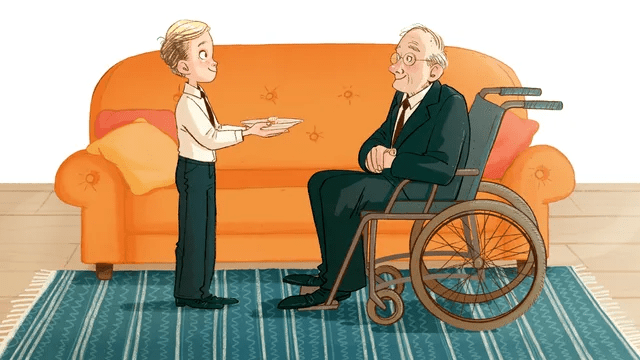
Friend November 2020 “Help Passing the Sacrament” Brayden was almost old enough to pass the sacrament, but he didn’t know how he was going to do it because he used a walker to help him walk. But then the other deacons volunteered to take turns pushing him in his transport chair so he could carry a tray. He was glad to be part of such a great deacons quorum!
Ministering
Friend December 2019 “Notes for Sister Puckett” Tyler was excited to become a deacon so he could serve and minister like his parents do. (His father takes notes in sacrament for Sister Puckett who is sick, and his mom made taco soup for her.)
Family History Service
Friend August 2021 “Meet Porter from Poland” Porter likes to help out at home and school. Porter also helps out by participating in the BillionGraves project. He and his family take photos of headstones at a cemetery and then upload them so people can find information on their Polish ancestors.
Singing
Friend June 2018 “A Baptism Song” Elizabeth and her sister sang at a baptism which helped those attending to feel the Spirit.
Friend March 2016 “A True pearl” Jetta must go away from home to learn the piano, but when she returns she uses her talent to serve.
Friend May 2026 “Playing Piano at Church” In Andhra Pradesh, India, one ward had no one to play the piano at church. Four children learned they could make a difference at church.
Leading Music
Friend April 2023 “Leading Like Jesus” Julie was asked to conduct the hymns in sacrament meeting, and she was very anxious. After talking to her father about her fears, she thought about how being a conductor is like Jesus Christ because he is our leader and he guides us in the right way and at the right time. She then became excited to conduct because she would represent Christ.
Friend May 2018 “Spirit of Eliza” Eliza loved family history. But could she talk about it in front of everyone at church?
Friend June 2022 “Moira’s First Talk” President Scott asked Moira to give a talk in district conference. Moira was only 12 and she was a new member of the church. She wasn’t sure if she could do it but she said she would try. She knew Heavenly Father would help her.
Friend June 2021 “Ana Cumandá Rivera” Ana taught her companion how to read while on her mission. After her mission, Ana wanted to continue to serve. She was invited to teach others how to read.
Friend April 2023 “Reaching for Mars” Michelle went to college to be an engineer. After college she got a job helping launch rockets to explore space! She helped create a robot called a rover to send to Mars. But then she and her husband were called to serve a mission leaders. She would have to leave her job and miss the launch of the Mars rover! But she knew serving the Lord was more important, so they accepted the calling. She bore her testimony that Jesus Christ created worlds without end, and he wants us to learn, grow, and use our talents for good.
Friend June 2024 “Serving at the Storehouse” Dominic and his mother help fill an order at the Bishop’s Storehouse. His mother explains that when we pay a fast offering the money helps buy food for those that need help. That is a way all the members of the Church help each other, so none go hungry.
Saul, the son of Kish, a Benjamite, is a choice and goodly person—He is sent to seek his father’s asses—The Lord reveals to Samuel the seer that Saul is to be king—Saul goes to Samuel and is entertained by him.).
Come, Follow Me—For Primary: Old Testament 2022 “1 Samuel 8–10; 13; 15–18” The accounts of God choosing Saul and David to be kings can help your class understand how people are called to serve in the Church today. These accounts can build faith that callings come from God through His authorized servants.
On separate strips of paper, write the following statements and scriptures: the people wanted a king (1 Samuel 8:6); the Lord told Samuel that Saul would be king (1 Samuel 9:15–17); Samuel anointed Saul (1 Samuel 10:1); Samuel presented Saul to the people (1 Samuel 10:24). Ask the children to read the scripture passages and put them in the correct order.
Learn together the fifth article of faith. Briefly tell the children how you received your calling to teach in Primary. How do you know that you were called of God? Testify that God inspires leaders to call people to serve.
“Article of Faith 5” (May 2011 Friend) Number pictures relating to how a person receives a calling in the right order.
Friend July 2026 “All on the Same Team” Kylee wonders why there are no girl bishops. Her aunt explained that everyone has a different job to do. It’s like playing on a team. Every position is important and needed.
When members receive callings or priesthood ordinations in the Church, we have the opportunity to formally sustain them by raising our right hands as a show of support. The principle of demonstrating public support and agreement is called common consent. As President Gordon B. Hinckley taught, “The procedure of sustaining is much more than a ritualistic raising of the hand. It is a commitment to uphold, to support, to assist those who have been selected” (“This Work Is Concerned with People,” Ensign, May 1995, 51).
Sustaining is a chance to show and give our support and to acknowledge the will of God.
Releases
Friend April 2018 “Bugs for Brother Baugh” Lizbethis upset when she hears that Brother Baugh is being released from the Bishopric, but she learns that Brother Baugh will still be at church and still love her. He will also still want to see her bug pictures that she draws for him.
Friend May 2018 “What’s on Your Mind” Ways to help with Heavenly Father’s work and make a difference in the world even when we are young.
Friend February 2023 “Marco’s New Calling” Marco had just moved from Primary to Young Men’s and the bishop extended a calling to him to serve as a family history consultant. He received some training and then worked on his own family history and got some names prepared to take to the temple for baptisms, including a much loved aunt who had died. He was excited to help others with their family history. He shared his testimony of family history at a Church activity, and he invited other youth in their ward to come with his family on their temple trip.
Worldwide Church Service
Friend September 2025 “Healthy Gardens” In Bolivia in 2014, the Church helped families build their own greenhouses and container gardens to grow vegetables. Jesus Christ, through His Church, helps people all around the world! Can you find the hidden items?
Come, Follow Me—For Primary: Old Testament 2022 “Ruth; 1 Samuel 1–3” When Ruth’s husband died, she could have stayed in her home country, but she chose to go with her widowed mother-in-law, Naomi, and care for her. Consider how Ruth’s Christlike example could inspire the children you teach to be kind to those around them.
Invite the children to represent Naomi, Ruth, Boaz, or other characters as you tell their story from the book of Ruth (see also “Ruth and Naomi” in Old Testament Stories). Invite the children to raise their hands every time they hear an act of kindness in the story. How do we feel when people are kind to us? How do we feel when we are kind to others?
Sing together a song about being kind, such as “Kindness Begins with Me” (Children’s Songbook, 145). Help the children think of ways they can be kind to their family and friends. If they need help, show them pictures of people showing kindness. For every idea mentioned, let the children draw a heart on the board.
After Ruth became a widow, she chose to stay with her mother-in-law, Naomi, instead of returning to her people, “for whither thou goest, I will go; and where thou lodgest, I will lodge: thy people shall be my people, and thy God my God” (Ruth 1:16).
Ruth supported Naomi by staying with her. Try this activity to learn about supporting family:
Choose a family member and stand back-to-back. Place any object (a small ball or a book) between each other’s backs.
Working as a team, see how many steps you can take together without letting the object fall.
Take turns as a family until everyone has had a chance to work as a team to help each other.
Discussion: How did Ruth and Naomi help each other? Ruth believed in Heavenly Father and had faith, so she stayed with Naomi. How was she blessed? How can we support each other and trust the Lord when we have difficulties?
Story: Read about Ruth in the scripture story on page 8. She worked hard and gathered grain to take care of her husband’s mother. God blessed her for serving others.
Activity: Cut out pieces of paper in the shape of grain kernels. Use a stick or long piece of paper as a stem. Glue or tape your kernels to the stem to make a stalk of grain. Whenever you serve someone, pull off a kernel. Keep going until the stem is bare!
Lesson 26: Ruth and Naomi,” Primary 6: Old Testament (1996), 114–16 To help the children have the desire to follow the example of righteous people and to be good examples themselves.
Friend July 2018 “Ruth was a Loyal Friend” Link includes story and goal card ideas to learn how to be a good friend like Ruth.
Friend April 2015 “April’s New Wheelchair” April’s brother helps her see that she can learn to get around in her wheelchair.
Friend April 2015 “Cheering Up Grandpa” After Mike’s grandmother dies, his grandpa becomes very sad, even when gardening. Mike nominates his grandpa for Gardener of the Year hoping to help his grandpa feel better.
Friend April 2015
Friend April 2015
Giving Time to Those We Love
Friend April 1988 “Hero Sister” Cassie takes her sister to the bus stop and stays with her until the buss arrives, even though she needs to get to school to finish some homework. While waiting, Cassie saves her sister from a runaway car.
Service Helps Us Be Happy
Friend June 2016 Two sisters throw a bedroom sleepover party for their younger sister because she feels left out.
Friend April 2016 “Off to Chicago” Alex is sad his brother will be gone for 3 days, but he makes a gift to help his brother not be lonely and that makes Alex feel better.
Friend April 2016 “Love Spoken” Cassie makes a recording of her mother’s favorite story for her mom to listen to while she’s sick. She learned this from her mom.
Friend January 2016 “The Cleanup Crew” Skit about children thinking of a way to help their mother.
Friend October 2015 “The Doll in the Green Dress” – Girl sacrifices what she wants when she chooses a doll, out of love for her sister.
Friend May 2026 “Eden the Laundry Fairy” Eden sees that her mom and dad have a lot to do, so she prays to how to help. She decides to help by folding the laundry
Friend December 2024 “Primary Power” Elder James W. McConkie III Of the Seventy and his wife served as mission leaders in the Czech Republic and Slovakia. He loved going to Primaries in the area. He learned three things about Primary children. First, he learned that they can feel and recognize the Holy Ghost. Second, he learned that they want to learn about spiritual things. Third, he learned that Heavenly Father is aware of them. He wants them to have spiritual experiences. Primary is a special place where they can learn about the gospel and feel the Holy Ghost. (See more at link)
Graduation from Nursery to Sunbeams
Friend January 2017 “For Parents of Little Ones” Ideas on how to help a child prepare to go to Sunbeams.
Friend January 2016 “It’s Primary Time” Preparing nursery children for Primary and Sunbeams
Friend December 2022 “The New Teacher” Anna likes her Sunbeam class and is nervous to go to a new class at the beginning of the new year. But her new teacher is very welcoming and the same kids from her Sunbeam class are in her new class.
Friend November 2020 “What’s on Your Mind?” A child is nervous about leaving Primary because everyone in Young Women and Young Men is older and more experienced. The Friend magazine and some other kids give some advice to the preteen.
Friend September 2018 “Friends by Mail” Robyn’s friends had all gone into Young Women and she didnt have any friends in Primary with her. It made her feel kind of sad and lonely. She found a maze in the Friend magazine about emotions like confusion and being afraid, with scriptures in the middle of each. After she looked up the scriptures and prayed, she felt peace and love from Heavenly Father.
Friend November 2024 “Too Big for Primary?” Gift was tired of Primary. She was older, taller, and bigger than all the other kids. Her friends at church were all in Young Women now. She asked the bishop if she could go to YW’s early, but she coudn’t. He pointed out that she probably makes a big difference for the younger children. The next week she helped teach a song in Primary. Afterwards one of the little girls said, “I want to be like you when I get big.” She realized maybe she could still learn and do good things in Primary.
Friend October 2017 “Finding Lydia” Lydia isn’t excited to be graduating from Primary and going to Young Women’s, but she becomes more excited when her mother finds some family names for her to do baptisms for in the temple, and one is named Lydia.
Friend November 2015 “Young Women Strong!” Maya learns about Young Womens and how it adds spiritual strength.
Friend May 2019 “Feed Your Spirit” President Nelson is happy when he sees 11 year olds that graduate from Primary doing good things in the gospel like passing the sacrament and going to the temple. He is thrilled when children of all ages feed their spirits by feasting on the truths of the gospel of Jesus Christ.
Friend January 2019 “Show and Tell” I am the oldest kid in Primary, and everyone looks up to me, so I act reverent. Nicholas F., age 11, Idaho, USA
Friend March 2023 “Just Lillian” Lillian was excited to go into Young Women’s, but then she learned she would be the only one in there, her and the teachers. She prayed for help, and her prayers were answered when her mom said that her young women’s leader was her best friend. Maybe that would happen for her too. And then a new girl moved into the ward too.
Moving On to Young Men and Young Women? Here are some things to get excited about! A new magazine: For the Strength of Youth. Also, a guide for making choices. (Also temple baptisms)
Friend November 2023 “We’ll Do This Together” Annie was nervous about starting Young Women’s. It wasn’t easy for her to make new friends and talk to people. Her sister suggested she look for others to help that might be nervous too. So she did and it helped her feel better.
Friend November 2025 “Ready to Keep Growing” Jewel was nervous about going to Young Women’s. But she felt the Holy Ghost telling her she was now old enough to learn more about being a disciple of Jesus Christ. She felt comforted by those words. Even though she didn’t have many friends in Young Women yet, she wasn’t alone. She had the Holy Ghost. The second time she went to YW’s a girl invited her to sit by her. The girl was kind and made her feel welcome. During the lesson Jewel even told how the Holy Ghost had helped her. Jewel still missed Primary sometimes. But because of the Holy Ghost, she was ready to keep on growing.
Friend November 2025 “Looking Forward to the Youth Program” Leaving Primary the year you turn 12 can sometimes feel scary or even sad. Luckily, there are a lot of exciting things about turning 12 and joining your Young Women class or Aaronic Priesthood quorum! Here are just a few.
FriendAugust 1986 “Primary Makes Me Happy” A play about how the Primary came to be.
Primary children in stake had a Friend reading challenge. Together they read 2,920 Friend stories! They put a box full of Friend magazines to read at each Church building in the stake. Each child had a punch card to keep track of how many stories they read or listened to. They even had a stake activity using ideas and recipes from the Friend.
Friend September 1986 Sister Grassli gave a talk in Primary when she was eight years old. She talked about pre-earth life and how Jesus Christ and Satan presented their plans and about how Christ’s plan was chosen. Satan got mad and said, ‘I’ll get them!’ She thought at the time, “Well, he’s not going to get me!” She remembered that decision and determination all her life. Primary talks helps us learn and grow spiritually stronger.
Friend July 1986 Game: Children practice teaching and giving talks.
Friend February 2015 “Juliana Gives a Talk” Juliana is scared to give a talk, but Heavenly Father helps her.
Friend November 2019 “The Primary Talk” Dennis was afraid to give a talk in Primary. He prayed, prepared, and practiced but he was still nervous, so he asked his father to give him a blessing. After the blessing he was able to give the talk with only a few stutters, and he knew Heavenly Father helped him.
Opening Exercises
Friend June 2020 “Friends by Mail” For our 2019 Kindness Garden, we adopted a “Primary grandma” each month. We sang their favorite Primary songs and listened to their testimonies. They even helped us sing in our Primary program! Garden Park 7th Ward, Utah, USA
Friend September 2019 “Friends by Mail” My mother is the Primary president, and sometimes I go with her to visit kids who haven’t been to Primary in a while. We say hi to them, or visit them on their birthday. We take the Friend with us as a gift for them. Levi C., age 9, California, USA
Primary Handouts
Friend August 2018 A wristband to cut out and wear that says “Primary is Awesome.”
Bulletin Board and Primary Room Displays
Friend January 2021 “Show and Tell” This Primary in Texas, USA, created a bulletin board of Christ appearing, with everyone in Primary standing around Him. It helps everyone feel closer to Him.
Friend June 2018 “Show and Tell” Primary children in this ward look for their photo holding to the iron rod whenever they are in the Primary room.
Friend August 2026 Primary children in West Yorkshire, England, collected over 200 books and donated them to children in South Africa.
Primary children in Miyagi Prefecture, Japan, participated in a beach cleanup with their friends. They admired the many beautiful shells as they picked up trash. Their experience helped them feel gratitude for the beautiful world Heavenly Father created.
Friend April 2026 “An Easter Idea” After watching “Friend to Friend” a Primary class wanted to do a service project. They decided to make Easter bags for kids who do not have much for Easter. They made flyers and got donations and made over 100 Easter bags!
Primary children in North Carolina, USA, collected broken crayons. They sorted them by color and peeled off the paper. The old crayons were sent to a recycling company and made into easy-to-hold triangle crayons. Then children in hospitals got the new crayons!
Primary children in Pohnpei State, Micronesia, picked up trash at a local park and played kickball after.
Friend March 2021 “Find It” The Primary invited the elderly in their branch to a game day activity. Find the hidden objects.
Friend January 2021 “Find It” These Primary children in Germany had a family history day! Find 5 old photos and 10 pairs of scissors. Then find the other hidden objects.
Friend June 2019 “Friends by Mail” Activity day girls in Florida, USA, created a tropical kindness garden! It hangs in the Primary room for other children to add their kind deeds. (includes photo)
Friend October 2018“The Parleys Creek Branch Primary, Utah, USA, went to the open house for the Jordan River Utah Temple.”
Friend March 2016 Primary children in a stake had a Friend reading challenge. Together they read 2,920 Friend stories! They put a box full of Friend magazines to read at each Church building in the stake. Each child had a punch card to keep track of how many stories they read or listened to. They even had a stake activity using ideas and recipes from the Friend.
Friend August 2023 “The Family Story Activity” The children in Lorrain’s primary were learning about their family history so they could share the stories at a Primary activity. Lorrain learned about being named after her great grandmother and about her father traveling to the temple to be sealed to his family when he was six. Before the Primary activity they heard some exciting news. A temple would be built in on their island!
Primary children in Acre, Brazil, collected and delivered essential items to seniors living in an assisted living center. They learned empathy, compassion, and service to others.
Primary children in North Carolina, USA, collected over 500 books for a stake service project. The books were donated to local free libraries to help children have access to free books.
Friend March 2026 “Celebrating Easter” These Primary children in Texas, USA, celebrated Easter together with a Primary activity! (See their picture on the back cover.) They also made cards and bracelets for people who were sick.
Bringing Scriptures to Primary
Friend October 2017 “Show and Tell” Primary children in the Cobblestone 2nd Ward Primary, Utah, USA, earned blocks by bringing their scriptures to church and by reading about Jesus and choosing the right. They built 12 different Book of Mormon scenes and had fun growing their testimonies of the scriptures! (Leaders could build with the blocks during the week and show the children what was built with their blocks. It would be fun for the kids to see what scene it will be. They could even guess.)
Friend June 2016 Primary children of the Sarasota Ward, Sarasota Florida Stake, earned blocks to build the Nauvoo Temple by coming to Primary, bringing their scriptures, and learning the Articles of Faith. They learned that families are forever!
Friend May 2016 Primary children in the Virden Ward, Duncan Arizona Stake, New Mexico, USA, fill jars of pennies to buy copies of the Book of Mormon for the missionaries. Every Sunday, children who bring their scriptures get to put a penny into a jar. When it is filled, they put a child’s testimony in each Book of Mormon to share.
Primary Teachers
Friend July 2020 “The Secret Ingredient” Sister Franco’s primary teacher when she was young always brought chocolate cake for her class. Sister Franco didn’t like chocolate cake but one day she tried it because her primary teacher said it was made with a special ingredient. Later, Sister Franco found out that her teacher used her bus money to make the cakes, and had to walk 2 miles to church. The secret ingredient was love.
Primary Sacrament Program
Friend April 2022 “A Part to Play” The kids in Capri’s Primary class each got a part to say in the Primary program, but Capri has disability that makes it hard to speak. Her teacher gave her a special music box to play in the program that plays “I Am a Child of God.” Capri felt something warm in her heart. She knew she was a child of God. And she had an important part to play.
Friend October 2024 “Just Right for Zack” Zack has sensory processing disorder, so he likes to do the same things every day. One day at church, all the kids practiced for the Primary program in the chapel. This was very different! Nothing helped him feel better so the leaders gave him a special job for the program. It was just right for him.
Friend November 2020 “The Great Big One-Girl Primary Program” Bella is the only child in primary in her small branch. She and her mom (who is the Primary president) work on ways to do a program with just one child, and other people pitch in and help too.
Friend May 2023 “Cameron the Piano Player” Cameron volunteered to play a couple of songs in the Primary Program even though he didn’t know how to play. He took lessons and practiced really hard and did great at the program and wanted to learn more songs. He felt like it was a way to share his testimony.
Friend November 2015 – Mandy wants to be a good example for the younger children in the Primary program.
Friend August 2015 “Clara and the Primary Program” New member, Clara, is asked to read and bear testimony in the Primary program.
Friend October 2022 “Being Brave” Brayden was scared to talk in front of so many people for the Primary program. His father suggested saying a prayer to help him fell brave. It helped him feel better and he was able to say his part and remember all the words.
Friend October 2023 “Find It!” These Primary children are singing in their sacrament meeting program. Can you find the hidden objects?
Friend December 2020 “What’s on Your Mind?” A child asks the Friend the following: “I love getting presents at Christmastime. But how can I focus more on Jesus Christ?” Serving others and learning more about Jesus can help you feel the real joy of Christmas! The game below has lots of ideas.
Friend December 2024 “The Prince of Peace” President Dallin H. Oaks “At this Christmas season, the world celebrates the birth of Jesus Christ, the “Prince of Peace” (see more at link) Sharing the Savior’s Peace: You can share the love and peace of Jesus Christ! For 12 days leading up to Christmas, choose an activity to do with your family. Then color in an ornament.
Friend December 2018 “Funstuff” Word Search: A bright new star announced the birth of Jesus Christ. And other stars shone down on Bethlehem too. See if you can find all the words about these heavenly lights.
For the Strength of Youth December 2025 “Fun Stop” In some countries, people put Christmas lights on their homes or trees. Christmas lights can remind us to “light the world.” More importantly, they can remind us of the “light of the world,” Jesus Christ (John 8:12).
The Christmas lights in this scene are arranged by color, in patterns. Can you find six places where the colors don’t follow their pattern?
Origami Star: When Jesus Christ was born, a new star appeared (see Helaman 14:5; Matthew 2:2). Make an origami star as a way to remember Him!
Friend December 2019 “Find It” These friends are collecting toys to give to others so that they can have an even happier Christmas. Can you find the hidden objects?
Friend December 2023 “Christmas Delivery” The Savior told us to love our neighbors as ourselves (see Matthew 22:39). Miles wants to take Christmas cards to his neighbors to show he cares about them. Use the clues to help him remember who lives where.
Just for Fun
Friend December 2016 “Funstuff: Puzzle Page”. Stockings could be used for a matching activity in teaching a song or concept. Copy and paste into word document to adjust size.
Service
December 2024 For the Strength of Youth “Fun Stop” Fix the Ornament Mix-Up: Around the world, many people celebrate the Savior’s birth by decorating Christmas trees. Can you tell which three ornaments are not like the others?
Friend January 2022 “Not So Lonely” Damián takes the bus to his grandparents house every Saturday so he can go to church with them on Sunday. It’s lonely going alone and wishes the rest of his family would come with him. Then Damian remembers all the people who love him including his family and Heavenly Father and Jesus, and that helps him not feel so lonely.
Friend April 2022 “Somebody Loves You” When Sister Susan H. Porter, First Counselor in the Primary General Presidency, was on her way to a new job, she started worrying that she wasn’t good enough. Then she had a clear feeling to try her best and remember that even if it doesn’t go well, there’s somebody who loves her.
Love Your Enemies
Friend December 2020 “A Gift of Friendship” Hermann was forced to fight with the Germans in World War 2. He was captured and put in a British POW camp. President Camm from the branch came to visit him when he heard he was a member. He and Hermann taught other prisoners of war the gospel and they were allowed to go to church. Hermann was nervous that the members would see him as their enemy. At first they were nervous around him but soon grew to trust him. Hermann carved toys for the children to thank the members for being so kind to him.
Friend January 2019 “Something Nice for Mean Mr. Gates” Michael wants to be like Jesus and love his grumpy neighbor Mr. Gates, so he makes him cookies even though everyone tries to persuade him not to. When Michael delivers the cookies, Mr. Gates smiles for the first time Michael had ever seen.
Friend January 2018 “A Friend for Mr. Maurice” Carter’s neighbor, Mr. Maurice, seems mean. Carter’s father tells him that Jesus taught that we are to love everyone. Carter tries to be kind and help Mr. Maurice and finds out Mr. Maurice is easier to love than expected.
Friend November 2017 “The Vegetable Thief” Earl is upset when he sees a lady taking vegetables from their garden, but he learns what charity means when his mother has him give the lady their best vegetables for her starving family.
Friend June 2017 “An Extra Dose of Love” Ashley’s mom likes to get to church early to look for people who need an extra dose of love. She sends those people cards. Ashley thinks of a friend who might need a card.
Friend January 2016 “Show the Love in your Heart” Lesson ideas about showing love for others.
Friend January 2016
Charity is the Pure Love of Christ.
We include others when we have charity in our hearts..
Friend June 1988 “Losers Win” Kristen asks a boy who has a prosthetic leg and isnt participating to be her partner in the three legged race, and they both have fun even though they don’t win.
Friend October 2016 “A New Picture for May” In Primary class May is sad because she doesn’t know how her family shows love for each other, but her friend adds May’s picture to her family chain with Jesus. May knows Jesus loves her and her friend loves her. (We are all brothers and sisters and Jesus is our elder brother.)
Valentine’s
Friend February 1986 “A Valentine for Carla” Lucy is reluctant to give a Valentine card to a girl who bully’s others, but Lucy makes the card which makes the girl happy.
Love Your Enemies
Friend February 1986 “Secret Formula” Aaron learns that the formula for getting rid of an enemy is love.
Friend December 2022 “Hi Friends” I like visiting the cemetery on Christmas Eve. We light candles on the graves of family and friends. Aasa L., age 3, Northern Savonia, Finland
Friend December 2024 “Christmas Eve Candles” Every year on Christmas Eve, people in Finland visited the cemetery to light candles on the graves of their loved ones. Joska’s family discussed why they light candles on Christmas Eve on graves. Joska thought it was because Jesus is the light of the world. His mother agreed and said, “It’s because of Jesus Christ that we can be with our family forever. And because He lived again, all of us will live again too.”
Latin America
Friends December 2022 “Find It” In many parts of Latin America, people set up Nativity scenes but leave the manger empty. They add the baby Jesus on Christmas Eve. It helps them remember His birth! Can you find the hidden objects?
Columbia
Friend December 2019 “Family Night Fun” Columbia Christmas mosaic gelatin treat.
Friend December 2021 “Christmas in Mali” Judith and her siblings were going to their branch’s Christmas party. Not many people in Mali celebrated Christmas. In this part of Africa, most people didn’t know much about Jesus. To them, Christmas was just an ordinary day of work and play.
Guatemala
Friend December 2022 “Cookies, Hugs, and Love” Because of a hurricane and Covid, Eva’s family Christmas traditions of celebrating with family, friends, and neighbors was not possible. Eva was sad. Their family decided to buy food for people who lost their homes in the hurricane and Eva wanted to make cookies for the children in the shelter. Serving others helped her feel better.
Friend December 2024 “Tying Hallacas” Ivette’s family gathering together to make hallacas, a Venezuelan holiday food. This year, Abuela had promised Ivette that she could help make them. When she found out that her job was to put her finger on the string to help finish the knot, she was disappointed and didn’t think her job was needed. Her Abuela said, “We all play a special part in making hallacas—just like we all play a special part in Heavenly Father’s family.”“We are all needed in this family,” Mom added. “It’s how we stay strong.” As she looked around at her family she realized that everyone was different. Her aunt told the best jokes. Her mom gave amazing hugs. And Abuela always knew what to say to make things better. Heavenly Father had given them all different gifts, but that was what made them special.
Peru
Friend December 2025 “The Nativity Tradition” Spencer’s family gathered rocks, twigs, flowers, and moss outside. His father explained that it was tradition where they live for families to gather things Heavenly Father has given them in nature to make a place for baby Jesus. Once the materials were gathered they made the stable and the manger with the things they had found outside, and then, on Christmas Eve, they would add the baby Jesus to the Nativity scene. Over the next few days, they gathered by the table to light a candle and sing Christmas songs. Spencer liked how the manger for baby Jesus stayed empty. It reminded him that they were waiting for something special. It helped him think about Jesus and feel closer to him.
For the Strength of Youth December 2023 Around the world, people celebrate the Savior’s birth in many different ways. Match the Christmas tradition with the part of the world it originates from.
Christmas Foods Around the World
For the Strength of Youth December 2022 “Fun Stop” Can you match the bolded food names with their picture and description? (Hint: foods are grouped on a table by country.) Christmas Food around the World: 1. E 2. F 3. A 4. B 5. K 6. L 7. I 8. J 9. C 10. D 11. G 12. H
Friend December 2025 “Articles of Faith”What this means: We believe that it’s important to live like Jesus Christ did. We can do this when we are honest, pure, and kind. Paul, one of the early Apostles, said that we should believe and hope in Jesus Christ. We should fill our lives with good things that help us follow Him.