2 Samuel CHAPTER 11 David lies with Bathsheba, and she conceives—He then arranges for the death in battle of her husband, Uriah.
2 Samuel CHAPTER 12 Nathan tells David the parable of the ewe lamb—The Lord gave many wives to David, who is now cursed for taking Bathsheba—David fasts and prays for his son, but the Lord takes him—Solomon is born—David conquers the royal city of the Ammonites.
“King David” in Old Testament Stories, 117–20, can help you tell your children the story in 2 Samuel 11. You might ask your children to identify the wrong choices David made and suggest good choices he could have made instead. What are some things we can do when we are being tempted that can help us make the right choice?
The children you teach make small but important decisions every day. How can you help them understand the importance of choosing what’s right even when it’s hard?
To share an example of someone who, unlike David, resisted temptation, ask the children if they remember the story of Joseph and Potiphar’s wife (see Genesis 39:7–12). You might review this story with the children and help them compare it with the story of David. What can we learn from the stories of David and of Joseph about how to resist temptation? (Watch below video until .38)
Lesson 15: Joseph Was Sold into Egypt,” Primary 6: Old Testament Tell the class that the nail, pin, or paper clip represents us. Place it between the two magnets on a flat surface so it can be attracted by one or the other. Show that the further away from “Satan” we are, the less power he has to tempt us. As you move the metal object toward the magnet representing God, explain that the closer we live to the Lord, the more we are influenced by his goodness. When we seek after good, we are less influenced by that which is evil. (What can we do to draw close to God? How can the Holy Ghost help us?)
Heavenly Father and Jesus Christ know that it is harder to avoid temptation when we allow ourselves to get close to it. Discuss with the children how they could distance themselves from temptation in the following situations:
You could make a list on the chalkboard of temptations, Discuss strategies for resisting evil, such as removing ourselves from the situation and replacing the temptation with something wholesome. Erase each harmful influence from the chalkboard as it is discussed.
Story: The prophet Nathan told a story about two men. The first man had lots of lambs. The second man had only one lamb. The man with many lambs stole the other man’s lamb. That made the man with only one lamb very sad. It also made Heavenly Father sad. (See 2 Samuel 12:1–4.)
Song: “I’m Trying to Be like Jesus” (Children’s Songbook, 78–79)
Activity: Act out the story of the two men and the lambs. You could use toys or other objects for the lambs. Then act it out again, but this time change the ending! What can the first man do to be kind instead of selfish?
Reading about David’s tragic sins might be a good opportunity to discuss the dangers of pornography. The video “What Should I Do When I See Pornography?” (Gospel Library) has helpful guidance. Help your children make a plan about what they will do when they encounter pornography.
Video tells story of David. President Oaks compares David’s story to looking at pornography.
Discuss some ways the children can interrupt impure thoughts that may come to them (turn away, leave the situation, replace the bad thoughts with good thoughts and actions, say a prayer, think of an uplifting song or verse of scripture, recite the thirteenth article of faith, and so forth). Challenge the class members to be prepared in advance with a specific replacement for an undesirable thought. Allow them a minute to choose something uplifting they can think of instead.
1 Kings CHAPTER 3 Solomon loves the Lord and keeps His commandments—The Lord appears to Solomon and promises him a wise and an understanding heart—He judges between two harlots and determines who is the mother of a child.
Ask the children to name things they would ask for if they knew they could ask Heavenly Father for anything and he would give it to them. Write the children’s ideas on the chalkboard.
Show the children some waterproof items that could represent worldly goods, such as a piece of jewelry, a coin, a pretty rock, and so on. Put the items in a large pitcher or container as you talk about them and discuss how some people spend most of their efforts accumulating material goods. Then add some water to the container to represent good deeds or spiritual gifts as you discuss the kind deeds we can do and the spiritual gifts we can develop, such as helping a family member or friend, gaining a testimony, being honest, or having an understanding heart. Pour the contents of the container through a strainer into another container. Explain that the first container represents someone’s life, the strainer represents death, and the second container represents life after death. Discuss how we cannot take material goods with us when we die, but we do take with us the spiritual gifts we have developed and the good deeds we have done.
Ask the children which of the items on the chalkboard represent things that could last forever and if they would like to change anything they named before. Tell the children that they are going to learn about someone who was able to ask God for one thing, and he chose an eternal, spiritual gift instead of a temporary, earthly one.
Write knowledge, wisdom, and an understanding heart on the chalkboard. Discuss the meaning of each one. Explain that knowledge is learning gained through study or experience; wisdom is using what we have learned in the best way to make right choices; and an understanding heart enables us to know how others feel.
Have the children find the book of Proverbs in their Bibles. Explain that most of these proverbs (wise sayings) were written by Solomon, and because of his great wisdom, these sayings can help us today. (See the lesson link for a list of some of the wise sayings found in Proverbs.)
Two Women, One Baby
“Lesson 96: 1 Kings 1–10,” Old Testament Seminary Student Material We read in 1 Kings 3:16–23 that two women petitioned King Solomon to judge a difficult situation. The two women lived in one house and had borne children at about the same time. One night, one of the women woke up to find that her baby had died. Rather than mourn the loss of her baby, she switched her dead baby with the other woman’s baby. The next morning, when the second woman awoke to nurse her child, she found the other woman’s dead baby in her arms instead of her son. When the women came before Solomon, the first woman fervently denied the other woman’s accusation that she had switched the babies.
Read 1 Kings 3:24–27 to find out how Solomon identified the child’s rightful mother.
We read in 1 Kings 3:28 that all of Israel heard of this experience and recognized that God had blessed Solomon with wisdom. According to 1 Kings 4, knowledge of Solomon’s wisdom spread to other nations.
Activity: When we follow Jesus Christ, we walk in His ways. Make a path outside using chalk, leaves, or rocks. If you can’t make a path outside, make one inside using towels and blankets! Now follow the path together. Talk about things you can do to walk in His way, like keeping the commandments.
THE TEMPLE OF SOLOMON
I Kings Chapter 6 Solomon builds the temple—The Lord promises to dwell among the Israelites if they are obedient—The ornaments of the temple are described.
1 Kings Chapter 7 Solomon builds himself a house—Hiram of Tyre makes the two pillars, the molten sea, the ten bases, the ten lavers, and all the vessels for the temple—The molten sea (baptismal font) rests on the backs of twelve oxen.
1 Kings CHAPTER 8 The ark, containing the two tablets of stone, is placed in the holy of holies—The glory of the Lord fills the temple—Solomon offers the dedicatory prayer—He asks for temporal and spiritual blessings upon repentant and prayerful Israel—The people sacrifice and worship for fourteen days.
I Kings Chapter 9 The Lord again appears to Solomon—The Lord promises great blessings if the Israelites are obedient and great cursings if they forsake Him—Solomon reigns in splendor, levies tribute upon the non-Israelites, and builds a navy of ships.
Making covenants in the Lord’s house—and keeping them—helps me walk in His ways.
Explain to the children that David, Solomon’s father, had wanted to build a temple but was denied the privilege. The Lord instead chose Solomon to direct the seven years of construction. When the elaborate temple (much of it was overlaid with gold) was finished, the priests carried the ark of the covenant, which contained the two tablets of stone the Lord gave Moses, “to the most holy place” of the building (1 Kings 8:6). Then the glory of the Lord filled the temple (see 1 Kings 8:10–11), and Solomon offered the dedicatory prayer (see 1 Kings 8:22–53.)
For the Israelites, building and dedicating the temple was an opportunity to turn their hearts to the Lord and recommit to “walk in all his ways” (1 Kings 8:58). How can you help the children you teach “walk in all his ways”?
As you and your children learn about the dedication of the temple in 1 Kings 8, you could look at the pictures of temples in this week’s outline. Let your children talk about details they see in the pictures. You might emphasize verses 57–58. What does it mean to “walk in all [the Lord’s] ways”? (1 Kings 8:58). Maybe your children could take a step for each answer they give.
Tell your children how keeping the covenants you make in the temple helps you walk in the Lord’s ways. You might tell them what these covenants are (see General Handbook, 27.2, Gospel Library).
Help the children understand that we walk in the Lord’s ways when we follow Jesus and try to become like Him. Ask the children what they do to walk in the Savior’s ways. You could sing a song about following Jesus, such as “I’m Trying to Be like Jesus” (Children’s Songbook, 78–79).
1 Kings CHAPTER 11 Solomon marries non-Israelite women, and his wives turn his heart to the worship of false gods—The Lord stirs up adversaries against him, including Jeroboam, the son of Nebat—Ahijah promises Jeroboam that he will be the king of the ten tribes—Solomon dies and Rehoboam reigns in his stead.
Reading about how Solomon’s wives influenced him could lead to a conversation about examples of “other gods”—or things that people worship or love instead of the Lord. How do we show that we love Him more than anything else in our lives?
1 Samuel CHAPTER 8 Samuel’s sons take bribes and pervert judgment—The Israelites seek for a king to rule over them—Samuel rehearses the nature and evils of kingly rule—The Lord consents to give them a king.
1 Samuel CHAPTER 9 Saul, the son of Kish, a Benjamite, is a choice and goodly person—He is sent to seek his father’s asses—The Lord reveals to Samuel the seer that Saul is to be king—Saul goes to Samuel and is entertained by him.).
1 Samuel CHAPTER 10 Samuel anoints Saul to be captain over the Lord’s inheritance—Samuel manifests the gift of seership—Saul prophesies among the prophets, and the Lord gives him a new heart—He is chosen king at Mizpeh.
As you read 1 Samuel 8 with your children, help them find reasons Samuel told the Israelites that having a king was a bad idea. Why is it better to have Jesus Christ as our king? Maybe you could make a paper crown together and take turns wearing it and sharing something we can do to show that we want Jesus to be our King. (See also Jeremiah 23:5; Doctrine and Covenants 45:59.)
DAVID IS CALLED TO BE KING
1 Samuel CHAPTER 15 Saul is commanded to smite and destroy the Amalekites and all that they have—He saves some animals to sacrifice—Saul is rejected as king and told that to obey is better than sacrifice—Samuel destroys Agag.
1 Samuel CHAPTER 16 The Lord chooses David of Bethlehem as king—He is anointed by Samuel—Saul chooses David as his companion and armor bearer.
Invite the children to imagine they were asked to pick someone to be a king. What qualities would they look for? Read together 1 Samuel 16:6–7 to find out what the Lord said to Samuel as he was looking for a new king for Israel. What do we learn from the Lord’s instructions?
An object lesson could help your children understand the principle in 1 Samuel 16:7. For example, you could show them some food or a book with a wrapper or cover that doesn’t match its true contents. What do 1 Samuel 16:7 and this object lesson suggest about how we should view ourselves and other people? Sing a song that emphasizes this principle, such as “Love One Another” (Children’s Songbook, 136).
What are some ways people judge others “on the outward appearance”? Present an object lesson to illustrate to the children that judgments we make based on “the outward appearance” (verse 7) may not be correct.
A cantelope is rough and drab on the outside but sweet and colorful on the inside.
You and your children could share experiences in which you learned why you should “look on the heart,” not just “the outward appearance” (verse 7). You might also take turns telling each other about the good qualities you see in each other’s hearts.
Activity Idea: Make one copy of the hearts page for each child. Put the child’s name on the top of their page. Have the children each write something good about that person on a heart.
Activity: The Lord cares most about what is in our hearts, not what we look like. Try seeing someone the way the Lord sees them. Draw a big heart on a paper and cut it out. Pick someone you know and love. Write some of their best traits and Christlike attributes on the heart and give it to them.
Friend May 2025 “The Mystery Can” Sadie’s family all try to guess what is inside of a tin can that didn’t have a label. They all guessed things that didn’t sound good, but when they opened it they found it was filled with lots of yummy fruit. They had a discussion about how sometimes we label people like that, and that we shouldn’t label people based on what we see on the outside, or believe false labels given to us. Because only God knows what we truly are inside.
1 Samuel 9:20-21; 16:7. Reading these verses along with the following words from Elder Dieter F. Uchtdorf could inspire a discussion about why the Lord chose Saul and David: “If we look at ourselves only through our mortal eyes, we may not see ourselves as good enough. But our Heavenly Father sees us as who we truly are and who we can become” (“It Works Wonderfully!” Ensign or Liahona, Nov. 2015, 23). Perhaps family members could take turns talking about what good qualities they see in each other’s hearts (see 1 Samuel 16:7).
Friend January 2017 “Min-Jun Measures Up” Min-Jun and his grandfather walk to church during a storm and arrive muddy and wet. Min-Jun doesn’t feel good enough to go in, but his grandfather teaches him that the Lord doesn’t measure us by our appearance, he measures us by what is in our hearts, and Min-Jan’s intentions are pure.
The accounts of God choosing Saul and David to be kings can help your children understand how people are called to serve in the Church today by revelation. To teach them these stories, you could write down events from the stories on strips of paper, and your children could put them in the correct order as you read the scripture passages together (see also “Young David” in Old Testament Stories, 110–11). Then you could talk about times when God blessed you with spiritual power to fulfill an assignment or calling (see 1 Samuel 10:9–10).
The Red Crystal Click on the Red Crystal link to find and print these cards.
This might also be a good time to teach your children the fifth article of faith. Tell them how you received your calling in the Church. How do you know that you were called of God?
Testify that God inspires leaders to call people to serve.
“Article of Faith 5” (May 2011 Friend) Number pictures relating to how a person receives a calling in the right order.
Ruth CHAPTER 1 Elimelech and his family go to Moab because of famine—His sons marry—The father and sons die—Ruth, the Moabitess, her husband having died, remains constant to Naomi—They come to Bethlehem.
Ruth CHAPTER 2 Ruth gleans in the fields of Boaz, a near relative of Naomi—He treats Ruth kindly.
Ruth CHAPTER 3 By Naomi’s instruction, Ruth lies at the feet of Boaz—He promises as a relative to take her as his wife.
Ruth CHAPTER 4 The nearest relative declines, and Boaz takes Ruth to wife—Ruth bears Obed, through whom came David the king.
Life is hard for a widow in any era. But when Ruth’s husband died, her situation was especially hard. In Israelite culture at the time, a woman without a husband or sons had no right to property and very few ways to earn a living. As you read Ruth’s story, notice how the Lord turned tragedy into great blessings.
As you share with your children the story of Ruth (you could use “Ruth and Naomi” in Old Testament Stories, 100–103), invite them to raise their hands every time they hear an act of kindness in the story. How do we feel when people are kind to us? How do we feel when we are kind to others? How has the Savior been kind to us? How can we follow His example? (see “Kindness Begins with Me,” Children’s Songbook, 145).
Sing together a song about being kind, such as “Kindness Begins with Me” (Children’s Songbook, 145). Help the children think of ways they can be kind to their family and friends. If they need help, show them pictures of people showing kindness. For every idea mentioned, let the children draw a heart on the board.
Ruth supported Naomi by staying with her. Try this activity to learn about supporting family:
Choose a family member and stand back-to-back. Place any object (a small ball or a book) between each other’s backs.
Working as a team, see how many steps you can take together without letting the object fall.
Take turns as a family until everyone has had a chance to work as a team to help each other.
Discussion: How did Ruth and Naomi help each other? Ruth believed in Heavenly Father and had faith, so she stayed with Naomi. How was she blessed? How can we support each other and trust the Lord when we have difficulties?
Story: Read about Ruth in the scripture story on page 8. She worked hard and gathered grain to take care of her husband’s mother. God blessed her for serving others.
Activity: Cut out pieces of paper in the shape of grain kernels. Use a stick or long piece of paper as a stem. Glue or tape your kernels to the stem to make a stalk of grain. Whenever you serve someone, pull off a kernel. Keep going until the stem is bare!
Friend July 2026 “Basket Craft Service” Make this basket with pieces of wheat to remember Ruth and her kindness! On each piece, write one way you can serve someone this week. When you do that service, put that piece of wheat into your basket.
The stories of Ruth and Hannah can inspire your children to stay faithful during hard times. Consider helping them create a simple chart with the headings Trials, Actions, Blessings. Then you could read together Ruth 1:3–5, 8, 16; 2:1–3, 8–12; 4:13–17; 1 Samuel 1:1–18 and write under the headings what they find in these verses. How did Ruth and Hannah show their faith in the Lord? You or your children could then share examples of how the Lord has blessed you during hard times.
The Red Crystal Include these in the chart activity, or use them for a match up activity.
Friend January 2017 “Will Heavenly Father Answer My Prayers” When Elder Oaks was seven his father died. Dallin’s mother had faith and trusted in the Lord’s will.
Sing together a song about faith, such as “The Lord Is My Light” (Hymns, no. 89) or “Faith” (Children’s Songbook, 96–97). What does the song teach us about trusting the Lord? How can we have faith in Jesus Christ even during difficult times?
HANNAH
1 Samuel CHAPTER 1 Hannah prays for a son and vows to give him to the Lord—Eli the priest blesses her—Samuel is born—Hannah loans him to the Lord.
1 Samuel CHAPTER 2 Hannah sings praises to the Lord—Samuel ministers before the Lord—Eli blesses Elkanah and Hannah, and they have sons and daughters—The sons of Eli reject the Lord and live in wickedness—The Lord rejects the house of Eli.
To learn about Hannah, your children could read 1 Samuel 1:1–18 or “Hannah” in Old Testament Stories (104–5) or watch “Hannah’s Faith” (video, Gospel Library). Afterward, toss a ball or small object to one child and invite him or her to tell part of the story before passing the ball to the next child to tell another part of the story. When the story is complete, ask the children to share something they learned from Hannah’s example.
Why was Hannah was sad? What can we do when we are sad? Read to the children 1 Samuel 1:10, and invite the children to listen for what Hannah did. Ask the children how they feel when they pray. Read from verse 18 to explain that after her prayer, Hannah “was no more sad.” Help the children see that they can always pray to Heavenly Father, especially when they are sad.
Use this week’s activity page to teach the children that they can pray to Heavenly Father and He will help them. While the children are coloring, sing or play a recording of a song that teaches about prayer, such as “A Child’s Prayer” (Children’s Songbook, 12–13).
Read together 1 Samuel 1:15, and discuss what it means to pour out our souls before the Lord. Maybe you could pour something out of a container to help family members visualize what Hannah meant when she said, “I … have poured out my soul before the Lord.” Why is this a good way to describe what our prayers should be like? How can we improve our personal and family prayers? Come, Follow Me—For Individuals and Families: Old Testament 2022 “Ruth; 1 Samuel 1–3”
Read to the children some of what Hannah said after the Lord blessed her with a son (see 1 Samuel 2:1–2). Share with the children a blessing you have received from the Lord and how it made you feel. Then invite the children to talk about blessings the Lord has given them. How can we show our gratitude to Him?
Friend October 2017 “Bread and Gratitude” For each letter of the alphabet, come up with something you’re thankful for!
Sing a song together that describes some of the blessings the Lord gives us, such as “My Heavenly Father Loves Me” (Children’s Songbook, 228–29). Invite the children to draw pictures of blessings they have received from the Lord.
Hannah’s poem of praise to the Lord may lead you to think of songs that you use to praise the Lord. You could sing some together. Your family members might also think of other ways to express their feelings for Jesus Christ. For example, they could draw pictures that show why they love the Savior. Come, Follow Me—For Individuals and Families: Old Testament 2022 “Ruth; 1 Samuel 1–3”
SAMUEL
1 Samuel CHAPTER 3 The Lord calls Samuel—The house of Eli will not be purged by sacrifices and offerings—Samuel is recognized as a prophet by all Israel—The Lord appears to him.
1 Samuel CHAPTER 4 The Israelites are smitten and defeated by the Philistines, who also capture the ark of God—Eli’s sons are slain, Eli dies in an accident, and his daughter-in-law dies in childbirth.
Perhaps a simple role-play could help your children learn from Samuel’s experience with revelation. One child could pretend to be Samuel, and another could pretend to be Eli as you read 1 Samuel 3:1–10 (see also “Samuel the Prophet” in Old Testament Stories, 106–9, or the video “Samuel and Eli,” Gospel Library). What do we learn from Samuel about how to hear the voice of the Lord? How do we show that we are willing to hear when the Lord speaks to us?
Ask your children how they would explain to someone how the Lord speaks to them. You could help them look for answers in Doctrine and Covenants 6:22–23; 8:2–3; 9:7–9.
Samuel heard the Lord’s voice when he was a young boy but did not recognize it at first. Try this activity to learn about listening:
Blindfold one person or have them cover their eyes.
From another room, a family member will say the blindfolded person’s name.
If the blindfolded person can guess who spoke, the speaking person will give directions to help the blindfolded person find him or her.
Take turns being the blindfolded person and the person saying the name.
Discussion: We can hear the voice of the Lord in the scriptures, the temple, and the teachings of living prophets. How do you hear His voice? Read or listen to President Russell M. Nelson’s April 2020 general conference talk “Hear Him” and look for ways we can hear the Lord’s voice better in our own lives. Talk about how you as a family can “hear Him.”
Ask the children the following question: When an impression or idea comes, how can we know it is from God? On the chalkboard or a large piece of paper write From God and Not from God. Then write Moroni 7:13, 16–17 and Doctrine and Covenants 6:23; 9:8–9. Read and discuss the references with the children, and put their ideas under the appropriate heading.
“Lesson 27: Samuel, the Boy Prophet,” Primary 6: Old Testament After the children have entered the classroom, choose a child to go outside and knock at the door. Have another class member let the child in; then show the picture Jesus at the Door. Read and discuss Revelation 3:20. Let the children discuss why the artist painted the outside of the door with no doorknob. (Jesus is waiting to help us, but we must open the door ourselves to invite him in.) Ask the children how they can let the Savior into their lives. Help the children understand that one way the Lord speaks to us is through his Holy Spirit. If we listen to the Holy Ghost, we can receive guidance from Heavenly Father and Jesus Christ. Tell the class that this lesson is about a young boy who heard the voice of the Lord, listened, and obeyed.
Once I forgot my swimsuit for swim team. My coach found a bikini for me, but I remembered our family home evening on modesty. I kept looking and found a one-piece swimsuit. I had a great feeling because I was able to follow the prophet by staying modest.
Modesty in dress, speech, and actions
Friend July 2017 “Modesty Means” Modesty also means being humble and moderate in behavior, manner, and appearance.
Read “Modesty Means …” and draw another cartoon about modesty together! Then make a family modesty goal for the next week.
1 Timothy 2:9–10
Come Follow Me for Individuals and Families While aspects of Paul’s counsel for women to dress modestly do not apply to our time, we can all learn from his counsel to “adorn [ourselves] … with good works.” Your family might enjoy putting together a fashion show, with family members dressing up in clothing or jewelry labeled with different kinds of good works. What are some good works your family could do this week?
Activity
Write different situations on slips of paper and have children take turns deciding if a situation is modest or immodest. If it’s immodest, discuss as a family how to make it modest. For example, if choosing to swear is immodest, then choosing good language is modest. Scenarios might include bragging, dressing for various activities, viewing different kinds of media, and so on. Ensign July 2017 See other lesson ideas at link.
Friend August 2016
“Rose Marie Takes a Stand” (May 2020 Friend)Rose Marie Reid (1906–1978) was a clothing designer who stood up for modesty and also helped design temple clothing.
“Hannah’s New Dress” (June 2011 Friend) A girl decides to wear a shirt under a sleeveless dress.
“Hero” (October 2005 Liahona and Friend) A young girl idolizes her favorite singer until the singer decides to dress and dance immodestly.
“Modesty Means …” (July 2017 Friend) Modesty is a lot more than how we dress. It’s how we act, speak, and treat people. Includes a drawing activity.
“Old Rules, New Dress” (May 2007 Friend) When a girl’s favorite dress shrinks in the wash and becomes too short, she must decide whether to follow her parents’ rules about modesty or be like everyone else. She prays to receive her own testimony about modesty.
“The Orange Shirt” (May 2013 Friend) A young girl learns about modesty when shopping with her friend.
“Remembering Modesty” (April 2012 Friend) This poster reviews the standards of modesty discussed in the For the Strength of Youth pamphlet.
“Sewing a Modest Style” (December 2011 Friend) Activity-day girls made modest skirts and modeled them in a fashion show.
“Shine Your Light!” (August 2016 Friend) Ideas for how you can be modest in how you act, dress, speak, treat your body, and treat others.
“Trying to Be Like Jesus” (July 2009 Friend) Features a girl from Italy who refused to wear an immodest dance costume, even when her teacher said she could not perform in the program.
“Why is what I wear to church important?” (December 2009 Friend) Elder D. Todd Christofferson of the Quoroum of the Twelve Apostles shares some thoughts on the subject.
Activities
Family Home Evening Idea: Family Modesty Read“Modesty Means …”(July 2017 Friend) and draw another cartoon about modesty together! Then make a family modesty goal for the next week.
“Modesty Checklist” (May 2010 Friend) A printable checklist of modesty standards. Includes a visual aid about respecting yourself.
“My Body Is a Temple of God” (August 2011 Liahona and Friend) A simple analogy of our bodies as temples, as well as a maze activity that uses choices as clues to find the right way.
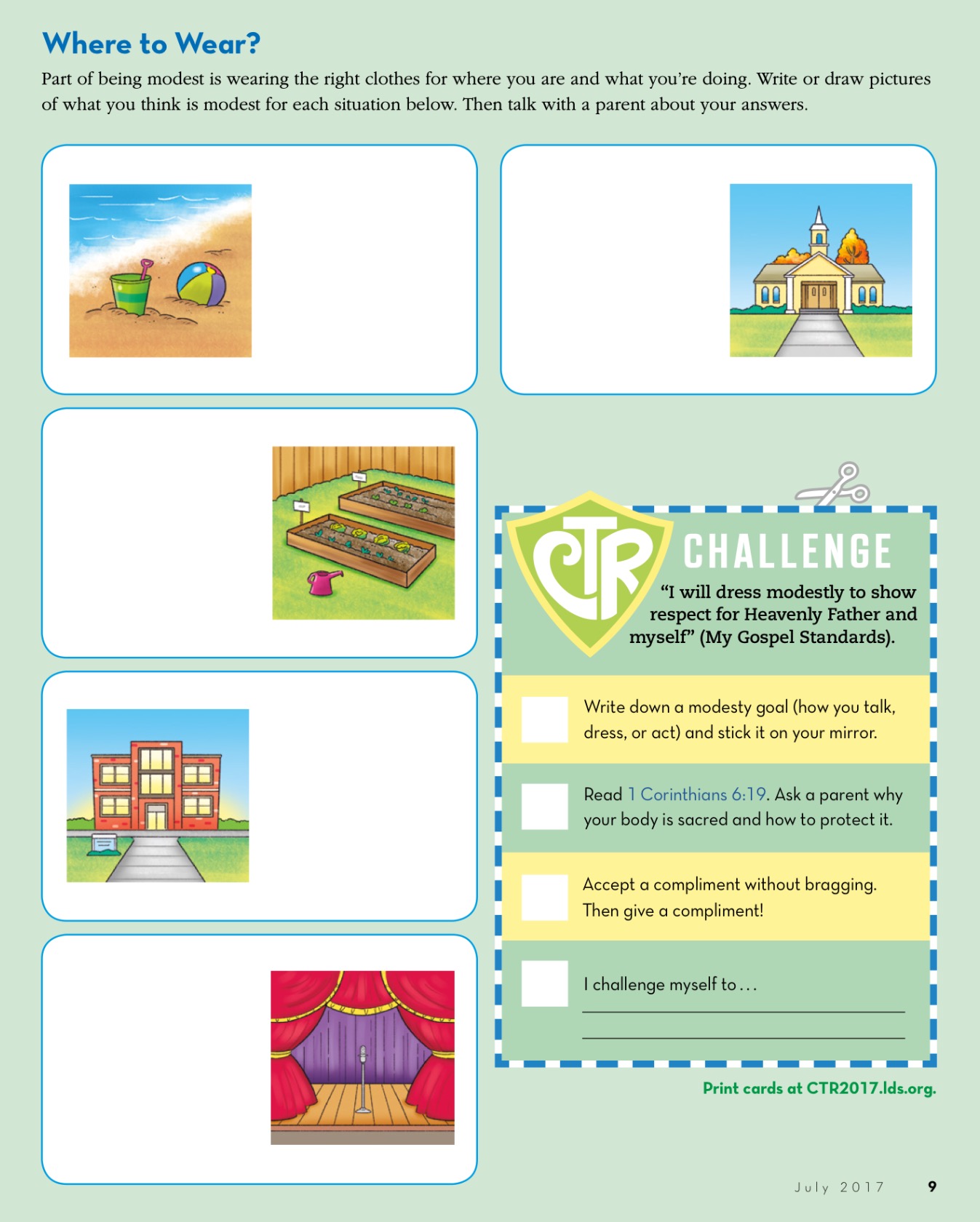
“Where to Wear?” (July 2017 Friend) Write or draw pictures of what you think is modest for each situation.
Media
Video: “195 Dresses” A young woman in Arizona came up with a prom-dress plan that allowed her to dress in a way that respected her body and Heavenly Father’s plan.
Come, Follow Me—For Individuals and Families: Old Testament 2022 “Judges 2–4; 6–8; 13–16” We all know what it’s like to make a mistake, feel bad about it, and then repent and resolve to change our ways. But in some cases we forget our earlier resolve, and, when we face temptation, we may find ourselves making the mistake again. This tragic pattern is typical of the Israelites’ experiences described in the book of Judges. Influenced by the beliefs and worship practices of the Canaanites—whom they were supposed to drive out of the land—the Israelites broke their covenants with the Lord and turned away from worshipping Him. As a result, they lost His protection and fell into captivity. And yet each time this happened, the Lord gave them the chance to repent and raised up a deliverer, a military leader called a “judge.” Not all of the judges in the book of Judges were righteous, but some of them exercised great faith in delivering the children of Israel and restoring them to their covenant relationship with the Lord. These stories remind us that no matter what has led us away from Jesus Christ, He is the Redeemer of Israel and is always willing to deliver us and welcome us back to Him.
THE ISRAELITES FORGET THE LORD
Judges CHAPTER 2 An angel rebukes Israel for not serving the Lord—As a pattern of future events, a new generation arises that forsakes the Lord and serves Baal and Ashtaroth—The Lord is angry with the children of Israel and ceases to preserve them—He raises up judges to guide and lead them—The Canaanites are left in the land to test Israel.
Judges CHAPTER 3 The children of Israel intermarry with the Canaanites, worship false gods, and are cursed—Othniel judges the Israelites—They serve Moab and are delivered by Ehud, who slays Eglon.
How do we come to know the Lord? Through scripture study, prayer, sacrament, living the commandments. etc.
Friend June 2019 “The Sacrament Reminds Us of Jesus Christ” Ways to prepare for the sacrament before hand, what to do during the sacrament, and remembering Jesus and following him after the sacrament.
Explain to the children that when the Israelites stopped keeping God’s commandments, they lost His protection and were defeated by their enemies. Read from Judges 3:9 the phrase “the children of Israel cried unto the Lord.” What did the Israelites do when they needed help? Share an experience when you prayed for help and God answered your prayer.
Read from Judges 3:9 the phrase “the Lord raised up a deliverer,” and invite the children to repeat it with you a few times. Explain that a deliverer is someone who saves us.
Senior Primary
Write the following on the board: “did evil,” “cried unto the Lord,” and “raised up a deliverer.” Invite some of the children to find these phrases in Judges 3:7–9, and invite others to find them in Judges 3:12–15. Explain to the children that over and over in the book of Judges, the Israelites “did evil.” Then, when their enemies attacked, they “cried unto the Lord,” and the Lord “raised up a deliverer” to help them. What do we learn about the Lord from this cycle?
What might lead us to forget the Lord? How can He deliver us? How can we be more consistently faithful to Him.
Both:
To emphasize that Jesus Christ is our Deliverer, you could gather several pictures of people, including a picture of Jesus, and place them face down. Let your children take turns flipping over the pictures. When they find the picture of Jesus, sing a song about Him, such as “He Sent His Son” (Children’s Songbook, 34–35). R. Testify that Jesus Christ is the Deliverer whom God has raised up to save us from sin, trials, sorrow, and death. Tell your children about how He has delivered you.
DEBORAH THE PROPHETESS
Judges CHAPTER 4 Deborah, a prophetess, judges Israel—She and Barak deliver Israel from the Canaanites—Jael, a woman, slays Sisera, the Canaanite.
Although many of the Israelites fell away from the Lord, some remained true to Him and were able to help many others return to righteousness. How can you encourage the children to stay true to the Lord no matter what others are doing?
You can use “Deborah the Prophetess” in Old Testament Stories, 92–95, to tell your children the story in Judges 4. Share with each other what you admire about Deborah. How did her faith in the Lord bless the people around her? What can we do to help others have more faith in Jesus Christ?
Read together Judges 4:14, and ask the children to find something Deborah said that showed that her faith in the Lord was strong. Then ask them to read Doctrine and Covenants 84:88 to find a principle that is also in Judges 4:14. Encourage them to share what the Lord’s promise “I will go before your face” means to them.
Story: Deborah was a righteous leader. She sat under a palm tree and listened to her people (see Judges 4:4–5). She helped them repent and follow God.
Activity:Psalm 92:12 says, “The righteous shall flourish like the palm tree.” Make the palm tree on page 36. Talk about ways you can follow God.
Friend June 2022 “Deborah under the Palm Tree” Color the pieces and cut them out along the blue lines. (Do not cut along the top of Deborah’s head—leave her attached to the base.) Fold the tab and then bend the tree base to glue the tab to the other side. Glue or tape the leaves to the top.
Sing a song about obeying the commandments, such as “Choose the Right” (Hymns, no. 239) or “Choose the Right Way” (Children’s Songbook, 160–61). How can we stand for righteousness and obey the commandments even when others around us do not?
Judges CHAPTER 6 Israel is in bondage to the Midianites—An angel appears to Gideon and calls him to deliver Israel—He overthrows the altar of Baal, the Spirit of the Lord rests upon him, and the Lord gives him a sign to show he is called to deliver Israel.
Judges CHAPTER 7 Gideon’s army is reduced to 300—They frighten the Midianite armies with trumpets and lights—The Midianites fight among themselves, flee, and are defeated by Israel.
Judges CHAPTER 8 Gideon pursues and destroys the Midianites—He frees the children of Israel but refuses their invitation to reign as king over them—Gideon dies, and Israel returns to idolatry.
Use Judges 7:4–7, this week’s activity page, or “The Army of Gideon” in Old Testament Stories, 96–99, to teach your children about how the Lord made Israel’s army smaller.
Ask the children to imagine that they needed to gather an army together to go to battle. How many people would they want in their army? Using Judges 7:4–7, invite the children to act out how the Lord helped Gideon choose the army that would deliver Israel from the Midianites. Why did the Lord want Gideon’s army to be so small? (see Judges 7:2).
Use this week’s activity page to teach the children about how the Lord made Israel’s army smaller so the Israelites would know that His power had saved them from their enemies. Share examples of small things that do a great work, such as bees gathering nectar to make honey. Bear your testimony that God can help us do a great work, even when we feel small.
Invite the children to draw pictures of a sword, shield, trumpet, lamp, and pitcher. Ask the children which of these objects they would take with them into a battle. Then they could read Judges 7:16 to learn what the Lord told Gideon’s army to use. Why would it have taken courage and faith to do this? Read together Judges 7:19–21 to learn how the army used the trumpets and pitchers to defeat the Midianites. What do we learn about the Lord from this story?
Read Judges 6:15 to the children, and ask them why Gideon didn’t feel he could do what the Lord wanted. Read verse 16, and ask them who the Lord said would help Gideon. Tell the children about a time when the Lord asked you to do something difficult to serve Him and you felt He was with you.
Gideon considered himself poor and insignificant, but God saw him as a “mighty man of valour” (Judges 6:12). Help the children see that even if they feel small, God can work through them to do important things (see Alma 37:6–7).
Friend February 2015 “Juliana Gives a Talk” Juliana is scared to give a talk, but Heavenly Father helps her.
Judges CHAPTER 13 Israel is in Philistine bondage for forty years—An angel comes to Manoah’s wife and promises a son who will begin to deliver Israel—The angel comes again; he ascends in a flame from the altar—Samson is born, and the Spirit of the Lord moves upon him.
Judges CHAPTER 14 Samson slays a young lion with his bare hands—He marries a Philistine wife, propounds a riddle, is deceived by his wife, and slays thirty Philistines.
Judges CHAPTER 15 Samson burns the grain of the Philistines—They burn his wife and father-in-law—Samson slays a thousand Philistines at Lehi with the jawbone of an ass.
Judges CHAPTER 16 Samson carries away the doors of the gate of Gaza—He loves Delilah, who delivers him to the Philistines—He destroys a building, killing himself and 3,000 others.
“Lesson 25: Samson,” Primary 6: Old Testament Samson’s mission would require physical strength. The Lord made a covenant with Samson that as long as he obeyed the Lord, he would be physically strong. Samson’s long hair (see Judges 13:5) was a sign of this covenant. When Samson kept his covenants he was blessed with the ability to help his people, but when he broke his covenants he lost both his spiritual and physical strength.
Ask for a volunteer to demonstrate how to flex his or her arm muscles. Let the whole class try it to see if they can feel their own muscles. How do muscles help us? Discuss what happens when we exercise our muscles and what happens when we do not use them. Help the children realize that exercise helps us develop strong muscles.
Explain that our spirits also need to grow stronger. How can we become stronger spiritually? (By keeping our baptismal covenants, obeying our parents, praying, attending church, reading the scriptures, and so on.)
What happens when people become spiritually weak? (They give in to temptations, they sin, they lose the guidance of the Holy Ghost, and they lose the ability to fulfill their callings and bless others.)
Why is it important to become spiritually strong? (So we can avoid temptation, be guided in our decisions by the Holy Ghost, and know good from evil.)
Samson’s covenants with the Lord gave him physical strength, just as our covenants give us spiritual strength. Your children might enjoy doing some physical exercises and discussing how those exercises can help make our bodies strong. What can we do to help us become spiritually stronger? For some ideas, the class could read Mosiah 18:8–10; Doctrine and Covenants 20:77, 79. How does keeping our covenants make our spirits strong? .
Samson lost both his physical strength and his spiritual strength because he violated his covenants with God,
Mosiah CHAPTER 29 Mosiah proposes that judges be chosen in place of a king—Unrighteous kings lead their people into sin—Alma the younger is chosen chief judge by the voice of the people—He is also the high priest over the Church—Alma the elder and Mosiah die. About 92–91 B.C.
Alma CHAPTER 1 Nehor teaches false doctrines, establishes a church, introduces priestcraft, and slays Gideon—Nehor is executed for his crimes—Priestcrafts and persecutions spread among the people—The priests support themselves, the people care for the poor, and the Church prospers. About 91–88 B.C.
Alma CHAPTER 2 Amlici seeks to be king and is rejected by the voice of the people—His followers make him king—The Amlicites make war on the Nephites and are defeated—The Lamanites and Amlicites join forces and are defeated—Alma slays Amlici. About 87 B.C.
Alma CHAPTER 3 The Amlicites had marked themselves according to the prophetic word—The Lamanites had been cursed for their rebellion—Men bring their own curses upon themselves—The Nephites defeat another Lamanite army. About 87–86 B.C.
Alma CHAPTER 4 Alma baptizes thousands of converts—Iniquity enters the Church, and the Church’s progress is hindered—Nephihah is appointed chief judge—Alma, as high priest, devotes himself to the ministry. About 86–83 B.C.
Some might see King Mosiah’s proposal to replace kings with elected judges as merely wise political reform. But to the Nephites, especially those who lived under wicked King Noah, this change had spiritual significance too. They had seen how an unrighteous king had influenced his people, and they were “exceedingly anxious” to be free from such influence. This change would allow them to be responsible for their own righteousness and “answer for [their] own sins” (Mosiah 29:38).
21 ¶ Not every one that saith unto me, Lord, Lord, shall enter into the kingdom of heaven; but he that doeth the will of my Father which is in heaven.
22 Many will say to me in that day, Lord, Lord, have we not prophesied in thy name? and in thy name have cast out devils? and in thy name done many wonderful works?
23 And then will I profess unto them, I never knew you: depart from me, ye that work iniquity.
29 He commandeth that there shall be no priestcrafts; for, behold, priestcrafts are that men preach and set themselves up for a light unto the world, that they may get gain and praise of the world; but they seek not the welfare of Zion.
30 Behold, the Lord hath forbidden this thing; wherefore, the Lord God hath given a commandment that all men should have charity, which charity is love. And except they should have charity they were nothing. Wherefore, if they should have charity they would not suffer the laborer in Zion to perish.
31 But the laborer in Zion shall labor for Zion; for if they labor for money they shall perish.
(In the Church we serve because we love others, not because we want to become rich or popular.)
24 And he also commanded them that the priests whom he had ordained shouldlabor with their own hands for their support.
25 And there was one day in every week that was set apart that they should gather themselves together to teach the people, and to worship the Lord their God, and also, as often as it was in their power, to assemble themselves together.
26 And the priests were not to depend upon the people for their support; but for their labor they were to receive the grace of God, that they might wax strong in the Spirit, having the knowledge of God, that they might teach with power and authority from God.
23 Therefore, blessed are they who will repent and hearken unto the voice of the Lord their God; for these are they that shall be saved.
24 And may God grant, in his great fulness, that men might be brought unto repentance and good works, that they might be restored unto grace for grace, according to their works.
25 And I would that all men might be saved. But we read that in the great and last day there are some who shall be cast out, yea, who shall be cast off from the presence of the Lord;
26 Yea, who shall be consigned to a state of endless misery, fulfilling the words which say: They that have done good shall have everlasting life; and they that have done evil shall have everlasting damnation. And thus it is. Amen.
As a member of the Church of Jesus Christ, I love and serve others.
Some members of the Lord’s Church in Alma’s day were generous and giving, and other members were unkind and prideful. To help your children learn from these experiences, you could read together Alma 1:27, 30 and make a list of the kinds of people members of the Lord’s Church helped. Who do we know who might “[stand] in need” (Alma 1:30) of our love and help? Invite the children to think of people in their neighborhoods or schools who might “[stand] in need” (Alma 1:30) of their love and help.
Read Alma 1:30 to the children, and help them understand that the people of the Church shared what they had with people who needed help. Help the children think of things they could share and people they could share them with. Encourage the children to draw pictures of their plans.
You could also sing together a song about love and service, such as “Kindness Begins with Me” (Children’s Songbook, 145), and help your children think of actions that could go with the song.
Help the children read Alma 4:6–13, and define words like “scornful,” “persecute,” and “despising” (use a dictionary if necessary). How do we feel when people treat us in these ways? Invite the children to find words in Alma 1:26–30 that describe how Heavenly Father wants us to treat each other.
Consider reading with your children how followers of Christ were treated in Alma 1:19–20. Talk about how they reacted in verses 22 and 25. Maybe you could practice ways to respond when others are unkind.
Friend May 2020 “Come Follow Me for Little Ones” Waiting Patiently Read Alma 1:25 together and help your little ones say, “Sometimes we have to wait patiently for blessings.” You could play freeze-dance to introduce the idea of patience. 1. Dance around as you listen to Primary songs or other good music. 2. Pause the music at random, and practice standing still while the music is paused.
Using pictures in this week’s outline in Come, Follow Me—For Individuals and Families or in “Chapter 21: The Amlicites” (Book of Mormon Stories, 56–57, or the corresponding video on ChurchofJesusChrist.org), tell the children how the Nephites gained strength to defeat the Amlicites. Ask the children about things that are scary or hard for them, and testify that they can pray to Heavenly Father for help with these things.
Share an experience when God helped you after you prayed to Him. Invite the children to share experiences they have had with prayer.
Friend March 2023 “The Earthquake Prayer” Violet woke up when she felt an earthquake. She and her family ran to the kitchen and crawled under the table. They had practiced what to do in an earthquake, but Violet was scared. She said a prayer, and felt like someone was giving her a hug. She was glad Heavenly Father helped her feel peace.
Friend May 2022 “A Prayer in the Storm” Alexis was scared of the thunder in the storm and didn’t feel safe. She found her dad and asked if they could say a prayer. After the prayer she felt peaceful and wasn’t afraid anymore.
Alma 3
Book of Mormon Seminary Student Manual (2024) Note: The curse that both the Amlicites and Lamanites experienced was a separation from God because of their rebellion and disobedience (see 2 Nephi 5:20–21). The mark, which at that time distinguished the Lamanites from the Nephites, was that “the skins of the Lamanites were dark” (Alma 3:6). It is important to remember that the nature and appearance of this mark are not fully understood. Book of Mormon prophets and modern prophets have taught it is wrong to revile or look down upon people because of the color of their skin (see Jacob 3:9).
What message did the Amlicites want to communicate when they “set [a] mark upon themselves”? (see Alma 3:4, 13). What messages might we send—intentionally or unintentionally—with our appearance? This might be a good time to review “Dress and Appearance” in For the Strength of Youth (2011), 6–8.
10 And thus ended the eighth year of the reign of the judges; and the wickedness of the church was a great stumbling-block to those who did not belong to the church; and thus the church began to fail in its progress.
Open the scriptures to Alma 4:19, and explain that when Alma saw how wicked the people were, he decided the best way to help them was to bear “pure testimony” to them. Alma gave up his position as chief judge so he could spend more time sharing his testimony and helping people repent. (Come, Follow Me—For Primary: Book of Mormon 2020 “Mosiah 29 – Alma 4”)
Often the “pure testimony” (Alma 4:19) of a child can have a strong influence on others. To help your children discover this, you could read with them Alma 4:8–12, 15, helping them identify the problems that were happening in the Church. What could Alma do to solve these problems? Help them find out what Alma decided to do in Alma 4:16–20. Maybe you could share with each other how someone else’s testimony of Christ has strengthened you.
Friend February 2016 “Testimony Treasure” Sabrina learns that a testimony is a treasure you want to share with others, so she shared her testimony with her friend that going to church and learning about Jesus makes her feel happy. Her friend then went to church and told Sabrina that it did make her feel happy.
If your children need examples of what a testimony is, consider showing a video clip of a speaker in general conference bearing testimony. You could also use this week’s activity page or sing together a song like “Testimony” (Hymns, no. 137). What do we learn about testimonies from these resources? Let your children practice sharing their testimonies.
Ensign January 2019 “Talking about Testimonies” Teach them what a testimony is in clear, simple terms–for example, “A testimony is what you know or believe is true about the gospel. The Holy Ghost helps us know what is true.” Help them recognize what they already believe with questions like, “How do you think Jesus feels about you?” or “How do you feel when you pray?”
Pour some clean water into a clear glass, and explain that the water is like our testimonies because we can share it with others. Pour the glass of water into a small cup for each child, and tell the children that when we share our testimonies, we help others have stronger testimonies too.
If the children would like to, let them practice bearing their testimonies. To invite children to bear testimony, ask questions that prompt them to think about and share how they feel about the Savior or His gospel. You could also ask about experiences they have had with prayer, service, ordinances such as baptism, or feeling the influence of the Holy Ghost.
Second Coming Surprise Jesus Christ will come again “as a thief in the night” (1 Thessalonians 5:2), meaning unexpectedly and at an unknown time. Are we preparing each day for that event? On small, individual slips of paper, have family members write down what they did yesterday (soccer practice, school, and so on). Put the slips into a hat (or bag). Parents secretly add another slip that reads: “Second Coming.”Take turns drawing an activity from the hat and reading it aloud. When someone draws “Second Coming,” the game’s over. Discussion: Which of the activities drawn from the hat helped prepare our family for Christ’s return? What should we add to our daily routines to prepare us more?
Ask the children if they have ever been to a wedding. What was it like? Why are people happy at a wedding? Display the picture of the Savior’s Second Coming in this week’s outline in Come, Follow Me—For Individuals and Families, and read Revelation 19:7. Explain that the “marriage of the Lamb” represents the Second Coming of Jesus Christ. Why will we rejoice when the Savior comes again? Help the children compare the joy of a wedding to the joy of the Savior’s return. (Come, Follow Me—For Primary: New Testament 2023 “Revelation 15–22”)
“Article of Faith 10” (September 2011 Friend) The pictures help illustrate what the tenth article of faith means.
Invite the children to share what they do to get ready for church on Sunday. Why do we do these things before we come to church? Why should we prepare for Christ’s Second Coming? On this week’s activity page, let the children draw what they can do to prepare for the Second Coming.(Come, Follow Me—For Primary: New Testament 2023 “Revelation 15–22”)
I can prepare for the Second Coming of Jesus Christ by choosing the right. (Sr)
Ask the children to talk about a time when they prepared for a trip or event. What did they do to prepare? Bring a suitcase or bag, and let the children pretend to pack it to get ready for a trip. With each item they pretend to pack, help the children think of one way we can prepare for Jesus Christ to come again.(Come, Follow Me—For Primary: New Testament 2023 “1 and 2 Thessalonians”)
Read 1 Thessalonians 5:6 to the children, and explain that if we are not preparing for Jesus to come again, it’s like we have fallen asleep and we won’t be ready for Him. Invite the children to pretend they are asleep. Explain that if we do prepare, it’s like we are awake and waiting for Him. Invite them to wake up.(Come, Follow Me—For Primary: New Testament 2023 “1 and 2 Thessalonians”)
Invite a child to read 1 Thessalonians 5:1–6 while the other children follow along. After each verse, ask a child to summarize what he or she thinks the verse is saying. You may want to explain that “the day of the Lord” means the Second Coming of Jesus Christ. Why is the Second Coming compared to a thief in the night or a woman about to have a baby? (Come, Follow Me—For Primary: New Testament 2023 “1 and 2 Thessalonians”)
Second Coming Surprise Jesus Christ will come again “as a thief in the night” (1 Thessalonians 5:2), meaning unexpectedly and at an unknown time. Are we preparing each day for that event? On small, individual slips of paper, have family members write down what they did yesterday (soccer practice, school, and so on). Put the slips into a hat (or bag). Parents secretly add another slip that reads: “Second Coming.”Take turns drawing an activity from the hat and reading it aloud. When someone draws “Second Coming,” the game’s over. Discussion: Which of the activities drawn from the hat helped prepare our family for Christ’s return? What should we add to our daily routines to prepare us more?
Tell the children to imagine that the Savior will be visiting your class sometime today. How can we prepare for His visit? Help the children think of things we can do to prepare ourselves for the day Jesus Christ returns. For example, we can repent, forgive, improve our relationships with our family, follow the prophet, seek to have the Holy Ghost’s influence, and keep our covenants. Encourage the children to choose one thing they will do to prepare themselves to receive the Savior at His Coming.(Come, Follow Me—For Primary: New Testament 2023 “1 and 2 Thessalonians”)
Sharing Time: What a Joyful Day” (December 2001 Friend) Includes an activity to color various pictures of activities that can prepare children for the Second Coming.
Show a picture of the Second Coming and help a child read Doctrine and Covenants 29:11. Help the children notice phrases in the scripture that describe what they see in the picture. Share with the children how you feel about Jesus Christ coming to earth again.
Show the children pictures of things they can do to prepare to meet the Savior (such as the ones below) . Help the children find other ways to prepare for the Second Coming in Doctrine and Covenants 29:2–10.
Sing a song about the Second Coming, such as “When He Comes Again” (Children’s Songbook, 82–83).
Friend November 2024 “Jesus Christ Will Come Again” Book mark and part of President Nelson’s conference address about helping prepare the world for the Second Coming. He said, “Today I call upon you to help prepare the world for the Second Coming of the Lord. I call upon you to talk of Christ, testify of Christ, have faith in Christ, and rejoice in Christ! “
Come, Follow Me—For Primary: New Testament 2023 The parable of the ten virgins teaches that we cannot borrow our conversion to the Savior from others. How can you help the children take responsibility for their own conversion?
“Lesson 25: Parable of the Ten Virgins,” Primary 7: New Testament Explain that the parable of the ten virgins is based on ancient Jewish wedding customs. The bridegroom and his friends escorted the bride from her home to the home of the bridegroom. Along the way friends of the bride waited to join them. When they arrived at the bridegroom’s home, they all went inside for the wedding. These weddings usually took place in the evenings, so those waiting for the bride and bridegroom carried lamps.
Before studying the parable, it is important to understand Jewish wedding customs during the Savior’s day. The bridegroom, accompanied by his close friends, would go at night to the bride’s house for the wedding ceremony. Following the ceremony, the wedding party would proceed to the groom’s house for a feast. Wedding guests joining the procession, including virgins or bridesmaids, were expected to carry their own lamps or torches to indicate they were part of the wedding party and to add brightness and beauty to the occasion.
The bridegroom is symbolic of the Savior, and the coming of the bridegroom represents the Second Coming (see Doctrine and Covenants 33:17 ; 88:92 ; 133:10).
President Dallin H. Oaks of the First Presidency taught: “The ten virgins obviously represent members of Christ’s Church, for all were invited to the wedding feast and all knew what was required to be admitted when the bridegroom came” (Dallin H. Oaks, “Preparation for the Second Coming,” Ensign or Liahona, May 2004, 8).
The lamps can symbolize our testimonies (see David A. Bednar, “Converted unto the Lord,” Ensign or Liahona, Nov. 2012, 109). Note that all ten virgins had lamps.
The oil can symbolize our conversion unto the Lord Jesus Christ (see David A. Bednar, “Converted unto the Lord,” Ensign or Liahona, Nov. 2012, 109). This can include our efforts to follow the guidance of the Holy Ghost and to live obediently to the Savior and His gospel (see Doctrine and Covenants 45:56–58 ; In our lives the oil of preparedness is accumulated drop by drop in righteous living. … Each act of dedication and obedience is a drop added to our store. (Spencer W. Kimball, Faith Precedes the Miracle [1972], 255–56)
Most Jewish wedding ceremonies would take place in the evening. Several scripture passages refer to the Savior coming again like a thief in the night (see Joseph Smith Translation, Luke 12:44 [in the Bible appendix]; 1Thessalonians 5:2 ; 2Peter 3:10 ; Doctrine and Covenants 45:19 ; 106:4). The coming of the bridegroom at midnight suggests the unexpected hour of the Savior’s return. President Spencer W. Kimball (1895–1985) explained:
In Matthew 25:12 , notice the bridegroom’s response to the foolish virgins who tried to enter the wedding feast late and without the necessary oil. Joseph Smith Translation, Matthew 25:11 clarifies that the bridegroom said, “Ye know me not” (in Matthew 25:12 , footnote a).
Remembering what the oil represents, why would the oil be essential to truly know the Savior and be ready to meet Him?
Why could the wise virgins not simply give the oil to the foolish virgins?
Ask a child to come prepared to share how he or she learned about the parable of the ten virgins at home this week.
Draw an oil lamp on the board, and label it testimony. Give each child a piece of paper shaped like a drop of oil, and ask each child to write on it something he or she will do to become more converted to the Savior. Attach their drops to the board around the lamp.
Come, Follow Me—For Individuals and Families: New Testament 2023 You might cut paper in the shape of drops of oil and hide the drops around your home. You could attach the drops to objects like the scriptures or a picture of the temple. When family members find the drops, you could discuss how these things help us prepare for the Second Coming.
Invite the children to help you make a list of things to do to prepare for a special visitor. How are these things similar to or different from ways we can spiritually prepare for the Savior’s Second Coming?
Friend August 2021 “The Important Guest” Ammon mother told him to tidy his room and she told him, “We want to invite someone important to be our guest. So we want our house to be clean and neat.” That night Ammon found out that the special guest was the Holy Ghost. The family also discussed additional ways to help the Holy Ghost feel welcome in their home.
On five strips of paper, write things that cannot be borrowed. On five other strips, write things that can be borrowed. Shuffle the strips, and ask the children to sort them into these two groups. Read together Matthew 25:1–13. Why is it important not to rely on others for our conversion to Jesus Christ?
“Lesson 25: Parable of the Ten Virgins,” Primary 7: New Testament Why do you think the five wise virgins did not share their oil? (Matthew 25:9.) Why couldn’t they have given some of their oil to the others? Explain that the shape of Jewish lamps, outside lips rounded inward, made it almost impossible for someone to pour oil from one lamp to another (see the illustration at the end of the lesson). In the parable, the oil in the wise virgins’ lamps represents their righteous living and obedience. We each fill our own lamp, which represents our own life, with our obedience and righteousness. Heavenly Father’s blessings to us for our righteous actions cannot be given to the disobedient.
Christ revealed signs of His coming as given on the Mount of Olives; 24–38, The gospel will be restored, the times of the Gentiles will be fulfilled, and a desolating sickness will cover the land; 39–47, Signs, wonders, and the Resurrection are to attend the Second Coming; 48–53, Christ will stand on the Mount of Olives, and the Jews will see the wounds in His hands and feet; 54–59, The Lord will reign during the Millennium; 60–62,The Prophet is instructed to begin the translation of the New Testament, through which important information will be made known; 63–75, The Saints are commanded to gather and build the New Jerusalem, to which people from all nations will come.
32 But my disciples shall astand in holy places, and shall not be moved;
Some people in Kirtland, Ohio, didn’t want to learn the gospel. Some even told lies about the Saints to try to stop others from learning about the gospel.Jesus told Joseph Smith that He would come to earth again soon. Before He comes, everyone on earth must hear the gospel. The Saints should be good missionaries and work hard to share the gospel.When Jesus lived on earth, He told His Apostles what would happen before He came again.Jesus told His Apostles that the temple in Jerusalem would be destroyed. The Jewish people would be scattered to many nations, and many of them would be killed. There would be many wars. People wouldn’t love each other, and they would turn their hearts from God. There would be terrible sickness, disease, and earthquakes. The sun would be dark, the moon would be like blood, and stars would fall.One important event in preparation for Jesus’ return to the earth is the restoration of His Church. Jesus said the restored gospel would be like a light in the darkness.Many things that Jesus told about have already happened. Other things are beginning to happen, and others will happen in the future.When these things happen, righteous people will know Jesus is coming soon. They will want Him to come. Many Jews will go back to Jerusalem. They will hear the gospel.Righteous Saints will build the new city of Zion, where they will be safe. They will not fight with each other. They will be happy and sing songs of joy. People who are not righteous will not be able to go to Zion.Jesus will come to earth in a bright cloud. Righteous people will see Him. All the righteous people who have died will be resurrected. They will meet Jesus in the cloud and come to earth with Him.Jesus will come to Jerusalem. He will stand on a mountain there, and it will split in half. The heavens and earth will shake. Wicked people will be destroyed.People in Jerusalem will see Jesus and ask, “What are those wounds in your hands and feet?” He will say: “I am Jesus who was crucified. I am the Son of God.” Then the people will cry because of their sins and feel sad because Jesus had been persecuted.Righteous people will be very happy to see Jesus. The whole earth will belong to them. Satan will not be able to tempt them. Their children will grow up without sin. Jesus will live with them for 1,000 years and will be their King.Jesus told Joseph Smith to send missionaries to tell everyone to repent and prepare for the Second Coming. Jesus said the Saints should also prepare. They should pray, fast, and teach each other the commandments.Jesus promised the Saints that if they would be close to Him, He would be close to them. He said they should pray, and He promised that God would answer them.The Saints should do everything they can to help Jesus. When people help Jesus, they become like Him. Then they will be ready for His Second Coming.
One reason the Savior and His prophets teach us about the signs of the Second Coming is to help us prepare. What do you learn in Doctrine and Covenants 45:31–32, 56–57 about preparing for the Lord’s Second Coming? It might be helpful to review the parable of the ten virgins, found in Matthew 25:1–13. The Savior compared the oil in this parable to truth and to the Holy Spirit (see Doctrine and Covenants 45:57).
In Doctrine and Covenants 45:32, the Lord taught that His disciples will find safety in the last days by standing in holy places—places that are special to the Lord.
Sing “Choose the Right Way” (Children’s Songbook, 160).
Jesus Christ taught that we should “stand in holy places” (Doctrine and Covenants 45:32). A holy place can be anywhere we have the Holy Ghost with us.
With your family, list some things that help you stand in holy places, like being kind or praying. How do those things prepare us for Jesus Christ’s coming? Stick the list somewhere you’ll see it often.
56 And at that day, when I shall come in my glory, shall the parable be fulfilled which I spake concerning the ten virgins.
57 For they that are wise and have received the truth, and have taken the Holy Spirit for their guide, and have not been deceived—verily I say unto you, they shall not be hewn down and cast into the fire, but shall abide the day.
Place pictures of a home, a church building, and a temple in different places throughout the room. Give clues describing these places, and invite the children to stand near the picture you are describing. Read the first line from Doctrine and Covenants 45:32. Testify that we are blessed when we spend time in holy places like our homes, our church buildings, and the temple. Ask the children to talk about how they feel when they are in holy places like these.
Invite the children to complete this week’s activity page. Help them write “I can help my home become a holy place” and “Doctrine and Covenants 45:32” on their drawing. What can they do to help their home become a holy place?
To help the children think about what it means to “not be moved,” ask them to stand still without moving for one minute. Read the first line from Doctrine and Covenants 45:32. Help the children understand that to “stand in holy places, and … not be moved” means to choose the right at all times, no matter what is happening. Invite them to “not be moved” away from righteous thoughts and actions.
5 And it shall come to pass also that the aremnants who are left of the land will marshal themselves, and shall become exceedingly angry, and shall vex the Gentiles with a sore vexation.
6 And thus, with the asword and by bloodshed the inhabitants of the earth shall bmourn; and with cfamine, and plague, and earthquake, and the thunder of heaven, and the fierce and vivid lightning also, shall the inhabitants of the earth be made to feel the wrath, and indignation, and dchasteningehand of an Almighty God, until the consumption decreed hath made a full fend of all gnations;
7 That the cry of the saints, and of the ablood of the saints, shall cease to come up into the ears of the Lord of bSabaoth, from the earth, to be avenged of their enemies.
8 Wherefore, astand ye in holy places, and be not moved, until the day of the Lord come; for behold, it cometh bquickly, saith the Lord. Amen.
Come, Follow Me—For Primary: Doctrine and Covenants 2021 “Doctrine and Covenants 85-87” The children you teach will face spiritual and physical dangers throughout their lives. You can help them prepare to face those dangers by teaching them to find and stand in holy places. No home is perfect, but there are things we can all do to make our homes into holy places of peace.
Read together Doctrine and Covenants 87:6 to learn about things the Lord said would happen in the latter days. Ask the children to talk about challenges that children their age sometimes face. Invite them to find in verse 8 what the Lord said we should do during hard times. Tell the children about holy places in your life.
Help the children make a list of holy places, holy thoughts, and holy actions that can help them face spiritual danger (for ideas, see the videos “Standing in Holy Places” and “Stand Ye in Holy Places—Bloom Where You’re Planted,” ChurchofJesusChrist.org). Invite them to keep their list with them to refer to when needed.
Show a picture of a temple, and share why the temple is a holy place. Show a picture of a home, and help the children think of ways they can make their homes holy like the temple (see this week’s activity page). Why do we want to be in holy places?
To introduce a discussion about how to make your home a holier place, you could invite family members to design a home for someone who loves the Savior. This may lead to ideas about how to “redesign” your home to make it a place of peace amid the spiritual danger in the world. Songs like “Love at Home,” “Home Can Be a Heaven on Earth” (Hymns,nos. 294, 298), or “Where Love Is” (Children’s Songbook, 138–39) could give you ideas.
Treasure Up God’s Word
Come, Follow Me—For Individuals and Families: New Testament 2023 To help your family explore this chapter, invite them to look for the Savior’s teachings about how we can prepare for His Second Coming (see, for example, verses 22–23, 29–30, 37, 46–48). What can we do to follow this counsel? Your family might enjoy singing “When He Comes Again” (Children’s Songbook, 82–83) and drawing pictures of what they imagine the Savior’s Second Coming will be like.
President Ezra Taft Benson (1899–1994) taught that false Christs and prophets are not limited to people but can also come in the form of false ideas and teachings (see Teachings of Presidents of the Church: Ezra Taft Benson [2014], 132). As you study this lesson, seek the guidance of the Spirit as you look for ways you can trust in the Lord and overcome any false ideas or deception.
After teaching about other deceptions and about signs of His Coming (see Joseph Smith—Matthew 1:23–36), the Savior taught a way to overcome deception. Read Joseph Smith—Matthew 1:37 .
In your study journal, draw a piece of treasure or a treasure chest. To treasure something means you cherish, hold dear, or greatly appreciate it. When we “treasure up” the Lord’s word, we consider it sacred and protect it (see Doctrine and Covenants 43:34). Around or inside the chest, write ways we can treasure up the Lord’s word.
Joshua CHAPTER 1 The Lord speaks to Joshua—He is commanded to be of good courage, to meditate upon the law, and to keep the commandments—He prepares Israel to enter Canaan.
Joshua CHAPTER 2 Joshua sends spies to Jericho—They are received and concealed by Rahab—They promise to preserve Rahab and her household.
Here is one way to help your children “be strong and of a good courage” (Joshua 1:6) through Jesus Christ. Invite them to find a phrase that is repeated in Joshua 1:6, 9, and 18, and write it down or memorize it. Help your children think of situations where they might need this message, just as Joshua did. You could also review together some of the stories in Joshua 1–4; 6 (see also “Joshua the Prophet” and “Rahab and the Spies” in Old Testament Stories, 85–91). How did the people in these stories show courage and strength in the Lord?
Come, Follow Me—For Primary: Old Testament 2022 “Joshua 1–8; 23–24” The Lord told Joshua that if he meditated on the scriptures and followed the counsel in them, he would have success leading the Israelites into the promised land. What can you do to teach the children of the great blessings that come from the scriptures?
Come, Follow Me—For Home and Church: Old Testament 2026 Reading Joshua 1:8 could inspire your children to read the scriptures on their own. Help them find words in this verse that teach them how and why we should read the scriptures. They could look for the same thing in 1 Nephi 15:23–24; 2 Nephi 31:20; 32:3; Jacob 4:6; Helaman 3:29–30. Ask them to find words and phrases in this verse that teach us about the blessings of studying the scriptures. How can meditating on the scriptures help us have success in the other things we do each day? You could also help them make and carry out a plan to read the scriptures.
Give each child a picture or drawing of the sun and the moon. Read to them from Joshua 1:8: “Meditate [on the scriptures] day and night.” Explain that meditate means to think deeply about something. Repeat the phrase several times, and invite the children to hold up the sun when you say “day” and the moon when you say “night.” Let the children repeat the phrase with you.
Older Children: Invite the children to write down how much time they spend in an average day on various activities. Then invite them to read Joshua 1:8, looking for something that we all need to do every day and night.
The Israelites Cross the River Jordan on Dry Ground
Joshua CHAPTER 3 Joshua leads Israel to the Jordan—The Lord cuts off the water of the Jordan; it stands up as a heap, and Israel passes over on dry ground.
Joshua CHAPTER 4 Joshua places twelve stones to commemorate the crossing of the Jordan—Joshua is magnified before the children of Israel as they cross the Jordan—After the priests bearing the ark pass over, the river returns to its course.
Joshua CHAPTER 5 The inhabitants of Canaan fear Israel—The males of Israel are circumcised—Israel keeps the Passover, eats the fruit of the land, and manna ceases—The captain of the Lord’s host appears to Joshua.
I must be baptized to enter the kingdom of heaven.
You might use the story of the Israelites crossing the Jordan River as a symbol of baptism—giving up our old life in the wilderness and starting a new one in a covenant relationship with God. So as you read together Joshua 3–4 (or “Joshua the Prophet” in Old Testament Stories, 85–89), you could also look at a picture of Jesus being baptized and explain that Jesus was baptized in the same river the Israelites crossed. You could then sing a song such as “Baptism” (Children’s Songbook, 100–101). Share with each other how being baptized is like starting a new life in Jesus Christ’s kingdom.
Come, Follow Me—For Individuals and Families: Old Testament 2022 “Joshua 1–8; 23–24” After reading what the Lord wanted the Israelites to do with stones from the Jordan River, your family could talk about some of the great things the Lord has done for you. Then you could give each family member a stone and invite them to write or draw on it something the Lord has done for them.
Story: God helped Joshua part the River Jordan so the people could walk across on dry ground. Then God asked Joshua and his people to collect stones from the river to remember how God helped them (see Joshua 4:5–7).
Song: “Where Love Is” (Children’s Songbook, 138–39)
Activity: Find rocks to paint or color. Write the word remember on them. While you decorate them, talk about ways God has helped you.
Miracle of the parting of the River Jordan didn’t occur until after the Israelites exercised faith and walked into the river.
Jericho is Destroyed
Joshua CHAPTER 6 Jericho is taken and destroyed—Only Rahab and her household are saved.
Joshua CHAPTER 7 Israel is defeated by the people of Ai—Joshua complains to the Lord—Achan and his household are destroyed because he disobeyed the Lord by taking the spoils of Jericho.
Joshua CHAPTER 8 Joshua uses an ambush, takes Ai, and slays its inhabitants—He builds an altar in Mount Ebal—The words of the law, both blessings and cursings, are read to the people.
Come, Follow Me—For Individuals and Families: Old Testament 2022 “Joshua 1–8; 23–24” These chapters deal with battles over the lands of Jericho and Ai. What do you learn about how God can help you and what you need to do to access His power? As you read them, consider how you battle temptation in your own life (for example, see Joshua 7:10–13). What impresses you about the Lord’s instructions for taking Jericho? (see Joshua 6:1–5). Perhaps the account in Joshua 7 will inspire you to determine if “there is an accursed thing” in your life that you need to remove (Joshua 7:13).
Your family might have fun acting out the instructions the Lord gave to the Israelites in order to conquer Jericho. What might the Lord want us to learn from this story?
Joshua led the Israelite army to the land of Canaan. They arrived at a city called Jericho. The city was very strong and had high walls. The Lord told Joshua how to conquer Jericho. He said the Israelites should march around Jericho every day for six days. Joshua obeyed the Lord.
Joshua told the priests to carry the ark of the covenant in front of the Israelites. Each day, the army marched around Jericho, and seven priests blew their horns. All the other Israelites were silent.
On the seventh day, the army marched around Jericho seven times. As the priests blew their horns, Joshua told the Israelites to shout. Suddenly Jericho’s walls fell to the ground, and Joshua’s army took the city.
Joshua CHAPTER 23 Joshua exhorts Israel to be courageous, keep the commandments, love the Lord, and neither marry among nor cleave unto the remnants of the Canaanites who remain in the land—When the children of Israel serve other gods, they will be cursed and dispossessed.
Joshua CHAPTER 24 Joshua recites how the Lord has blessed and led Israel—Joshua and all the people covenant to choose the Lord and serve Him only—Joshua and Eleazar die—The bones of Joseph, taken from Egypt, are buried in Shechem.
Come, Follow Me—For Home and Church: Old Testament 2026 Joshua’s final teachings to the Israelites in Joshua 23–24 include important warnings, counsel, and promised blessings. Perhaps you could make a list of what you find. Considering everything the Israelites had been through, why do you think Joshua chose to tell them these things at the end of his life? What do you find that inspires you to “cleave unto the Lord”? (Joshua 23:8).
Ask the children to talk about some of the choices they have made today. Read to the children from Joshua 24:15: “Choose you this day whom ye will serve; … but as for me and my house, we will serve the Lord.” How have the children chosen to serve the Lord today? What are some ways we can choose to serve Him every day?
Invite the children to suggest situations in which they might have to decide to choose God over other things. Ask them to consider what they would do. Why is it important to “choose … this day” rather than waiting for the situation to arise? How will we be blessed when we make the right choice?
Friend April 2017 “Game Changer” Caleb feels like it is hard to have to make different choices than his friends, but the Holy Ghost comforts him and and helps him.
Friend September 2015 – “To Cheat or not to Cheat” Boy chooses not to cheat on a test
Sing a song about making good choices, such as “Choose the Right Way” (Children’s Songbook, 160–61). How do we feel when we choose to serve Jesus Christ? Invite the children to draw pictures of themselves doing something to serve the Lord. Share a story from your life or from a Church magazine about choosing to serve the Lord.
Moses proclaims, The Lord our God is one Lord, and, Thou shalt love the Lord thy God—The children of Israel are commanded to teach their children—Moses exhorts them to keep the commandments, testimonies, and statutes of the Lord that they may prosper.
Moses had spent his life preparing the children of Israel to enter that promised land, and the book of Deuteronomy records his final instructions, reminders, exhortations, and pleadings with the Israelites.(Come, Follow Me—For Individuals and Families: Old Testament 2022)
To help your children understand Deuteronomy 6:5, you could draw a heart, an outline of a body, and a strong arm. Your children could point to the pictures as you read the words “heart,” “soul,” and “might” in the verse. How do we show the Lord that we love Him with all our heart, soul, and might?
Read with your children the Lord’s counsel to the Israelites to put scripture passages where they would see them every day (see Deuteronomy 6:6–9). This might inspire you and your children to think of ways to make sure you don’t “forget the Lord” (verse 12) and to remember what He has done for you.
On the board, write words and phrases from Deuteronomy 6:6–9 that indicate when and how the Israelites were to remember the word of God (such as sittest, walkest, liest down, hand, and house). Invite the children to find these words in the verses. What do these words teach about how to make the scriptures part of our everyday lives? Ask the children what they can do to remember the word of God in their daily life.
Give each child a piece of paper, and invite them to write down a phrase from Deuteronomy 6 that is meaningful to them. Ask them to share why they chose their phrase. Suggest that they decorate their paper and display it in their home to remember it. Encourage the children to write down and display other phrases they find in the scriptures.
Friend November 2019 “For Older Kids” Jordan’s Primary teacher told the class that she posts scripture verses on her door so she can always see them and read them every day. Jordan started doing that too, and soon her door was covered in scriptures.
You might point out that Deuteronomy 6:13, 16 and 8:3 helped the Savior during an important moment in His life. To see how, read together Matthew 4:1–10. Then you could share with each other some scripture passages that have helped you in times of need.
DEUTERONOMY CHAPTERS 7-8
Chosen to be a special people
Deuteronomy CHAPTER 7 Israel is to destroy the seven nations of Canaan—Marriages with them are forbidden lest apostasy result—Israel has a mission as a holy and chosen people—The Lord shows mercy unto those who love Him and keep His commandments—He promises to remove sickness from the children of Israel if they obey.
Deuteronomy CHAPTER 8 The Lord tested the children of Israel in the wilderness for forty years—Eating manna taught them that man lives by the word of God—Their clothing did not wear out—The Lord chastened them—If they serve other gods, they will perish.
DEUTERONOMY CHAPTER 15
Deuteronomy CHAPTER 15 Every seven years, all debts are to be released—The people are admonished to care for the poor—Hebrew servants are to be released and given gifts during the seventh year—The firstling males of herds and flocks are the Lord’s.
The teachings in Deuteronomy 15:7–11 can help the children you teach understand that helping others involves more than just actions. It should be done with a willing heart.
Write who,why, and how on the board. Invite the children to read Deuteronomy 15:7–11 to find out who we should help, why we should help them, and how our hearts should feel about helping. Let them write on the board what they find. Sing a song that reinforces the message in these verses, such as “Have I Done Any Good?” (Hymns, no. 223).
Friend January 2021 “You Can Help Like Jesus” When Jesus was on the earth, he helped all he saw. Today many people in the world need our help. Each of us can do something to help, even children. About years ago, children helped build the Primary Children’s hospital by collecting pennies. (See more at link)
President Nelson told about some ways people need help in the world today, such as 1 out of 9 people don’t have enough food and many don’t have clean water to drink. The article discusses how the church helps and how we can help people in need. (The article includes photos of the ways people need help, a quote handout idea, and a coloring page.)
food bank
Refugees
Ask the children to think of someone they could help—especially in their own family. Provide time for them to write down what they will do this week to help that person. If possible, make plans to reach out as a class to someone in need.
Deuteronomy CHAPTER 18 How priests are supported—Divination, spiritualism, and the like are abominations—A Prophet (Christ) will arise like unto Moses.
At least four other scriptures refer to the prophet like unto Moses (see Acts 3:22–23; 1 Nephi 22:21; 3 Nephi 20:23; JS—H 1:40). In each instance these scriptures make it clear that the prophet like unto Moses was the Savior, Jesus Christ. When Jesus visited the Nephites, as recorded in the Book of Mormon, He identified Himself in this way:
“Behold, I am he of whom Moses spake, saying: A prophet shall the Lord your God raise up unto you of your brethren, like unto me; him shall ye hear in all things whatsoever he shall say unto you. And it shall come to pass that every soul who will not hear that prophet shall be cut off from among the people.” (3 Nephi 20:23.)
Maybe you could look at pictures of things Moses did and things Jesus Christ did, and let your children match them (see Gospel Art Book, nos. 15, 16, 38, 39).
Show the children a picture of our prophet today, and share something he has taught about the Savior.
Coming Closer to Christ: President Oaks emphasized increasing humility, studying the scriptures, and serving others as key ways to strengthen personal faith and hear the Savior’s voice.
The Saving Atonement: He teaches that Jesus has done everything essential for our mortal journey out of love, offering forgiveness and overcoming the challenges of mortality.
Following His Teachings: He has urged members to embrace the Savior’s command to love one’s enemies, particularly in times of conflict, and to become peacemakers.
Deuteronomy CHAPTER 29 The children of Israel make a covenant with the Lord under which they will be blessed if they are obedient, and cursed if they are disobedient—If they are disobedient, their land will be as brimstone and salt.
Deuteronomy CHAPTER 30 The scattered Israelites will be gathered from all nations when they remember the covenant—Moses places life or death, blessing or cursing, before the people.
Because of my covenants, I am part of God’s people.
Talking about Deuteronomy 29:12–13 provides an opportunity for you and your children to talk about covenants Ask the children what a covenant is (if they need help, suggest that they find a definition in “Covenant” in the Guide to the Scriptures [scriptures.ChurchofJesusChrist.org]).
Draw a two-column chart on the board with these headings: Israelites’ promises and God’s promises. Invite the children to search Deuteronomy 30:8–10 and fill in the chart. (If necessary, help the children understand the meanings of phrases in verse 9.) Testify of blessings that have come to you from keeping your covenants.
What promises have we made with God? (see Doctrine and Covenants 20:37, 77). Invite the children to list on the board the promises we make at baptism and the promises Heavenly Father makes to us. How do these promises connect us with Him? (By keeping our covenants, we can receive heavenly help and strength.)
Come, Follow Me—For Individuals and Families: Old Testament 2022 Even though Deuteronomy 34:5–8 says that Moses died, latter-day understanding clarifies that he was translated, or changed so that he would not suffer pain or death until being resurrected (see Alma 45:18–19; Bible Dictionary, “Moses”; Guide to the Scriptures, “Translated Beings,” scriptures.ChurchofJesusChrist.org). It was necessary for Moses to be translated because he needed to have a physical body in order to give priesthood keys to Peter, James, and John on the Mount of Transfiguration (see Matthew 17:1–13).
Story: God loves all His children. He wants them to be gathered together in His Church. Part of gathering Israel is bringing God’s children back to Him (see Deuteronomy 30:3).
Song: “Israel, Israel, God Is Calling” (Hymns, no. 7)
Activity: Cut out the puzzle pieces on page 27. Then have someone hide the pieces around the room. Have everyone else search for the pieces. Once all the pieces are gathered, put the puzzle together. Why does God want all of His children to return to Him?
Numbers CHAPTER 11 Fire from the Lord consumes the rebels in Israel—Israel murmurs and lusts for meat instead of manna—Moses complains that he cannot bear the burden alone—He is commanded to choose seventy elders to assist him—The Lord promises meat until it becomes loathsome to the Israelites—The seventy elders are chosen, they prophesy, the Lord comes down, and Eldad and Medad prophesy in the camp—Israel is provided with quail—The people lust, a great plague follows, and many die.
Ask your children if they remember some of the miracles the Lord performed to help the Israelites (see “The Plagues of Egypt” and “The Passover” in Old Testament Stories, 67–74). Then you could summarize for them Numbers 11:4–10, emphasizing that the Israelites had forgotten their blessings and were complaining. What blessings do we sometimes forget?
Story: Sometimes the Israelites forgot how the Lord had helped them. God wants us to remember to be grateful. It makes us happier too!
Song: “My Heavenly Father Loves Me” (Children’s Songbook, 228–29)
Activity: Play a gratitude game! Mark some sticks with one of three colors. Then take turns choosing a stick. For one color, name a person you are thankful for. For another color, say a place you are thankful for. For the third color, say a thing you are thankful for.
Sing together a song about gratitude, such as “Count Your Blessings” (Hymns, no. 241). Invite each child to draw pictures of blessings the Lord has given them or their families. Encourage them to think about or look at their picture whenever they are tempted to complain about something they don’t have.
This video is not produced by the Church of Jesus Christ of Latter Day Saints or any of its members, but it has visuals and words to help you sing the song.
Numbers CHAPTER 12 Aaron and Miriam complain against Moses, the most meek of all men—The Lord promises to speak to Moses mouth to mouth and to reveal to him the similitude of the Lord—Miriam becomes leprous for a week.
To introduce Numbers 12, you could tell your children that the Lord was unhappy with Aaron and Miriam, Moses’s brother and sister. Invite them to read Numbers 12:1–8 to find out why.
This video is not produced by the church or any of its members, but it carefully follows the scripture account.
Consider using the Gospel Art Book to help your children find examples of people in the scriptures who respected the Lord’s prophet and were blessed. How are we blessed when we follow the Lord’s prophet?
Numbers CHAPTER 13 Moses sends twelve spies to search the land of Canaan—Ten of them bring an evil report, telling only of the strength of the inhabitants.
Numbers CHAPTER 14 Israel murmurs and speaks of returning to Egypt—Joshua and Caleb give a good report of Canaan—Moses mediates between Israel and the Lord—The adults of Israel will not enter the promised land—The Lord slays the false spies by a plague—Some rebels try to go alone and are slain by the Amalekites and Canaanites.
Come, Follow Me—For Primary: Old Testament 2022 “Numbers 11–14; 20–24” When Moses sent 12 men to find out about the promised land, 10 of them came back afraid because of the mighty people who lived there. Two of them, Caleb and Joshua, were not afraid, because they had faith in the Lord.
Use pictures or drawings of grapes, honey, giants, and grasshoppers to briefly tell the children about the 12 men Moses sent to explore the promised land (see Numbers 13:17–33). Explain that they found a lot of fruit and other foods (invite the children to pretend to eat the food), but they also were afraid because the people there were large and strong (invite the children to pretend to be afraid). Show a picture of Jesus, and point out that two Israelites, Caleb and Joshua, were not afraid because they had faith in Jesus Christ.
Read Numbers 14:9 to the children, and talk about a time when you were afraid but your faith in Jesus Christ helped you have courage. Help the children think of any similar experiences they’ve had.
Two (or more) members of your family could pretend to “spy out” (Numbers 13:17) another part of your home as if it were the promised land. Then they could each give a report based on Numbers 13:27–33 or Numbers 14:6–9. What do we learn about faith from the two different reports in these verses? How can we be more like Caleb and Joshua?
Numbers CHAPTER 20 Miriam dies—Moses smites a rock at Meribah and brings forth water—The king of Edom refuses to let Israel pass peacefully through his land—Aaron dies, and Eleazar becomes the high priest.
Numbers CHAPTER 21 The children of Israel destroy those Canaanites who fight against them—The Israelites are plagued with fiery serpents—Moses lifts up a serpent of brass to save those who look thereon—Israel defeats the Amorites, destroys the people of Bashan, and occupies their lands.
Just as the children of Israel were healed by looking at the serpent of brass, the children in your class receive salvation by looking to the Savior.
How is the brass serpent like Jesus Christ? (see John 3:14–15). Your children might enjoy making a serpent out of paper and write on it some simple things they can do to “look upon the Son of God with faith” (Helaman 8:15).
The brass serpent represented Christ taking upon Himself the “sins” or, in this case, the venomous consequences of rebellion, allowing for healing.The healing was not in the object itself, but in the deliberate action of looking, which was a required show of faith in God’s plan
Using this week’s activity page, tell the children what happened when “fiery serpents” came into the Israelites’ camp (see Numbers 21:6–9). Help them see how the brass serpent is like Jesus Christ (see John 3:14–15). Then let the children take turns using the picture to tell the story to each other.
Ask the children to close their eyes while you place a picture of the Savior somewhere in the room. Then invite the children to open their eyes, find the picture, and look at it. Let them take turns being the one to place the picture. Each time the children find the picture, help them think of something they can do to look to the Savior.
Jesus Christ has the power to heal me spiritually.
Write on the board a question like What can we do to “look upon the Son of God with faith”? (Helaman 8:15). Give each of the children a piece of paper, and invite them to write as many answers to the question as they can think of. Collect the papers, read a few answers aloud, and invite the children to talk about how doing these things can help us when we need the Savior’s healing power.
Ask how each item helps grow or show faith in Jesus Christ as the family walks the path.
Numbers CHAPTER 22 Balak offers money, cattle, and great honors to Balaam to curse Israel—The Lord forbids Balaam to do so—An angel opposes Balaam on the way.
Numbers CHAPTER 23 The Lord commands Balaam to bless Israel—He does so, saying, Who can count the dust of Jacob? and, What hath God wrought!
Numbers CHAPTER 24 Balaam sees in vision and prophesies of the destiny of Israel—He prophesies of the Messiah: There will come a Star out of Jacob, and a Sceptre will rise out of Israel.
I can follow God’s will, even if others try to persuade me not to.
Summarize Numbers 22:1–18 for the children, emphasizing how Balaam refused to curse God’s people, even though Balak, the king of Moab, offered him honor and riches. Ask the children to search the following verses for phrases that they feel show Balaam’s determination to follow God: Numbers 22:18; 23:26; 24:13. Invite the children to pick one phrase they like and write it on a card to help them remember to obey the Lord.
Talk with the children about situations when friends or others might try to persuade them to do something wrong, as Balak did to Balaam. How did Balaam’s commitment to the Lord help him resist pressure from Balak? Invite the children to practice responding to these situations using words like Balaam’s.
“Treehouse” (August 2003 Friend) Jordan refuses when his friends try to get him to use a bad word as the password for their club.
“The Strength to Choose” (April 2010 Friend) Chris’s friend tries to get him to smoke a cigarette.
“Tag, You’re It” (August 2015 Friend and Liahona)Lauren decides to not follow Tami’s plan to be mean to Ally.
“Garbage Can Graffiti” (September 2010 Friend) Joe makes a bad decision after he listens to his friend instead of the Holy Ghost.
Joshua is Set Apart to Lead Isreal
Numbers Chapter 27 The law of inheritances to sons, daughters, and kinsmen is explained—Moses will see but not enter the promised land—Joshua is called and set apart to lead Israel.
“‘According to the order of God,’ ordination to offices in the priesthood is performed by the laying on of hands. (Alma 6:1; Acts 6:5–6; 1 Tim. 5:22.) Setting apart to positions of presidency, administration, or special responsibility comes in the same way. (Fifth Article of Faith; Num. 27:18–23; Deut. 34:9.)” (McConkie, Mormon Doctrine, p. 438.)
Institute: Old Testament Student Manual Genesis-2 Samuel “Numbers 1–12” According to Josephus, when Moses was a general of the Egyptian army in the attack against the Ethiopians, he married an Ethiopian woman as a political alliance to end the war (see Josephus, Antiquities of the Jews, bk. 2, chap. 10, par. 1).
The ostensible reason for Miriam’s and Aaron’s complaining was that the Ethiopians were non-Israelite descendants of Cush. The real reason for the complaint, however, seems to have been jealousy motivated by Moses’ position as spiritual leader and prophet of Israel. Miriam was the instigator of the attack on Moses’ right to preside and was punished with leprosy. Even if Moses’ wish had been granted and every soul in Israel had received the gift of prophecy (see Numbers 11:29), Moses would still have been the one chosen by the Lord to preside. (See additional information at link and #17-24 Why Did Miriam and Aaron Oppose Moses?)
Come Follow Me Kid Lesson ideas Snake Bite Game: Each person find a small object to use as their game piece. Roll a die to determine how many spaces to move forward. If someone lands on a “SNAKE BITE!” space, they will automatically be out of the game unless they state something they can do to look to the Savior in their lives. Print up the picture on page 5 below and tape it up on the wall. Have each person write down the ways they’ll look to the Savior on this page.