Section 63 Kirtland, Ohio, August 30, 1831. The Prophet, Sidney Rigdon, and Oliver Cowdery had arrived in Kirtland on August 27 from their visit to Missouri. Joseph Smith’s history describes this revelation: “In these infant days of the Church, there was a great anxiety to obtain the word of the Lord upon every subject that in any way concerned our salvation; and as the land of Zion was now the most important temporal object in view, I enquired of the Lord for further information upon the gathering of the Saints, and the purchase of the land, and other matters.”
The site for the city of Zion had been chosen. Church leaders had visited the area and dedicated it as a gathering place for the Saints. According to Joseph Smith’s history, “the land of Zion was now the most important temporal object in view” (Doctrine and Covenants 63, section heading). But views on Zion were mixed. Many Saints were eager to start gathering in Missouri. On the other hand, people like Ezra Booth were disappointed with the land of Zion and made their views known. In fact, when Joseph returned to Kirtland from Missouri, he found that dissension and apostasy had crept into the Church while he was away. It was in this setting that the revelation in Doctrine and Covenants 63 was received.
Ezra Booth was converted to the Church after seeing Joseph Smith heal Elsa Johnson’s arm (which she hadn’t been able to use for two years). But Ezra later lost his faith, and he became critical of the Prophet. Doctrine and Covenants 63 contains warnings against trying to build our faith on signs, such as miraculous healings, rather than on spiritual confirmation of truth. (Come, Follow Me—For Primary: Doctrine and Covenants 2021 “Doctrine and Covenants 63”)
Invite the children to draw a house sitting on top of a rectangle and another house sitting on the point of a triangle. Tell the children that the houses represent our faith and testimonies. Ask them to read Doctrine and Covenants 63:9–10 and Helaman 5:12. Then have them write in the rectangle what we should build our faith on and in the triangle what we should not build our faith on. Point out that the rectangle provides a solid place to build but the triangle is not safe and secure. Why is it important to build our faith on Jesus Christ rather than on other things? (Come, Follow Me—For Primary: Doctrine and Covenants 2021 “Doctrine and Covenants 63”)
As I Keep the Commandments, God will Teach Me His Truths.
The “mysteries of [God’s] kingdom” are available only to those who keep God’s commandments. This is why they are mysteries to many people. This principle will help the children as they seek truth.
Write on the board If I keep the commandments, then, and ask the children to write on the board different ways to finish the sentence. Ask them to read Doctrine and Covenants 63:23 and find something they can add to their list. Show the children a glass of water, and ask them how the truths of the gospel are like water to us. (As water is essential to sustain physical life, the Savior and His teachings (living water) are essential for eternal life. Guide to the Scriptures)
A mystery is something people don’t understand. He gives us commandments and scriptures to show us how to gain eternal life and bring salvation to our souls.
Explain that the Holy Ghost will also teach us and guide us, but to receive his help we must do things that will invite him to continue to be with us. Make two columns on the chalkboard. Label one Invites the Spirit and the other Offends the Spirit. Help the children understand that the Spirit (the Holy Ghost) is very important in our lives. Explain that good things invite the Spirit into our lives while bad things offend the Spirit and cause him to leave (see Moroni 7:12–13). Ask the children to think of actions to list in each column, such as listening to good music and being kind under Invites the Spirit and quarreling and being dishonest under Offends the Spirit. Primary 5: Doctrine and Covenants and Church History “Lesson 7: Joseph Smith Translates the Gold Plates,”
Either now or in the future, the children you teach will be comforted to know that because of the Savior’s Atonement, all who have died will be resurrected one day.
Show the children a picture of one of your loved ones who has died, and share a story about that person (or tell the below story) Read Doctrine and Covenants 63:49 to the children, and testify that one day that person will “rise from the dead” and never die again. Ask the children if they know someone who has died. Testify that we will all be resurrected because of Jesus Christ. (Come, Follow Me—For Primary: Doctrine and Covenants 2021 “Doctrine and Covenants 63”_
The children you teach may hear others using the name of God in irreverent and profane ways. How can you help them understand that the names of Heavenly Father and Jesus Christ “must be spoken with care”? (Doctrine and Covenants 63:64).
Friend August 2000 “Sharing Time: A Beautiful Tapestry” Ask several children how their parents chose their names. Say their names with varying voice inflections—excitement, annoyance, love, and so on. Ask how hearing their names said different ways made them feel. Display several names of Jesus Christ and Heavenly Father. Remind the children that they are keeping their baptismal covenant as they speak reverently of Heavenly Father and Jesus Christ and never swear or use crude words.
Read to the children from Doctrine and Covenants 63:58: “This is a day of warning.” Ask them to talk about warnings they hear from their parents, teachers, and Church leaders. Then help them find warnings from the Lord in verses 58–64. What are some appropriate ways to “use the name of the Lord”? (verse 62).
Review together “Language” in For the Strength of Youth(pages 20–21). Ask the children to make small posters reminding them of something they learned about how to use the names of Heavenly Father and Jesus Christ.
“Should I Keep Reading?” (October 2019 Liahona and Friend) Brooklyn P., age 9, shares how she decided to stop reading a book after the author repeatedly used the Lord’s name in vain.
“Take Not the Name of God in Vain” (November 2004 Friend) President Gordon B. Hinckley (1910–2008) shares how his mother once washed his mouth out with soap to teach him not to take the Lord’s name in vain.
Section 60 Revelation given through Joseph Smith the Prophet, in Independence, Jackson County, Missouri, August 8, 1831. On this occasion the elders who had traveled to Jackson County and participated in the dedication of the land and the temple site desired to know what they were to do.
Section 61 Revelation given through Joseph Smith the Prophet, on the bank of the Missouri River, McIlwaine’s Bend, August 12, 1831. On their return trip to Kirtland, the Prophet and ten elders had traveled down the Missouri River in canoes. On the third day of the journey, many dangers were experienced. Elder William W. Phelps, in a daylight vision, saw the destroyer riding in power upon the face of the waters.
Section 62Revelation given through Joseph Smith the Prophet, on the bank of the Missouri River at Chariton, Missouri, August 13, 1831. On this day the Prophet and his group, who were on their way from Independence to Kirtland, met several elders who were on their way to the land of Zion, and, after joyful salutations, received this revelation.
Perhaps you could write some of the statements about the Savior found in Doctrine and Covenants 60–62 on small pieces of paper. Your children could then match these statements to pictures of Jesus from His earthly ministry (see Gospel Art Book, nos. 34–61) that demonstrate these attributes. How does He make Himself known to us today?
Show a few pictures of Jesus from His earthly ministry [possibly where he is illustrating some of the other characteristics found in Doctrine and Covenants 60-62 such as forgiveness, mercy, power, succoring the weak] (see Gospel Art Book, nos. 34–61). Let the children help you explain what Jesus is doing in the pictures. Tell the children about one of your favorite scriptures that teaches about Jesus. Share how you feel about Jesus Christ. Ask the children to share why they love Jesus. (Come, Follow Me—For Primary: Doctrine and Covenants 2021 “Doctrine and Covenants 60–62”)
On the way back to Kirtland, Joseph Smith and other Church leaders had a life-threatening experience on the Missouri River (see Saints, 1:133–34).
The Lord used this opportunity to warn and instruct His servants. What do you find in Doctrine and Covenants 60:4; 61:1–2, 36; 62:1 that encourages you to put your trust in the Lord as you face your own challenges?
How could you help your family remember that the Savior is “in [our] midst”? (Doctrine and Covenants 61:36) You could decide together where to prominently display a picture of Him in your home. How can we invite the Savior into our daily lives?
What reason do we see in Doctrine and Covenants 61:36 to “be of good cheer”? (see also John 16:33). Perhaps your family could write or draw pictures of things that bring them joy and collect them in a “good cheer” jar. (Be sure to include pictures of the Savior and reminders of His love for us.) Throughout the week when family members need a reminder of reasons to be happy, they could choose something from the jar.
Joseph Smith and other leaders of the Church were not perfect. Sometimes they argued and were impatient (see “Ezra Booth and Isaac Morley,” Revelations in Context, 133). But the Lord was merciful to them and always offered forgiveness if they repented.
As you read Doctrine and Covenants 60:7; 61:2 with your children, help them find words that these verses have in common. Remind them that these revelations were given to Joseph Smith and other Church leaders. What did the Lord want them to know? You could also talk about how the Savior feels about us when we make mistakes and what it means to repent. According to Doctrine and Covenants 62:1, how can Jesus help when we are tempted?
Friend August 2017 “Jesus Forgives” Jesus teaches Peter to forgive. Jesus forgave sins, and he forgave his crucifiers.
Friend May 2020 “Sister Squabble” Jaide’s little sister borrowed her tennis shoes without asking and accidentally got them muddy. Jaide was so mad that she told her sister, “I wish you weren’t my sister.” She felt terrible about what she said. She read a scripture about Jesus forgiving and healing someone (people who came to arrest him in Garden of Gethsemane), and she realized she needed to forgive and try and fix what she had done to her sister with her words.
Ensign January 2018 “Repentance is a Gift” Match each picture with a different step of repentance.
Friend February 2019 “A Little Better Every Day” Heavenly Father can help us make better choices every day. That’s part of what it means to repent! Match the wrong choices with the better choices these kids made the next day.
The Lord wants me to use my Agency and His Spirit to make Good Choices.
Ask the children to talk about a time when they had to make a decision. How did they decide what to do? Read together Doctrine and Covenants 62:5, 7–8 to learn about what the Lord said to the elders who were about to journey from Missouri to Kirtland, Ohio. What choices did they need to make about their journey? What has the Lord given us to help us make choices? Tell the children about how you have used the guidance of the Spirit and your own best judgment to make decisions.(Come, Follow Me—For Primary: Doctrine and Covenants 2021 “Doctrine and Covenants 60–62”)
Divide the class into three groups, and ask each group to read one of the following verses, in which the Lord instructed some missionaries about how to fulfill their missions: Doctrine and Covenants 60:5; 61:22; 62:5. What do we notice about the Lord’s instruction in these verses? Why is it sometimes good for us to use our own judgment instead of waiting for specific instruction from God on every matter? (Come, Follow Me—For Primary: Doctrine and Covenants 2021 “Doctrine and Covenants 60–62”)
Story below about rolypolys that didn’t do anything until they got instructions.
Friend June 2021 “Scripture Time Fun” What good choices have you made today? Together, make a CTR shield to remind you to choose the right. You could draw it on a poster or make the shape out of items in your home.
Explain that the Lord asked the Prophet Joseph Smith and other Church leaders to travel from Kirtland, Ohio, to Jackson County, Missouri. He asked them to preach the gospel along the way and as they returned home. Read Doctrine and Covenants 62:3, and ask the children to listen for what the missionaries did that pleased the Lord. Testify that the Lord is pleased with us when we share the gospel with others.
3 Nevertheless, ye are blessed, for the testimony which ye have borne is recorded in heaven for the angels to look upon; and they rejoice over you, and your sins are forgiven you.
You might ask your children what they would say if someone asked them what they love about Jesus Christ and His Church. Singing together a song about sharing the gospel, such as “I Want to Be a Missionary Now” (Children’s Songbook, 168), could give them ideas. You could then read Doctrine and Covenants 62:3 and ask your children to listen for what happens when we share our testimonies. How can the promise in verse 9 help if we feel nervous?
9 Behold, the kingdom is yours. And behold, and lo, I am with the faithful always. Even so. Amen.
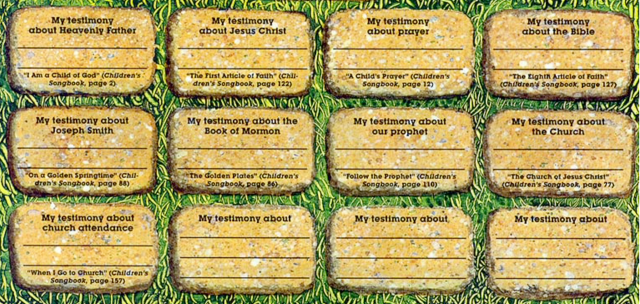
Friend December 1991 “I Have a Testimony of Jesus Christ” One possible way to use this activity would be to have each child choose a testimony card below and write or think about what their testimony is about that that topic. Then have them share their testimony (if they would like to). Could also have them work in pairs so it’s easier to share together. (For little ones you could use pictures instead of the testimony cards.) Help the children understand that their testimonies are gifts and treasures that can be shared with others
We bear testimony not only in words but in the way we act—even in the way we dress. Write out a role-play situation for each class to help the children see that there are many times when they can share their testimonies. Give the classes a few minutes to prepare their role plays; then present them. Possible situations:
You are playing with a group of friends. Two of you are wearing CTR rings. One of the other children asks what the letters mean.
You have a friend who is ill or injured, and you visit her. She is very discouraged. What can you say to help her understand that Heavenly Father loves her and will bless her?
Two of your friends at school are talking about a child who is new in your class. They think that he dresses strangely, and they don’t want to play with him. You think that you should follow what Jesus taught and be a friend. What can you say to them? How can you include him?
Your family listened to a talk by President Gordon B. Hinckley. He said that every member of the Church needs a friend, a responsibility, and nurture (spiritual nourishment) with the good word of God. A family who lives not too far from you has just joined the Church. They have children your age. As you ride home in the car, you start to discuss what you might do for this family, since you have a testimony that President Hinckley is a prophet.
Your class has been asked to give a Sharing Time presentation about prayer. Have you or has someone in your family had an experience in which your prayers were answered? Ask if two or three class members would like to briefly share their experiences, their testimonies that prayers are answered.
You have a friend who has a serious problem. You know that reading the scriptures would help her. What could you tell her?
A repairman comes to your house and sees a Book of Mormon sitting on the table. He asks what it is about. What would you tell him?
In conclusion, thank the children and remind them that we can share our testimonies in testimony meeting, when we give talks, when we sing, when we interact with our friends, whenever we are prompted to by the Spirit, and by our examples.
The other day I had a friend over who is not a member of the Church. He saw a picture of Jesus on our refrigerator, and told me that he did not believe that Jesus was real. I said, “Jesus is real, and I believe in Him!” I then told him that Jesus really lived on this earth a long time ago and that He died, but on the third day He was resurrected. I told him that because of Jesus, we will be able to live again after we die too.
My friend listened to what I was saying as he looked at the picture of Jesus. He seemed to believe that what I was telling him was true. I want to give him a Book of Mormon with my testimony written in it for his birthday. I know this Church is true, and I am thankful when I can share my testimony with my friends. (Brigham P., age 6, Montana)
Sing together a song about sharing the gospel, such as “I Want to Be a Missionary Now” (Children’s Songbook, 168). Help the children think of what they could say if someone asked them what they love about Jesus Christ and His Church. Invite them to draw pictures of things they love about Christ’s gospel.
Section 63 Kirtland, Ohio, August 30, 1831. The Prophet, Sidney Rigdon, and Oliver Cowdery had arrived in Kirtland on August 27 from their visit to Missouri. Joseph Smith’s history describes this revelation: “In these infant days of the Church, there was a great anxiety to obtain the word of the Lord upon every subject that in any way concerned our salvation; and as the land of Zion was now the most important temporal object in view, I enquired of the Lord for further information upon the gathering of the Saints, and the purchase of the land, and other matters.”
To introduce Doctrine and Covenants 63:64, you could sing a song about reverence with your children, such as “Reverence Is Love” (Children’s Songbook, no. 31). Then you could talk about different ways to show reverence for Heavenly Father and Jesus Christ.
You can help your children understand what reverence is by talking with them about an item that is special to them, such as a favorite toy, book, or blanket. Ask them how they take care of and protect things that are special to them(or show your family a precious family treasure. How do we treat this item differently than other things that aren’t as valuable?). You could then read together Doctrine and Covenants 63:64.“That which cometh from above is sacred.” Help them think of things that are special—or sacred—to Heavenly Father. (See, for example, verse 61 and this week’s activity page).How should we speak of these things? How should we treat these things.
Heavenly Father has given us many gifts—like temples, scriptures, our bodies, and our Savior. He wants us to treat and talk about these gifts with respect and reverence. When we do this, we show Heavenly Father we are grateful for the gifts He has given us. Help the children think of ways they can show reverence for sacred things.
Friend June 2021 “Respect for Sacred Things” The word sacred means holy and special. Heavenly Father wants us to show respect for the sacred things He has given. (Cut out the cards of sacred things and put them face down.Take turns picking a card. Tell why the sacred thing on the card is important to you. For each card, choose one option from the “Ways to Show Respect” and talk about how you can show respect for that sacred thing.)
God wants us to speak about sacred things carefully (see Doctrine and Covenants 63:64). With a group, stand in a circle with one person in the middle, holding a set of scriptures. That person closes their eyes, spins, and points to someone. The person they chose shares a scripture with everyone else.
For younger children: Teach your little ones how to speak reverently. Practice by showing them pictures of different places, like a temple or a park, and showing how we speak there.
Section 58 Earlier, on the first Sabbath after the arrival of the Prophet and his party in Jackson County, Missouri, a religious service had been held, and two members had been received by baptism. During that week, some of the Colesville Saints from the Thompson Branch and others arrived (see section 54). Many were eager to learn the will of the Lord concerning them in the new place of gathering.
When the elders of the Church first saw the site of the city of Zion—Independence, Missouri—it was not what they expected. Some thought they would find a thriving, industrious community with a strong group of Saints. Instead, they found a sparsely populated outpost, lacking the civilization they were used to and inhabited by rough frontier settlers rather than Saints. It turned out that the Lord wasn’t asking them just to come to Zion—He wanted them to build Zion. Come, Follow Me—For Home and Church: Doctrine and Covenants 2025
When our expectations do not match reality, we can remember what the Lord told the Saints in 1831: “Ye cannot behold with your natural eyes, for the present time, the design of your God … and the glory which shall follow after much tribulation” (Doctrine and Covenants 58:3). Yes, life is full of tribulation, even wickedness, but we can “bring to pass much righteousness; for the power is in [us]” (verses 27–28).
Doctrine and Covenants 58:1–5; 59:23. What messages in these verses strengthen your ability to bear tribulation more patiently? What blessings have you received after tribulation? Why do you think some blessings come only after tribulation?
26 For behold, it is not meet that I should command in all things; for he that is compelled in all things, the same is a slothful and not a wise servant; wherefore he receiveth no reward.
27 Verily I say, men should be anxiously engaged in a good cause, and do many things of their own free will, and bring to pass much righteousness;
28 For the power is in them, wherein they are agents unto themselves. And inasmuch as men do good they shall in nowise lose their reward.
Reading together Doctrine and Covenants 58:26–28 can give you and your children an opportunity to talk about the power Heavenly Father has given us to choose to do good. Tell the children about a time when you made a good choice, and describe how you felt afterward. Invite the children [to share good choices they made and what happened as a result] Maybe your children would like to draw a picture of their experience.
God has given us the power to choose, and with that power we can “bring to pass much righteousness” (verse 27). How can you help the children you teach see that even though there is wickedness in the world, “the power is in them” to “do good”? (verse 28)
Friend January 2012 “A boy in my class bullied me. One day he hit me. I was sad, but I forgave him. When I was chosen to be a class helper, I could choose a friend to work with me. I picked this boy because he never gets chosen by others. I wanted to make him feel good. He thanked me for choosing him and was nice to me. It made me feel good to be an example like Jesus.” Canyon H., age 6, Washington
You could write choice on one side of a piece of paper and consequence on the other and use this paper to illustrate that our choices and their consequences are inseparable. Invite a child to pick up the paper to show that when you pick up the paper, you get both the choice and the consequence of that choice. Perhaps your children could list a few choices and talk about the consequences that come from them. Then you could read together Doctrine and Covenants 58:27–28 and talk about choices that “bring to pass much righteousness” or good consequences. How does Heavenly Father “reward” or bless us as we strive to do good? (verse 28).
Help the children know that Heavenly Father wants us to make good choices that bring happiness to our lives and to others.
Read phrases from Doctrine and Covenants 58:27–28 to help children understand that they can choose to do good. Put a happy face on one side of the room and a sad face on the other side. How do we feel when we choose to do good? Describe several situations along with a good or bad choice for each one. After describing each situation and choice, ask the children to stand by the happy face if the choice is good and by the sad face if it is bad.
Sing a song about choices, such as “Choose the Right” (Hymns, no. 239). Ask questions to help the children ponder the words of the song—for example, Who helps guide you to make the right choice? Who tries to get you to make the wrong choice? How does choosing the right make you feel?
Perhaps family members could make a list of some of the things they are “anxiously engaged” in. Are all of them “good cause[s]”? Why does the Lord want us to do “many things of [our] own free will”? Ask each family member to think of what they can do this week to “bring to pass much righteousness.” Later they can report on what they did. (Come, Follow Me—For Individuals and Families: Doctrine and Covenants 2021 “Doctrine and Covenants 58-59”)
Section 59
Jackson County, Missouri, August 7, 1831. Preceding this revelation, the land was consecrated, as the Lord had directed, and the site for the future temple was dedicated. On the day this revelation was received, Polly Knight, the wife of Joseph Knight Sr., died, the first Church member to die in Zion. Early members characterized this revelation as “instructing the Saints how to keep the sabbath and how to fast and pray.”
Doctrine and Covenants 59, section headingWho was Polly Knight? Polly Knight and her husband, Joseph Knight Sr., were some of the first believers in Joseph Smith’s prophetic calling. Polly and Joseph gave vital support to the Prophet in the work of translating the Book of Mormon. The Knight family left Colesville, New York, to gather with the Saints in Ohio and were later commanded to move to Jackson County, Missouri. As they traveled, Polly’s health began to fade, but she was determined to see Zion before she died. She had been in Missouri only a few days when she passed away (see Saints,1:127–28, 132–33). Doctrine and Covenants 59 was received on the day of her passing, and verses 1 and 2 seem to refer specifically to her.
Consider reading these verses while you and your children go for a walk or look at pictures of nature, noticing things that “please the eye and … gladden the heart” (verse 18).
You could also notice similar things in a song like “My Heavenly Father Loves Me” (Children’s Songbook, 228–29).
Or you might invite your children to draw pictures of things they are thankful for and let them tell you about their pictures. How can we show our gratitude for these things?
Friend February 2017 Find the things in the picture that show Heavenly Father and Jesus’s love for us.
Make thankful journals with your family! Fold pieces of paper together like a book and decorate the cover. Every night before you go to sleep, write or draw three things you are grateful for.
What can we do on Sunday to worship the Lord and find joy? Help your children find ideas in Doctrine and Covenants 59:9–12 and this week’s activity page. Maybe they could also find pictures or objects to represent things we do on the Sabbath (such as the pictures of the sacrament in this outline). How do these things help us feel closer to Heavenly Father and Jesus Christ?
Hide several pictures of people doing things that show love for Heavenly Father on the Sabbath day. Ask the children to find the pictures and share how doing the things in the pictures shows our love for God.
What might it mean to be “crowned … with commandments”? (verse 4). As you read the commandments in verses 5–19, discuss the blessings you have received by obeying each of these commandments.
You could also notice how words like “joy,” “rejoicing,” “cheerful,” and “glad” are used to describe the commandment to honor the Sabbath day. How can you make your Sabbath more joyful? Maybe your family could make a matching game with cards that depict things you can do to keep the Sabbath day holy.
Section 51: At this time the Saints migrating from the eastern states began to arrive in Ohio, and it became necessary to make definite arrangements for their settlement. As this undertaking belonged particularly to the bishop’s office, Bishop Edward Partridge sought instruction on the matter, and the Prophet inquired of the Lord.
1–8, Edward Partridge is appointed to regulate stewardships and properties; 9–12, The Saints are to deal honestly and receive alike; 13–15, They are to have a bishop’s storehouse and to organize properties according to the Lord’s law; 16–20, Ohio is to be a temporary gathering place.
To help your children learn what it means to be honest, you could read together Doctrine and Covenants 51:9 and share stories of children who face decisions about being honest. You could use pictures, sock puppets, or paper dolls to make the stories more interesting. How does the Lord bless us as we strive to be honest?
Friend August 2020 “How Do You Spell Honesty” When Elder Timothy J. Dyches was in six grade he hadn’t missed a spelling word all year long. If he kept getting perfect scores, I would receive an award for spelling at the end of the year. Then he noticed that he had missed a word on a spelling test that was incorrectly graded. He was honest and told his teacher about it.
Friend April 2019 “Sweet Honesty” Trying to get a taste of sugar, Arlen accidentally knocks the sugar jar off a high shelf when she is left in charge of the house. She considers not telling her mom that she spilled all the sugar, but decides to be honest.
Consider playing a game with your children. Afterward, discuss how the game would have been different if someone had cheated. Why is it important to “deal honestly” with each other?
Pitching Pennies Find a wall with some space around it and draw a line (real or imaginary) about six feet away from it. Each player takes a penny and stands behind the line. One at a time, each player throws their penny, trying to get it as close to the wall as possible. You must throw the penny; you cannot roll or slide it. The winner is the one who gets there penny closest to the wall.
Jesus taught that we should “deal honestly” with each other (Doctrine and Covenants 51:9). That means telling the truth and being fair with others.
Come up with situations you might face in everyday life—like finding money that someone lost or losing something you borrowed. Act out what you would do to “deal honestly.”
Hide the words “faithful,” “just,” and “wise” around the room. Invite the children to find the words in the room and then find them in Doctrine and Covenants 51:19. Read the verse together, and talk about what it means to be a steward. “A person who takes care of the affairs or property of another. That which a steward cares for is called a stewardship. All things on earth belong to the Lord; we are His stewards. We are accountable to the Lord.” (“Steward, Stewardship” in the Guide to the Scriptures).
Section 52 & 53
Section 52 A conference had been held at Kirtland, beginning on the 3rd and closing on the 6th of June. At this conference the first distinctive ordinations to the office of high priest were made, and certain manifestations of false and deceiving spirits were discerned and rebuked. (1–2, The next conference is designated to be held in Missouri; 3–8, Appointments of certain elders to travel together are made; 9–11, The elders are to teach what the apostles and prophets have written; 12–21, Those enlightened by the Spirit bring forth fruits of praise and wisdom; 22–44, Various elders are appointed to go forth preaching the gospel while traveling to Missouri for the conference.)
Section 53 At Sidney Gilbert’s request, the Prophet inquired of the Lord as to Brother Gilbert’s work and appointment in the Church. (1–3, Sidney Gilbert’s calling and election in the Church is to be ordained an elder; 4–7, He is also to serve as a bishop’s agent.)
I receive the gift of the Holy Ghost by the laying on of hands.
Receiving the Holy Ghost by the laying on of hands is mentioned several times in Doctrine and Covenants 51–57. This might be a good opportunity to teach your children about this ordinance. For example, they could look at a picture of a child being confirmed and describe what is happening in the picture. Ask them to clap their hands when they hear “laying on of the hands” or “laying on of hands” while you read Doctrine and Covenants 52:10; 53:3; 55:1.
Idea for older kids: Copy and paste each scripture to a word document or slide show. Leave the space empty where it says laying on of hands in each scripture. Have the children read the scriptures and find what is missing in each scripture.
Following a person’s baptism, men who hold the Melchizedek Priesthood place their hands upon the person’s head, as shown in the picture. One of the men (usually the father, the bishop, a missionary, or a friend of the person being confirmed) says the prayer. During the prayer, the person is confirmed a member of the Church and receives the gift of the Holy Ghost. (Primary 3 “Lesson 12: The Gift of the Holy Ghost,”)
Explain that after we are baptized, we are confirmed. Invite the children to say “confirmed.” Tell them this means that men who hold the priesthood put their hands on our head to give us the gift of the Holy Ghost.
Review the fourth article of faith.
You could also sing “The Holy Ghost” (Children’s Songbook, 105) or a similar song. Help your children find words and phrases in the song that teach about the gift of the Holy Ghost.
With many people claiming spiritual manifestations, the early Saints were concerned about being deceived. How could they tell who was “accepted of [God]”? (verse 15) In these verses, the Lord gave a pattern so “that [we] may not be deceived” by false teachers and messages.
To teach about the Lord’s pattern for avoiding deception, you might start by helping children find examples of patterns—in nature, in colorful blankets or clothing, or in daily life. Help them find the pattern the Lord gave in Doctrine and Covenants 52:14–15. Make sure they understand any unfamiliar words in these verses. How can we use this pattern to recognize truth?
Draw something simple, and invite the children to follow your pattern to make the same drawing. Then explore with them the Lord’s pattern recorded in Doctrine and Covenants 52:14–19.
Section 54 Members of the Church living in Thompson, Ohio, were divided on questions having to do with the consecration of properties. Selfishness and greed were manifest. Following his mission to the Shakers (see the heading to section 49), Leman Copley had broken his covenant to consecrate his large farm as a place of inheritance for the Saints arriving from Colesville, New York. As a consequence, Newel Knight (leader of the members living in Thompson) and other elders had come to the Prophet asking how to proceed. The Prophet inquired of the Lord and received this revelation, which commands the members in Thompson to leave Leman Copley’s farm and journey to Missouri.
As part of the gathering to Ohio, a group of Saints led by Newel Knight arrived from Colesville, New York, and needed a place to live. Leman Copley had a large farm near Kirtland, and he covenanted to allow the Saints to settle on his land. However, soon after they started settling there, Copley wavered in his faith, broke his covenant, and evicted the Saints from his property. Come, Follow Me—For Individuals and Families: Doctrine and Covenants 2021 “Doctrine and Covenants 51–57”
Jesus told Joseph that the Saints in Ohio should share their land with the Saints from New York. Leman Copley had a lot of land, and he promised to share it. Some of the Saints from New York moved onto the land.
But Leman Copley didn’t keep his promise. He decided he didn’t want the Saints from New York to have his land. He made them move, and they had nowhere else to live.
Your children could pretend to be a member of the Church who has arrived in Ohio. How would they have felt after Leman broke his covenant? What does this teach us about keeping our covenants or promises? Even though our covenants are personal, our faithfulness in keeping them can affect the lives of others. Read together Doctrine and Covenants 54:6 to discover blessings for people who keep their covenants.
Cut a paper heart in half, and give each half to two different children. Ask them to hold up their halves together to make a whole heart. Let other children take turns holding up part of the heart. Help the children compare this to the promises or covenants we make with God. God will always hold up His side of the covenant if we hold up ours.
Remind the children of the covenants they made (or will make) when they were baptized (see Mosiah 18:8–10). Help them think of ways they are keeping (or will keep) these covenants, and help them see how this will prepare them to make additional covenants in the future.
Friend February 2019 “The Baptism Covenant” Cut out and mix up these cards. Then take turns matching cards that go together. With each match, talk about that part of the baptism covenant.
Tell the following story about how Darren and Bryon were covenant keepers and then tell ways you have seen each child keep or prepare to keep baptismal covenants. Print the “Covenant Keeper” badges and give one to each child.
Friend May 2017 “Cracking the Code” Darren and Byron crack the code to notes left in their beds that represent the words “Covenant Keepers.” At FHE they learn ways they have been covenant keepers.
I can turn to the Lord when I am hurt by others’ choices.
As recorded in section 54, the Lord told Newel Knight what the Saints should do about their situation. What do you find in this revelation that can help you when another person’s broken commitments or other poor choices affect you?
Section 55
Section 55 Ohio, June 14, 1831. William W. Phelps, a printer, and his family had just arrived at Kirtland, and the Prophet sought the Lord for information concerning him.
I Can Use the Blessings God has Given Me to Bless Others.
To introduce section 55, you may want to explain that William W. Phelps was a newspaper publisher who learned about the gospel and joined the Church. Ask the children to read Doctrine and Covenants 55:1–4 and list what God wanted William to do. How did He plan to use William’s talents? (for example, see the author index in the hymnbook for a list of hymns he wrote).Ask the children to identify talents they see in each other, and discuss how they can use those talents to serve God and His children.
Make a list of your talents! You could ask your friends and family for ideas too. How can you use the talents Heavenly Father gave you to help bless others?
Friend November 2018 “What’s on Your Mind” Someone who feels talentless asks the Friend magazine how they can find something they are good at.
The Friend responds by saying that God has given everyone talents. “Here are just a few of the gifts Heavenly Father might have given you. Circle the ones you have already. Underline ones you might want to practice. What others can you think of?”
You may wish to read some of the below stories to see how others used their talents to help others.
Friend October 2018 “The Talents Team” Short story about Kennedy, age 11, who won a tv cooking competition and since then, she has taught cooking classes to help other children. (Photos included. )
Friend October 2018 “Show and Tell” “Before I started kindergarten, I made a goal to learn how to tie my shoes. I practiced every day. Whenever I notice a classmate with untied laces, I offer to help them. I am thankful that I can use my talents to help my friends, like Jesus did. Creighton D., age 5, Indiana, USA”( Includes photo of Creighton)
Friend September 2015 “When I Grow Up…” Artist, Rose Datoc Dall, uses her art talent to share her testimony and inspire others.
Friend March 2016 “A True pearl” Jetta must go away from home to learn the piano, but when she returns she uses her talent to serve.
Section 56-57
Section 56 Revelation given through Joseph Smith the Prophet, at Kirtland, Ohio, June 15, 1831. This revelation chastises Ezra Thayre for not obeying a former revelation (the “commandment” referred to in verse 8), which Joseph Smith had received for him, instructing Thayre concerning his duties on Frederick G. Williams’ farm, where he lived. The following revelation also revokes Thayre’s call to travel to Missouri with Thomas B. Marsh (see section 52:22).
1–2, The Saints must take up their cross and follow the Lord to gain salvation; 3–13, The Lord commands and revokes, and the disobedient are cast off; 14–17, Wo unto the rich who will not help the poor, and wo unto the poor whose hearts are not broken; 18–20, Blessed are the poor who are pure in heart, for they will inherit the earth.
Section 57 Revelation given through Joseph Smith the Prophet, in Zion, Jackson County, Missouri, July 20, 1831. In compliance with the Lord’s command to travel to Missouri, where He would reveal “the land of your inheritance” (section 52), the elders had journeyed from Ohio to Missouri’s western border. Joseph Smith contemplated the state of the Lamanites and wondered: “When will the wilderness blossom as the rose? When will Zion be built up in her glory, and where will Thy temple stand, unto which all nations shall come in the last days?” Subsequently he received this revelation.
1–3, Independence, Missouri, is the place for the City of Zion and the temple; 4–7, The Saints are to purchase lands and receive inheritances in that area; 8–16, Sidney Gilbert is to establish a store, William W. Phelps is to be a printer, and Oliver Cowdery is to edit material for publication.
Revelation given through Joseph Smith the Prophet to Sidney Rigdon, Parley P. Pratt, and Leman Copley, at Kirtland, Ohio, May 7, 1831. Leman Copley had embraced the gospel but still held to some of the teachings of the Shakers (United Society of Believers in Christ’s Second Appearing), to which he had formerly belonged. Some of the beliefs of the Shakers were that Christ’s Second Coming had already occurred and that He had appeared in the form of a woman, Ann Lee. They did not consider baptism by water essential. They rejected marriage and believed in a life of total celibacy. Some Shakers also forbade the eating of meat. In prefacing this revelation, Joseph Smith’s history states, “In order to have [a] more perfect understanding on the subject, I inquired of the Lord, and received the following.” The revelation refutes some of the basic concepts of the Shaker group. The aforementioned brethren took a copy of the revelation to the Shaker community (near Cleveland, Ohio) and read it to them in its entirety, but it was rejected.
1–7, The day and hour of Christ’s coming will remain unknown until He comes; 8–14, Men must repent, believe the gospel, and obey the ordinances to gain salvation; 15–16, Marriage is ordained of God; 17–21, The eating of meat is approved; 22–28, Zion will flourish and the Lamanites blossom as the rose before the Second Coming.
What does it mean to “desire to know the truth in part, but not all”? Maybe you could show a partially covered picture and let family members guess what it is. What happens when we accept only part of the truth? (see 2 Nephi 28:29). How is the fulness of the gospel a blessing to us?
To teach your children the principles in these verses, you could prepare four paper footprints and four pictures that represent faith in Jesus Christ, repentance, baptism, and receiving the Holy Ghost. (Your children could place a footprint on the floor with the picture that matches what they hear as you read Doctrine and Covenants 49:12–14. Then they could take turns walking on the footprints and saying what each picture represents. Help them understand that when we do the things in these pictures, we are following Jesus Christ.
Acts 2:38 Then Peter said unto them, Repent, and be baptized every one of you in the name of Jesus Christ for the remission of sins, and ye shall receive the gift of the Holy Ghost.
Use this week’s activity page to make finger puppets that can help the children learn how they can follow Jesus Christ by having faith, repenting, being baptized, and receiving the gift of the Holy Ghost.
To introduce these verses, you could explain that the Shakers were a religious group that believed people should not get married (see the section heading to Doctrine and Covenants 49). Invite your children to find things the Lord taught about marriage in Doctrine and Covenants 49:15–17. What does it mean that “marriage is ordained of God”? Maybe you could read together the first three paragraphs of “The Family: A Proclamation to the World.” Then talk about why marriage and family are important to Heavenly Father.
What truths about marriage do you learn from Doctrine and Covenants 49:15–17? Why do you feel marriage between a man and a woman is essential to Heavenly Father’s plan? Elder David A. Bednar gave two reasons: “Reason 1: The natures of male and female spirits complete and perfect each other, and therefore men and women are intended to progress together toward exaltation. … Reason 2: By divine design, both a man and a woman are needed to bring children into mortality and to provide the best setting for the rearing and nurturing of children” (“Marriage Is Essential to His Eternal Plan,” Ensign, June 2006, 83–84). See also 1 Corinthians 11:11
Sing together the second verse of “Families Can Be Together Forever” (Children’s Songbook, 188) or another song about families. Help the children think of ways they can prepare to be married in the temple someday and have an eternal family.
Satan did not like to see the Church growing, and he worked hard to stop the growth. One of his methods was to imitate the spiritual gifts given to members of the Church by the Lord. He did this so he could deceive people and lead them away from the Church.
Show the children an imitation item such as play money, a cut-glass “jewel,” or a paper flower. Which would you rather have—this imitation item or the real thing? Why?
During the first year after the Church was organized, some people claimed to have received revelations for the Church, just as the Prophet did. Other people claimed to have seen visions or had other strange things happen to them. Parley P. Pratt observed that some people would get terrible expressions on their faces and seem to faint. Others would twist their bodies or have cramps and convulsions. Others claimed to have visions and revelations that did not agree with the teachings and spirit of the gospel.
Although some people had received revelations and visions from the Lord, Parley P. Pratt and other Church leaders felt that the strange happenings they observed were not from the Lord. They asked Joseph Smith to inquire of the Lord concerning these events. The answer Joseph received from the Lord in May 1831 is found in Doctrine and Covenants 50.
How can we know if what we are seeing or hearing is from God? (Moroni 7:15–17; D&C 50:23–24.) Have a child read aloud Doctrine and Covenants 50:23. What does it mean to edify? Explain that something that edifies makes us feel uplifted and makes us want to improve. Things that are from God make us want to follow Christ and be better people. Things that are from Satan have a bad influence and try to lead us to disobey the commandments.
23 And that which doth not edifyis not of God, and is darkness.
24 That which is of God is light; and he that receiveth light, and continueth in God, receiveth more light; and that light groweth brighter and brighter until the perfect day.
25 And again, verily I say unto you, and I say it that you may know the truth, that you may chase darkness from among you;
Talk about ways we receive God’s light and ways we can chase darkness away. You could then sing together a song about their spiritual light, such as “Shine On” (Children’s Songbook, 144).
Sing “Teach Me to Walk in the Light” (Children’s Songbook,177).
Jesus Christ taught, “That which is of God is light” (Doctrine and Covenants 50:24). The gospel is like a light that leads us out of darkness and confusion.
Hide an item in a dark room and try to find it. Then look again with a flashlight or small lamp. How does the gospel help you find your way?
You might gather in a dark room to read Doctrine and Covenants 50:23–25 and gradually add more light by lighting candles or turning on lights one by one. You could also read these verses while watching the sun rise in the morning. What can we do to make our gospel light continue to grow? When family members learn something new about the gospel during the week, encourage them to share it with the family by writing a note and attaching it to a lamp or other light in the house.
Friend December 2018 “Family Night Fun” Could poke holes in a styrofoam cup sitting on a light as the children mention ways to add God’s light to their lives.
Abstract concepts like truth and spirit can be hard for young children to understand, but comparing them to light, as the Lord does in Doctrine and Covenants 50:23–25, can help.
Use an activity that illustrates how our spiritual light can grow brighter and brighter. You could show pictures of things that give light (such as a candle, a light bulb, and the sun) and let the children arrange them in increasing order of brightness. Or invite the children to pretend to be lights getting brighter by bending down and slowly standing and stretching up their arms. Help them think of good things they can do to make their spiritual light brighter.
Sing with the children a song about their spiritual light, such as “Shine On” (Children’s Songbook, 144). Testify about how Heavenly Father has helped your light grow brighter. Tell the children about the light you see in them.
After reading Doctrine and Covenants 50:40–46 together, you could show the picture of the Savior at the end of this outline and ask questions like these: How does a shepherd feel about His sheep? How is the Savior like a shepherd to us?
Friend June 2018 “Apostles Testify of Jesus” “Shepherds lead their sheep to food, water, and shelter and protect their sheep from harm. Jesus taught that He is the Good Shepherd. When we choose to follow Him, He can lead us to safety and peace. Lead the sheep safely home through the maze!”
Jesus Christ is the Good Shepherd. We are His sheep, and He loves each of us. Ask the children how they know Jesus loves children.
Make paper sheep, write on them the names of the children in the class, and hide them around the room. Display a picture of the Savior, and read Doctrine and Covenants 50:41–42. Help the children understand what these verses teach about how Jesus Christ feels about them. Let them find the sheep around the room and put them on the board near the picture of Jesus so “none of them … shall be lost” (verse 42).
Make a matching game using phrases from Doctrine and Covenants 50:40–46. For instance, you could write “Fear not, little children” on one card that would match with another card that says “for you are mine” (verse 41). Read Doctrine and Covenants 50:40–46 together. Then mix up the cards on the floor, a table, or the board, and ask the children to match the phrases. What do these phrases teach us about Jesus Christ?
To help the children understand how the Savior is like a good shepherd show the video “Jesus Declares the Parable of the Lost Sheep” and ask them to find something in the video that reminds them of what they read. How does Jesus rescue us? How can we be good shepherds to others?
Doctrine and Covenants 46 Revelation given through Joseph Smith the Prophet to the Church, at Kirtland, Ohio, March 8, 1831. In this early time of the Church, a unified pattern for the conducting of Church services had not yet developed. However, a custom of admitting only members and earnest investigators to the sacrament meetings and other assemblies of the Church had become somewhat general. This revelation expresses the will of the Lord relative to governing and conducting meetings and His direction on seeking and discerning the gifts of the Spirit.
1–2, Elders are to conduct meetings as guided by the Holy Spirit; 3–6, Truth seekers should not be excluded from sacramental services; 7–12, Ask of God and seek the gifts of the Spirit; 13–26, An enumeration of some of these gifts is given; 27–33, Church leaders are given power to discern the gifts of the Spirit.
Friend February 2020 “A Kind Primary Class” Jayden was nervous to go to a different ward when he was out of town. But when he got to Primary he felt better because the other kids included him and were kind. They shared their scriptures with him, talked to him, and helped him. They became his friends. Activity: Aria is new at church. Fill in the speech bubbles with what you could say. How could you help a visitor feel welcome?( sit by them, ask them their names, show them where to go, share your scriptures, etc.).
Heavenly Father gives me spiritual gifts to bless others.
In Kirtland, many of the new members that Parley P. Pratt and the other missionaries had baptized had plenty of zeal but little experience or direction in how to live the gospel. They had been drawn to the restored gospel by the promise of marvelous manifestations of the Spirit. Soon, some unusual expressions of worship—including falling to the ground or writhing like a snake—were introduced into their Church meetings. Many found it hard to discern which manifestations were of the Spirit and which were not. Seeing the confusion, Joseph Smith prayed for help. The Lord revealed that spiritual manifestations are real and clarified what they are—gifts from a loving Heavenly Father, “given for the benefit of those who love [Him] and keep all [His] commandments” (Doctrine and Covenants 46:9).
The early Saints believed in spiritual gifts but needed some help recognizing them and understanding their purpose.
Older Children: To help your children learn about the spiritual gifts described in Doctrine and Covenants 46:13–26, consider this idea. You could write the gifts on pieces of paper and hide them around the room. Invite each child to find one of the papers and search the verses to find where that gift is mentioned in the scriptures in section 46. For each gift, talk with them about how it is used to bless others (the descriptions in “Chapter 20: Gifts of the Spirit,” in Doctrine and Covenants Stories, 77–80, can help).Explain that Heavenly Father gives us gifts, and He wants us to use them to help others. Tell the children about a time when you were blessed because someone shared his or her spiritual gifts. Come, Follow Me—For Home and Church: Doctrine and Covenants 2025
According to Doctrine and Covenants 46:8–9, 26, why does Heavenly Father give us spiritual gifts? How can we use our gifts to help others?
Tell the children that they each have spiritual gifts. Tell your children about the gifts you feel Heavenly Father has given them, and let them talk about the gifts they notice in each other.
Friend May 2025 “Come, Follow Me Activities”God gives every person spiritual gifts. That means He blesses us with talents through the Holy Ghost (see Doctrine and Covenants 46:11–33). Find an empty jar or cup. On slips of paper, write different talents or gifts someone might have. Take turns choosing from the jar and naming someone you know who has that gift!
For younger children: Practice saying kind words with your child. These could be statements like “I am kind,” “I am smart,” or “I am a child of God.”
Encourage them to ask Heavenly Father to help them recognize their gifts and how they can use them to help others.
Sing “I’m Trying to Be like Jesus” (Children’s Songbook, 78–79).
Heavenly Father gave each of us spiritual gifts (see Doctrine and Covenants 46:11–26). That means He gave us special talents. Everyone is unique and important to Heavenly Father!
Think about what gifts you have. Then put on a family talent show! Share the gifts Heavenly Father has given you with others.
Ponder why it is important that you “always [remember] for what they are given” (verse 8). How can these truths help you “not be deceived”? (verse 8).
D&C 46:32 says that we need to give thanks to God for the blessings He blesses us with. Remind them that we should be grateful for all of the gifts we get from God.
See also Gospel Topics, “Spiritual Gifts,” topics.ChurchofJesusChrist.org.
Doctrine and Covenants 47 Revelation given through Joseph Smith the Prophet, at Kirtland, Ohio, March 8, 1831. John Whitmer, who had already served as a clerk to the Prophet, initially hesitated when he was asked to serve as the Church historian and recorder, replacing Oliver Cowdery. He wrote, “I would rather not do it but observed that the will of the Lord be done, and if he desires it, I desire that he would manifest it through Joseph the Seer.” After Joseph Smith received this revelation, John Whitmer accepted and served in his appointed office.
1–4, John Whitmer is designated to keep the history of the Church and to write for the Prophet.
The Lord called John Whitmer to keep a history of the Church. Today we are richly blessed because of Church histories that have been kept over the years.
You might also share with each other favorite stories from the scriptures. Point out that we know about these stories because someone recorded them.
Consider how you might inspire your children to record their personal histories. You could share some entries from your personal journal or a story about an ancestor (see FamilySearch.org or the Memories app).
You might provide some journal prompts, like “What happened this week that you would like your grandchildren to know about?” or “How did you see the Lord’s hand in your life this week?” Young children could draw pictures of their experiences, or you could record them telling their stories. What blessings come from keeping a “regular history”? (Doctrine and Covenants 47:1).
If the children you teach keep a journal, ask them to talk about the kinds of things they write about in their journal. The children might enjoy hearing a story from your childhood journal or the journal of an ancestor.
Friend January 2022 “Papa’s Journals” Allen loves reading the stories in his dad’s journals. He wants to write a journal too so his kids can read them someday.
Show the children examples of ways they could keep a regular history of their lives. For example, they can write in a book, collect pictures in a scrapbook, type on a computer, or make audio or video recordings. Help the children make a list of things that would be good to include in their personal histories, such as their testimony of Jesus Christ. Invite the children to make a sign or poster to take home with some of these ideas to remind them to record their personal histories.
Some families set aside a few minutes each week for everyone to write in their journals. You might provide some journal prompts, like “What happened this week that you would like your grandchildren to know about?” or “How did you see the Lord’s hand in your life this week?” Young children could draw pictures of their experiences, or you could record them telling their stories. What blessings come from keeping a “regular history”? (verse 1).
“We keep records to help us remember. … We desire to help Church members remember the great things God has done for His children. … Lessons from the past help us cope with our present and give us hope for our future” (“There Shall Be a Record Kept among You,” Ensign, Dec. 2007, 28, 33).
I Can Help Others by Sharing What I Have Been Given.
Doctrine and Covenants 48 Revelation given through Joseph Smith the Prophet, at Kirtland, Ohio, March 10, 1831. The Prophet had inquired of the Lord as to the mode of procedure in procuring lands for the settlement of the Saints. This was an important matter in view of the migration of members of the Church from the eastern United States, in obedience to the Lord’s command that they should assemble in Ohio (see sections 37:1–3; 45:64).
1–3, The Saints in Ohio are to share their lands with their brethren; 4–6, The Saints are to purchase lands, build a city, and follow the counsel of their presiding officers.
As you read Doctrine and Covenants 48:2–3 with your children, you might need to explain that people were coming to Ohio from the East, and they didn’t have a place to live. Help the children find in Doctrine and Covenants 48:2 what the Lord asked the Saints in Ohio to do to help. Help your children think of things God has given them that they can share with others.
Cut out the arrow, and attach it to the center of the circle. Spin the arrow, and tell about how you can share what the arrow points to. CFM for Primary: BofM
Read Doctrine and Covenants 48:4 together, and invite the children to look for something the Lord asked the Saints to do to help His work. Explain that saving money would allow them to buy land and build a temple someday. What can we save money for so we can help do the work of the Lord? Show the video “First Things First” (ChurchofJesusChrist.org), and discuss how the children in the video fulfilled the Lord’s command to save money.
Friend April 2020 “The First Easter” Cut out the story and the pictures to tell the story of the first Easter.
Think of an object lesson that can help the children understand what happens when we die (our spirits and bodies separate) and when we are resurrected (our spirits and bodies come back together and our bodies are perfect and immortal). For example, what happens when we remove the battery from a flashlight or the ink container from a pen? What happens when they are reunited?Come, Follow Me—For Primary: Doctrine and Covenants 2021 “Easter: “I Am He Who Liveth, I Am He Who Was Slain”
Assign each child one of the following scripture passages: Doctrine and Covenants 63:49; 88:14–17, 27; 138:11, 14–17. Invite the children to search their verses to find a phrase that they feel captures the message of Easter. Let them share their thoughts. If time allows, let them make cards that feature the phrases they found that they can give to family members or friends. They could do the same with the video “Because He Lives” (Gospel Library). How can we share this message with others?
Show the children a picture of Joseph Smith’s First Vision. Invite the children to tell you what is happening in the picture, and ask them to find Jesus Christ.
Ask the children if they know about other times Joseph Smith saw the Savior. In your own words, tell about the experiences described in Doctrine and Covenants 76:11–24; 110:1–7. Why is it a blessing to know that Joseph Smith saw the risen Savior?
April 3, 1836, was Easter Sunday. After helping administer the sacrament to Saints gathered in the newly dedicated Kirtland Temple, Joseph Smith and Oliver Cowdery found a quiet place behind a veil in the temple and bowed in silent prayer. Then, on this sacred day when Christians everywhere were commemorating the Resurrection of Jesus Christ, the risen Savior Himself appeared in His temple, declaring, “I am he who liveth, I am he who was slain” (Doctrine and Covenants 110:4).
On the board, list some truths we learn about the Savior from these verses. Invite the children to identify which verses teach the truths listed on the board. On this week’s activity page, help the children match the pictures with the scripture verses.
What does it mean to say that Jesus Christ is “he who liveth”? It doesn’t just mean that He rose from the tomb on the third day and appeared to His Galilean disciples. It means that He lives today. He speaks through prophets today. He leads His Church today. He heals wounded souls and broken hearts today. So we can echo the words of Joseph Smith’s powerful testimony: “After the many testimonies which have been given of him, this is the testimony … which we give of him: That he lives!” (Doctrine and Covenants 76:22). (Come, Follow Me—For Individuals and Families: Doctrine and Covenants 2021 “Easter: “I Am He Who Liveth, I Am He Who Was Slain”)
In addition to saving us from physical death, Jesus Christ provided a way for us to be saved from spiritual death—in other words, to be forgiven of our sins and return to God’s presence.
The truths Joseph Smith learned about forgiveness through Christ can give your children hope that they can be forgiven of their mistakes and sins.
Write on the board two headings similar to these: What the Savior did and What I must do. Invite each child to search one of the following passages to find something that belongs under these headings: Doctrine and Covenants 18:10–13; 19:16–19; 45:3–5; 58:42–43. Share your joy and gratitude for what the Savior did for us.
Help the children learn the third article of faith. You could help them memorize it by showing pictures that go with key phrases.
Show the video “The Shiny Bicycle” (ChurchofJesusChrist.org), or tell a story of your own about a child who made a wrong choice and then repented. Help the children discuss what the child in the story did to receive forgiveness. How has the Savior made it possible for us to be forgiven? You could also share experiences when you felt the Savior’s forgiveness as you repented.
Doctrine and Covenants Section 29 Revelation given through Joseph Smith the Prophet, in the presence of six elders, at Fayette, New York, September 1830. This revelation was given some days prior to the conference, beginning September 26, 1830.
1–8, Christ gathers His elect; 9–11, His coming ushers in the Millennium; 12–13, The Twelve will judge all Israel; 14–21, Signs, plagues, and desolations will precede the Second Coming; 22–28, The last resurrection and final judgment follow the Millennium; 29–35, All things are spiritual unto the Lord; 36–39, The devil and his hosts were cast out of heaven to tempt man; 40–45, The Fall and Atonement bring salvation; 46–50, Little children are redeemed through the Atonement.
Jesus Christ is gathering His people before He comes again.
Talk with each other about how a hen protects her chicks and how that’s similar to what the Savior can do for us.
What did the Lord say we must do to be gathered by Him? We are gathered by the Savior when we accept and follow His teachings.
Friend March 2024 “The Hen and the Baby Chicks” Clara helped her dad pick out a hen to care for some baby chicks they had bought. She watched as the hen lifted up her wing and the baby chicks disappeared under it. Her dad explained that that was the way the hen protects and keeps the baby chicks safe and warm. Her dad shared the scripture of Jesus gathering us and protecting us and caring for us just like a hen gathers her chickens under her wings.
What would inspire your children to want to help the Savior gather His people? Maybe they’d like to hear the experience of someone who “gathered” to Him by joining His Church. For example, who introduced your family to the Church? How have we been blessed by accepting the Savior’s call to gather to Him? How can we help others gather to Him? (See “A Message for Children from President Russell M. Nelson” , ChurchofJesusChrist.org.)
We “gather Israel” when we help other people learn about the gospel. Jesus taught about this gathering in 3 Nephi 20–22.
Give each person a piece of paper and ask them to write down any name that comes to mind.
Everyone should close their eyes while one person hides the papers.
Read 3 Nephi 20:18 and 39–40 out loud. How can you help other people learn about Jesus?
While listening to a song about Jesus, invite everyone to help find the names and put them by a picture of the Savior.
Discussion: How does it make you feel to know that Heavenly Father and Jesus Christ know each person by name?
Invite the children to make a list of ways they can help people gather to the Savior. For example, they could invite friends or family members to a Primary activity or to a home evening with their families.
Show a picture of the Second Coming (see Gospel Art Book,no. 66), and help a child read Doctrine and Covenants 29:11. Help the children notice phrases in the scripture that describe what they see in the picture. Share with the children how you feel about Jesus Christ coming to earth again.
11 For I will reveal myself from heaven with power and great glory, with all the hosts thereof, and dwell in righteousness with men on earth a thousand years, and the wicked shall not stand.
To start a conversation about Heavenly Father’s plan for us, you and your children could talk about a time when you made a plan, such as for a trip or for accomplishing a task. You could also share examples of plans, such as a calendar with activities written on it or instructions to make something. Why are plans useful? (Share with the children that Heavenly Father has a plan that will allow us to become like Him.)You could then talk about what Heavenly Father wants to accomplish and how His plan helps us accomplish it.
You could use the images at the end of this outline to help your children find verses in Doctrine and Covenants 29 that teach about different parts of Heavenly Father’s plan.(You could cut off the scripture and have the children look up the scriptures and place each scripture with it’s matching picture.) You could also cut out the images and ask your children to put them in the correct order. Why are we thankful to know that Heavenly Father has a plan for us? How does knowing about it influence our everyday lives?
To help the children understand God’s plan, make signs with these terms:
After explaining each term (see Doctrine and Covenants 29:9–45), give each sign to a different child, and ask them to stand in a line in the correct order to show when each event occurs in Heavenly Father’s plan. Each child could share what he or she knows about what is on his or her sign. Help the children see how knowing about Heavenly Father’s plan helps us become more like Him and the Savior.
Use one or more of the activities below to teach truths about the plan and how they apply to us. Consider asking a few of the children to come prepared to help you teach.
Agency
Agency. Help the children understand that Heavenly Father has given us the gift of agency—the freedom to choose—and holds us accountable for our choices (see Doctrine and Covenants 29:39–40). Create two signs for each child: one that represents making a good choice (for example, a smiling face) and one that represents making a bad choice (for example, a frowning face). Share examples of good choices and bad choices, and ask the children to raise the correct sign. Ask the children to share blessings that come when we follow Jesus Christ. Why does Heavenly Father let us make our own choices?Come, Follow Me—For Primary: Doctrine and Covenants 2021 “Doctrine and Covenants 29: “Jesus Christ Will Gather His People”
2017 Sharing Time Outline Show the children a container of many different colors of crayons. Show them a second container with only one color. Ask the children: “If you were going to color a picture, which of these containers of crayons would you want to use? Why?” Explain that having a variety of choices is a blessing. Testify that Heavenly Father and Jesus Christ love us and They want us to make correct choices.
The Savior told the Prophet Joseph Smith: “All things unto me are spiritual, and not at any time have I given unto you a law which was temporal” (Doctrine and Covenants 29:34).
Temporal means relating to this physical world. Isn’t the Word of Wisdom a “temporal” law?
Even those “temporal” laws are spiritual too, for at least two reasons:
When you obey any commandment, you come closer to the Holy Ghost. You feel God’s presence and His love more. Obviously, those are spiritual blessings! (See more at link)
Spiritual death is separation from God. The scriptures teach of two sources of spiritual death. The first source is the Fall, and the second is our own disobedience. Spiritual death can be overcome through the Atonement of Jesus Christ and by obedience to His gospel. (Topics and Questions, “Death, Spiritual,” topics.ChurchofJesusChrist.org)
Doctrine and Covenants 27 Revelation given to Joseph Smith the Prophet, at Harmony, Pennsylvania, August 1830. In preparation for a religious service at which the sacrament of bread and wine was to be administered, Joseph set out to procure wine. He was met by a heavenly messenger and received this revelation, a portion of which was written at the time and the remainder in the September following. Water is now used instead of wine in the sacramental services of the Church.
Sally Knight and Emma Smith were baptized in June 1830, but their confirmations were disrupted by a mob. Two months later, Sally and her husband, Newel, came to visit Emma and Joseph, and it was decided that the confirmations should now be performed and that the group would partake of the sacrament together. While on his way to obtain wine for the sacrament, Joseph was stopped by an angel.
Children might wonder why we use water for the sacrament when Jesus used wine (see Luke 22:19–20; 3 Nephi 18:1–11). You could read Doctrine and Covenants 27:1–2 together and help the children think about what it means to take the sacrament “with an eye single to [God’s] glory” (verse 2). Discuss questions like the following: What are some distractions our eyes or minds might be focused on during the sacrament? What can we do to focus our attention on the Savior while we partake of the sacrament? How will this help us follow Him every day?
Perhaps having pictures, scripture verses, or song lyrics about the Savior could help your children remember Him when taking the sacrament. They might enjoy creating a booklet with some of these pictures, verses, and lyrics. They could draw their own pictures or find some in the Friend magazine.
Friend June 2019 “The Sacrament Reminds Us of Jesus Christ” Ways to prepare for the sacrament before hand, what to do during the sacrament, and remembering Jesus and following him after the sacrament.
Read Doctrine and Covenants 27:2, beginning with “remembering unto the Father,” and ask the children to listen for what the Savior wants us to remember when we take the sacrament.( Come, Follow Me—For
Friend June 2020 “Koa and the Sacrament” He sings the sacrament hymn. Koa thinks about Jesus. He listens to the sacrament prayers. Koa is reverent. He feels happy inside!
Friend June 2019 “The Sacrament Reminds Us of Jesus Christ” Ways to prepare for the sacrament before hand, what to do during the sacrament, and remembering Jesus and following him after the sacrament.
What do we know about the prophets in these verses? You could search for information about them in the Guide to the Scriptures (scriptures.ChurchofJesusChrist.org). What blessings have been unlocked for us through the keys they held? For more information about some of these keys, see Matthew 16:16–19; Doctrine and Covenants 110:11–16.
You could show your children a picture of armor like the one in this outline or on the activity page in the outline for Ephesians in Come, Follow Me—For Primary: New Testament 2023. As you read Doctrine and Covenants 27:15–18, help them find the pieces of armor in the picture. How can the armor of God help us “withstand the evil day”? (verse 15).
The armor of God protects me and helps me withstand evil.
Invite the children to think of things they can do to withstand temptations around them. Ask them to finish the sentence “We put on God’s armor every day by …” with their ideas. Help them see how their efforts to come unto Christ are helping them put on the armor of God.
Cut out the pieces of armor, and let the children put them on one of the figures as you read Doctrine and Covenants 27:15–18.
Perhaps your family would enjoy staging a pretend battle with additional clothing to represent the armor of God, such as hats, vests, aprons, or shoes. How does armor help protect us in battle? Discuss some of the evil influences your family faces and the things you can do to put on spiritual armor. Consider showing the video “Put on the Whole Armor of God” (ChurchofJesusChrist.org).
Give each student a small sheet of paper. Invite students to write down on the paper one way the adversary tempts or tries to discourage youth. Then invite them to crumple the paper into a ball. Invite a student to the front of the room and have him or her try to dodge or deflect as the other students throw the paper ball at him or her.
Invite students to come to the front of the room, uncrumple the papers, and share what was written on them. Ask the class to identify ways they see these temptations or attacks today.
Doctrine and Covenants 28 Revelation given through Joseph Smith the Prophet to Oliver Cowdery, at Fayette, New York, September 1830. Hiram Page, a member of the Church, had a certain stone and professed to be receiving revelations by its aid concerning the upbuilding of Zion and the order of the Church. Several members had been deceived by these claims, and even Oliver Cowdery was wrongly influenced thereby. Just prior to an appointed conference, the Prophet inquired earnestly of the Lord concerning the matter, and this revelation followed.
The prophet receives revelation for the Church; I can receive revelation for my life.
If you have several children, you might invite them to play “follow the leader,” but ask two or more children to be the leader at the same time. What happens when there is more than one leader? You could then learn about Hiram Page (see “Chapter 14: The Prophet and Revelations for the Church,” in Doctrine and Covenants Stories, 56–57, or the corresponding video in Gospel Library; or the section heading for Doctrine and Covenants 28). How did Heavenly Father correct the confusion of the early Church members? How does He lead the Church today? (see Doctrine and Covenants 28:2). Share your testimony that the current prophet is called by the Lord to lead His Church in our day.
While revelation for the Church will always be given through the prophet, we can all be guided by the Holy Ghost. You could help your children search some of the following scriptures and make a list of ways the Holy Ghost can guide us: Doctrine and Covenants 28:1, 4, 15; John 14:26; Moroni 8:26; 10:4–5. Share with each other how you have been guided by the Holy Ghost.
Only the Prophet Receives Revelation for the Whole Church
In August 1830, Hiram Page, one of the Eight Witnesses of the Book of Mormon, claimed to have received two revelations about the future location and organization of Zion using a black seer stone. These revelations contradicted previous revelations given to Joseph Smith, but many members believed them.
Doctrine and Covenants 28:1–7, 15 can help the children understand that everyone can be guided by the Holy Ghost, but revelation for the Church will always be given through the prophet.
Ask the children to play “follow the leader”—one child could stand at the front of the room, and the rest of the children could imitate whatever he or she does. This could lead into a discussion about why we follow the prophet. You could show a picture of Jesus Christ and emphasize that we follow the prophet because he follows the Savior and speaks the Savior’s words.
For additional ideas about prophets, see the following resources:
One purpose of the Book of Mormon is “that the Lamanites might come to the knowledge of their fathers, and that they might know the promises of the Lord” (Doctrine and Covenants 3:20). This was consistent with promises the Lord made to many Book of Mormon prophets (see, for example, 1 Nephi 13:34–41; Enos 1:11–18; Helaman 15:12–13). Early Church members considered the American Indians to be descendants of the Book of Mormon people. (The official position of the Church today is that the Lamanites “are among the ancestors of the American Indians” [introduction to the Book of Mormon].)
To read more about Oliver’s mission to nearby American Indian tribes, see “A Mission to the Lamanites” (Revelations in Context, 45–49). What does this mission teach you about the Lord and His work?
Section 23 A series of five revelations given through Joseph Smith the Prophet, at Manchester, New York, April 1830, to Oliver Cowdery, Hyrum Smith, Samuel H. Smith, Joseph Smith Sr., and Joseph Knight Sr. As the result of earnest desire on the part of the five persons named to know of their respective duties, the Prophet inquired of the Lord and received a revelation for each person.
Section 24 Revelation given to Joseph Smith the Prophet and Oliver Cowdery, at Harmony, Pennsylvania, July 1830. Though less than four months had elapsed since the Church was organized, persecution had become intense, and the leaders had to seek safety in partial seclusion. The following three revelations were given at this time to strengthen, encourage, and instruct them.
Section 25 Revelation given through Joseph Smith the Prophet, at Harmony, Pennsylvania, July 1830 (see the heading to section 24). This revelation manifests the will of the Lord to Emma Smith, the Prophet’s wife.
Section 26 Revelation given to Joseph Smith the Prophet, Oliver Cowdery, and John Whitmer, at Harmony, Pennsylvania, July 1830 (see the heading to section 24).
When the Church was first organized, there weren’t many members. The Lord asked the Saints to build up the Church by sharing the gospel and strengthening one another. We can do the same today.
Ask the children to find every instance of the words “exhortation” and “exhort” in Doctrine and Covenants 23:3–7; 25:7. Help them define these words. How might exhorting someone strengthen them? Invite the children to role-play “exhorting” someone but doing so with love.
How can we do better in the work of strengthening other members of the Church? To illustrate this principle, give one child a task that requires many helpers. Then ask other children to help, and discuss how much easier the task became. Share an experience in which you were strengthened by the service of a fellow Church member.
Use an object lesson to teach that we are stronger together than we are apart. For example, invite the children to try breaking one stick and then a bundle of sticks or tearing one piece of paper and then a stack of papers. How are we like the sticks or the paper? How can we strengthen each other when we gather together in our families or at church?Come Follow Me for Primary: Book of Mormon 2020 “3 Nephi 1–7: “Lift Up Your Head and Be of Good Cheer”
Friend September 2016 “Heavenly Father Hears Your Prayers” Heavenly Father has many blessings he wants to give us. Prayers unlock the treasure chest of blessings.
Friend September 2016
Read to the children from Doctrine and Covenants 23:6, beginning with “you must pray.” Help them identify the different ways and places the Lord said we should pray. Invite them to draw a picture of themselves praying in one of those ways or places.
Sing together “Search, Ponder, and Pray” (Children’s Songbook, 109) or another song about prayer and scripture study. Help the children discover the blessings promised in the song.
Help the children list on the board some of the afflictions or challenges that Joseph Smith and other early Saints were facing (see “Chapter 11: More People Join the Church,” Doctrine and Covenants Stories, 46–47 or watch the video below. Then you and your children could discover what the Lord said to Joseph about his afflictions in Doctrine and Covenants 24:1, 8. You could also share with each other how the Lord helps you during difficult times.
Joseph Smith suffered many trials, but he was able to “be patient in afflictions” because the Lord promised that He would always be with him.
Friend April 2018 “Trouble in Adventure Forest” When Owen’s feet get burned he learns that Heavenly Father doesn’t always stop bad things from happening, but He helps us get through them.
Invite the children to discover what the Lord said to Joseph about his afflictions in Doctrine and Covenants 24:1, 8. How can we seek the Savior’s help when we are having a difficult time?
8 Be apatient in bafflictions, for thou shalt have many; but cendure them, for, lo, I am with thee, even unto the dend of thy days.
Friend September 2020 “For Older Kids” “Once I had a good friend. We had been friends for years. But she just stopped being my friend when a new girl moved in. It made me sad, so I said a prayer. I thought of the words from a song: “Courage, for the Lord is on our side” (Hymns, no. 243). I’m happy that Heavenly Father is with me and can help me through this trial.” Scarlett W.
To learn what it means to be “patient in [our] afflictions,” you and your children could re-create the experiment in the video “Continue in Patience” (Gospel Library). What does Doctrine and Covenants 24:8 teach us about patience? Teach the children that sometimes we need to be “patient in [our] afflictions.” Ask the children to think of something they really want but have to wait for. Why does the Lord sometimes require us to have patience during challenging times in our lives? How does He let us know that He is “with [us]” during our afflictions?
Come Follow Me Kid Mystery Person Puzzle – Guess who the person is by doing a puzzle. Have the Emma Smith picture pieces cut out and put in a paper bag. Without looking, everyone will pull one piece out at a time. As they pull each piece out, have them find the matching number on the white clue chart. Before you tape the piece on the number where it belongs, read the hint for that number and talk about what it means. Once the puzzle’s all put together, summarize who Emma Smith was and how we can be inspired by her.
After reading Doctrine and Covenants 25:12, you could tell each other about your favorite hymn or Church song—your “song of the heart”—and sing them together. Share with each other why you love these songs. Why is the Lord happy when we sing these songs? How is our singing like “a prayer unto [Him]”?
Friend September 2025 “God’s Power Is a Gift!” (See more at link) Activity: Emma Smith was asked to create the first hymnbook. We still sing hymns today! Take turns tossing a coin or another small item onto the board. When it lands on a picture, think of a song about that topic. Then sing it together!
What has Heavenly Father promised us if we sing hymns to worship him? (D&C 25:12.) What kinds of blessings might we receive from singing hymns? Explain that hymns can help teach us the gospel and strengthen our faith and testimonies. They can help us want to repent and keep the commandments. They can make us feel happy when we are sad and can fill our minds with good, clean thoughts (see enrichment activity 5). They remind us that Heavenly Father and Jesus Christ love us.
See Music for ideas and stories on how sacred music helps us.
The Lord said that sacred music “is pleasing unto me.” Help the children see singing as not just a fun activity but also a way to worship Him. Singing is one way we can show our love for God.
Friend March 2021 “Scripture Time Fun: Name that Song” Have a family song challenge! One person hums a Church song. Everyone else guesses what song it is. When someone guesses right, everyone sings the song together! Then take turns choosing the next song.
Come Follow Me Kid You can hide the below song cards around the room, or make a poster punch game or, use the above “Name That Song” activity with them.
My covenants with Heavenly Father bring me joy/ I can “cleave unto the covenants” I have made.
Read Doctrine and Covenants 25:13 to the children. Explain that the word “cleave” in this verse means to hold tightly to something. To understand what it means to “cleave unto the covenants” (Doctrine and Covenants 25:13), your children could take turns holding on to something as tightly as they can. Explain that cleaving to our covenants means holding on to (or keeping) the promises we make with Heavenly Father and never letting go (or never giving up). (Or to illustrate, pass around objects that are firmly fastened together and let the children try to tear them apart. Why is the word “cleave” a good word to describe how we should feel about our covenants?) Use this week’s activity page to teach the children about the times when we make covenants with Heavenly Father. (Or if needed, review with the children the covenants we make when we are baptized (see Mosiah 18:8–10; Doctrine and Covenants 20:37). What does it mean to “cleave” to these covenants?) Read Doctrine and Covenants 25:15, and explain that the “crown of righteousness” represents the blessing of returning to live with God, our Heavenly King.
To give your children context for Doctrine and Covenants 25:13, you might point out that this is something the Lord told Emma Smith soon after her baptism. Why would this be good counsel for someone who was recently baptized?
When members receive callings or priesthood ordinations in the Church, we have the opportunity to formally sustain them by raising our right hands as a show of support. The principle of demonstrating public support and agreement is called common consent. As President Gordon B. Hinckley taught, “The procedure of sustaining is much more than a ritualistic raising of the hand. It is a commitment to uphold, to support, to assist those who have been selected” (“This Work Is Concerned with People,” Ensign, May 1995, 51).
Sustaining is a chance to show and give our support and to acknowledge the will of God.